

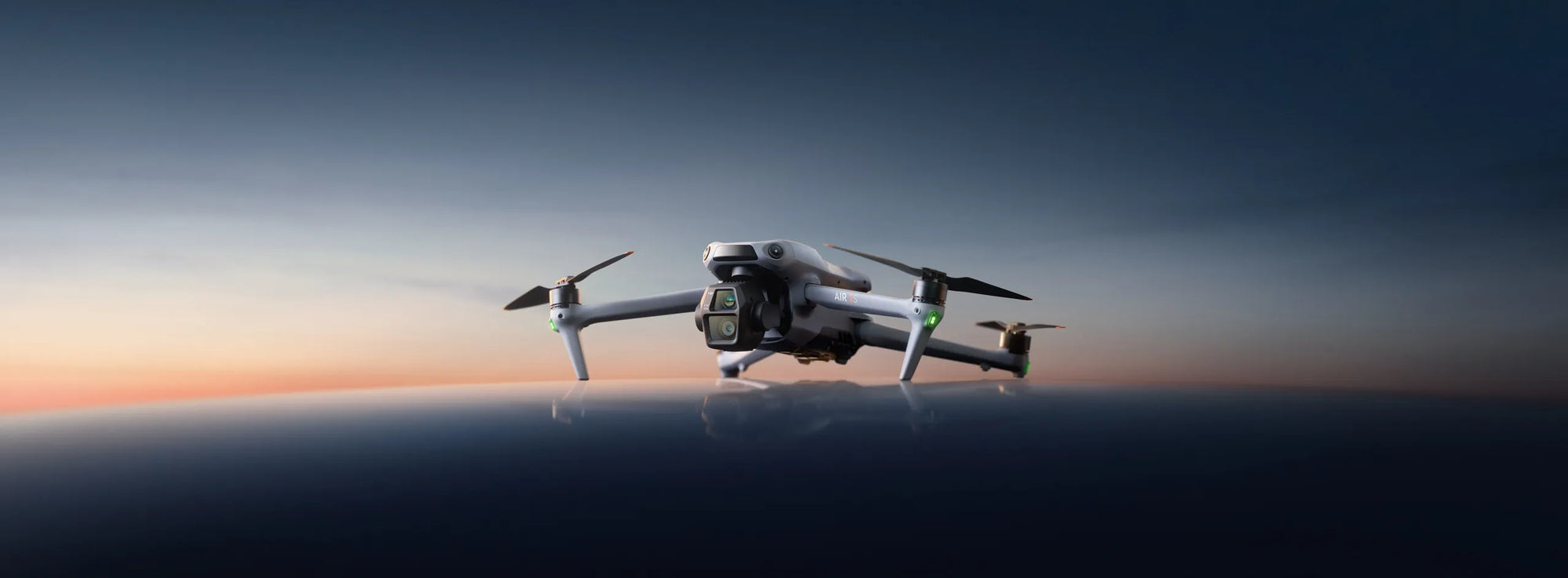
Choosing the best drones 2026 has to offer is trickier than it looks, because the market is both mature and chaotic: DJI still owns over 90 percent of consumer camera drones, yet US buyers face import restrictions that make “wait for the next model” genuinely bad advice. We merged five major buying guides, cross-checked their test data, and rebuilt everything into one complete resource — the drones worth your money, the regulations you need to know, and how to match a drone to what you actually want to film. Pair your new drone with the right gear from our best phone accessories of 2026.
The Best Drones of 2026 at a Glance
Most people should buy the DJI Air 3S — it delivers roughly 90 percent of the flagship experience for less than half the money. Budget buyers get the DJI Flip, travelers and beginners get the sub-250g Mini 5 Pro, and professionals who need the absolute best camera get the Mavic 4 Pro. Fun-seekers have the Neo 2 for selfies and the Avata 2 for FPV thrills.
| Drone | Best for | Key spec | Price |
|---|---|---|---|
| DJI Air 3S | Overall | Dual camera, 45-min flight | $989 |
| DJI Mavic 4 Pro | Pro cinema | Triple Hasselblad, 6K | $2,199 |
| DJI Mini 5 Pro | Travel / sub-250g | 1-inch sensor, 249g | $689 |
| DJI Mini 4 Pro | Compact all-rounder | 4K/100fps, 34-min flight | $759 |
| DJI Flip | Budget | Sub-250g, 31-min flight | $439 |
| DJI Neo 2 | Selfies / fun | Palm launch, 4K/60fps | $259 |
| HoverAir X1 Pro Max | Follow-me | 8K/30fps tracking | $699 |
| DJI Avata 2 | FPV | Goggles, 4K/100fps | $999 |
| Antigravity A1 | 360 video | 8K 360° capture | $1,599 |
| Autel Evo Lite+ | Non-DJI pick | 6K, 40-min flight | $1,259 |
Best Overall Drone: DJI Air 3S
The Air 3S is the consensus pick across nearly every major guide — the drone reviewers would tell most people to buy. Its dual-camera system pairs a 50MP 1-inch wide sensor with a 48MP medium-telephoto, both shooting 4K/120fps with 10-bit D-Log M and 14 stops of dynamic range, while omnidirectional obstacle sensing with forward LiDAR keeps it safe even in low light.
Real-world flight time lands around 38 to 45 minutes against a 45-minute claim, and the $989 base price buys you about 90 percent of the Mavic 4 Pro experience. Skip it only if you need sub-250g portability or true cinema-grade 6K — otherwise this is the sensible enthusiast’s drone.
Best Pro Cinema Drone: DJI Mavic 4 Pro
The Mavic 4 Pro is overkill for most people, and that is exactly the point. Its triple Hasselblad array — 28mm wide, 70mm medium telephoto, 168mm telephoto — is built around a 100MP Four Thirds sensor with 6K/60fps HDR video and the only adjustable aperture (f/2.0–f/11) on any consumer drone, giving you real depth-of-field control. A 360-degree Infinity Gimbal even shoots straight upward and true vertical.
Forward LiDAR works down to 0.1 lux for night obstacle detection, and the 51-minute claimed battery delivers roughly 37 to 45 minutes in practice. At $2,199 and 1,063g it triggers registration and location rules everywhere — and US buyers should note the FCC situation below — but for paid work, nothing else touches it.
Best Mini Drone: DJI Mini 5 Pro
The Mini 5 Pro is an engineering flex: the first sub-250g drone with a true 1-inch 50MP sensor, hitting exactly 249g so recreational US flyers skip FAA registration entirely. You get 4K/120fps, D-Log M, a 225-degree gimbal for dramatic tilt angles, and — remarkably at this size — omnidirectional obstacle avoidance with forward LiDAR.
The trade-offs are physics: at 249g it gets pushed around in wind above 20 mph, and there is no telephoto camera. At $689 it is the travel drone to beat, though note that the high-capacity Battery Plus pushes it over 250g and into registration territory.
Best Compact All-Rounder: DJI Mini 4 Pro
Before the Mini 5 Pro arrived, the Mini 4 Pro was the default recommendation, and it remains a superb buy — especially discounted. Its 1/1.3-inch sensor shoots 4K/100fps with 10-bit D-Log M, ActiveTrack 360 follows subjects reliably, and O4 transmission reaches 20km. The 34-minute battery and sub-249g weight keep it in the lightest regulatory bracket.
Low-light performance is merely average and it is not crash-proof, but for most travelers the choice between this and the Mini 5 Pro comes down to price: if the 5 Pro’s 1-inch sensor is not worth the premium to you, the 4 Pro still flies beautifully.
Best Budget Drone: DJI Flip
The Flip is the best drone under $500 by a wide margin. Its clever folding design stacks the propellers beneath the body with built-in guards, making it people-safe in a way no other camera drone at this price manages. The 1/1.3-inch sensor delivers 48MP stills and 4K/60fps HDR, and 31 minutes of flight time embarrasses everything near its $439 price.
Obstacle sensing is forward-only, and the large surface area makes it wind-sensitive — treat it as a calm-day flyer. But with no license needed at sub-250g and image quality matching the Mini 4 Pro, it is the entry point that makes sense.
Best Selfie Drone: DJI Neo 2
The Neo 2 is barely a drone in the traditional sense — it is a flying camera that lives in your pocket. At around 150g it launches from your palm, follows you with AI tracking, and lands back in your hand, all controlled by gestures or your phone with no controller required. The 4K/60fps footage is stabilized and perfectly good for social media.
Eighteen minutes of claimed flight time is optimistic — testers saw 10 to 15 — and the small sensor struggles in low light. At $259, though, it is the cheapest way to get genuinely fun follow-me footage while hiking, cycling, or skiing. Check our best accessories for every budget for carry cases and spare batteries.
Best Follow-Me Drone: HoverAir X1 Pro Max
If your priority is being filmed rather than filming, the HoverAir X1 Pro Max beats every DJI at the tracking game. Its folding, people-safe design dodges obstacles while locked onto you at up to 26 mph, shooting 8K/30fps or 4K/120fps slow motion from a 1/1.3-inch sensor — all at 192.5g.
The 16-minute battery is the obvious weakness, and the 1km range (with optional beacon) is modest. But for cyclists, runners, and solo creators who want a cameraman that fits in a jacket pocket, the $699 price is justified.
Best FPV Drone: DJI Avata 2
The Avata 2 is the gateway to FPV flying without the DIY pain. Its cinewhoop design with integrated prop guards is crash-resistant and indoor-safe, while the 1/1.3-inch camera shoots 4K/100fps with 10-bit D-Log M — the best image quality on any ready-to-fly FPV drone. Goggles 3 and the motion controller make acrobatic flight genuinely accessible to beginners.
Real endurance is about 23 minutes of gentle cruising and far less when flown hard, and at 377g it sits above the 250g line in most regions. Buy the Fly More combo with three batteries — one is never enough for FPV.
Best 360 Drone: Antigravity A1
Backed by Insta360, the Antigravity A1 is the only consumer 360 drone on the market, and it commits fully: dual 1/1.28-inch sensors capture 8K/30fps in full 360 degrees, so you fly first and choose your framing in post. The FPV goggles and point-to-fly grip controller make it an experience as much as a tool.
At $1,599 for the standard kit it costs far more than the Avata 2, and 360 reframing demands editing time. But for immersive, impossible-looking footage, there is literally no alternative.
Best Non-DJI Drone: Autel Evo Lite+
For buyers who want to avoid DJI over US-market uncertainty, the Autel Evo Lite+ is the credible alternative. Its 1-inch sensor shoots 6K/30fps with an adjustable f/2.8–f/11 aperture, flight time stretches to 40 minutes, and Autel’s absence from sanctions lists removes the availability anxiety.
You lose the secondary telephoto camera and DJI’s best-in-class obstacle sensing — it is weaker in dense environments. At $1,259 it is a rational hedge, not a performance upgrade.
How to Choose the Best Drone in 2026
The 250-Gram Line Matters Most
Weight class is the first filter, not camera specs. Under 250g — Mini 5 Pro, Mini 4 Pro, Flip, Neo 2 — US recreational flyers skip FAA registration and Remote ID, and UK/EU rules are lightest. Over it, budget $5 and a few minutes for registration, plus tighter rules around people and locations.
Camera vs Portability
Bigger sensors win low light and dynamic range: the Mavic 4 Pro’s Four Thirds sensor and the Air 3S’s 1-inch sensor visibly outperform smaller ones after sunset. But a drone you leave at home takes no photos — the sub-250g models exist precisely because portability gets used more.
Battery Math: Subtract 25 Percent
Claimed flight times assume gentle hovering in still air. Subtract 20 to 25 percent for real-world recording — a “45-minute” drone gives you about 35. FPV drones manage roughly half the endurance of camera drones. Multi-battery Fly More kits are almost always worth the premium.
Wind Tolerance Follows Weight
Heavier drones handle wind better; it is simple physics. The Mavic 4 Pro and Air 3S stay composed in moderate wind, the Mini 5 Pro and Flip struggle above 20 mph, and the Neo 2 is, in one reviewer’s words, a kite in anything gusty. Check the wind rating before a coastal trip.
The FCC Ban, Explained Simply
In December 2025, DJI landed on the FCC’s Covered List, which blocks new DJI models from getting the equipment authorization needed for official US sale. Crucially, this is not a ban on owning or flying drones: already-authorized models remain fully legal to buy, fly, and receive firmware support.
The practical effect is on availability and price. Newer models like the Mini 5 Pro and Neo 2 reach US buyers through third-party sellers, often above list price, and inventory is finite. If you are in the US and want a DJI drone, buying sooner rather than waiting for the next generation is the rational move.

Frequently Asked Questions
Do I need a license to fly a drone in the US?
Recreational flyers need no license but must pass the free TRUST test and carry proof; drones between 250g and 25kg must be FAA-registered. Commercial flying requires a Part 107 Remote Pilot Certificate regardless of weight.
Do I need to register my drone?
Usually yes — unless you fly recreationally with a sub-250g drone like the Mini 5 Pro, Mini 4 Pro, Flip, or Neo 2, which skip FAA registration and Remote ID. Heavier drones cost $5 to register for three years.
Can I still buy DJI drones in the US?
Yes. Pre-ban models are fully available at retail, and newer models reach buyers through third-party sellers. All remain legal to fly, and DJI continues support and firmware updates.
What is the best drone under $500?
The DJI Flip at $349–$439: sub-250g, a 48MP camera with 4K/60fps HDR, and DJI’s reliability. Nothing else comes close at the price.
Which drone has the best camera?
The DJI Mavic 4 Pro by a wide margin — triple Hasselblad cameras, 100MP stills, and 6K/60fps HDR video with an adjustable aperture.
What is a gimbal and do I need one?
A gimbal is the mechanical stabilizer that keeps aerial footage silky smooth; without one, video is shaky and jarring. Do not buy a drone without at least a 2-axis gimbal — 3-axis mechanical is the standard to look for.
Should I choose the Flip or the Neo 2 as a first drone?
Choose the Flip for conventional twin-stick flying with a proper 3-axis gimbal and 48MP camera. Choose the Neo 2 for the lowest-friction experience — palm launches, gestures, and automated tracking for quick social clips.
What is considered good flight time?
Most camera drones fly 20 to 30 minutes; advanced models claim 40 to 51 minutes but deliver 20 to 25 percent less in practice. FPV drones manage roughly half that. Spare batteries matter more than headline numbers.
Our Verdict
For most people, the DJI Air 3S is the answer — the best balance of camera, flight time, portability, and price in 2026. Stretch the budget only if you know why: the Mavic 4 Pro for paid work, the Mini 5 Pro for travel, the Flip to start cheap, and the Avata 2 when you crave the goggles. Match the drone to the flying you will actually do, buy the Fly More kit, and check your local rules before takeoff.
