

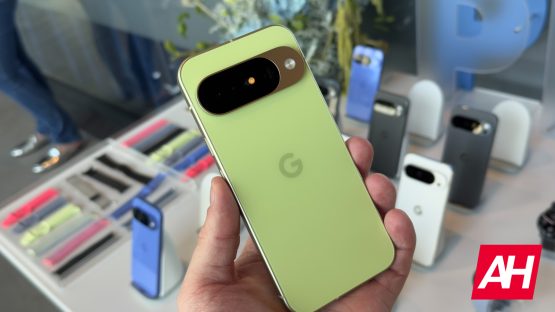
This Google Pixel 10 review covers the most complete standard Pixel Google has ever made. The big story: a dedicated 5x telephoto camera joins the regular model for the first time, alongside the Tensor G5 chip and magnetic Pixelsnap charging — all for $799.
A year on from launch, it remains one of the smartest flagship buys around. But the Tensor G5’s raw performance and merely average battery life keep it from a clean sweep.
Design and Build
The Pixel 10 keeps the familiar camera-bar identity in a 6.3-inch chassis measuring 152.8 x 72 x 8.6mm. The spacecraft-grade aluminium frame and Gorilla Glass Victus 2 front and back feel properly premium, and IP68 dust and water resistance is standard.
At 204 grams it is not a lightweight — the compact claim applies to the screen size, not the mass. Colours are Frost, Indigo, Lemongrass and Obsidian. The camera bar’s full-width extrusion means the phone rests at a slight angle on flat surfaces, a minor quirk most owners stop noticing.
Display
The 6.3-inch Actua OLED runs 1080 x 2424 at 60–120Hz — smooth, but not the LTPO panel of the Pro, so it cannot drop to 1Hz for static content. Peak brightness hits 3,000 nits (2,000 in HDR), making it easily readable outdoors.
For a 6.3-inch panel the resolution is plenty sharp at 421 PPI, and colours are vivid with deep blacks. It is a clear step below the Pro’s finer resolution and adaptive range, but there is nothing here that feels like a compromise in daily use.
Cameras: The Telephoto Changes Everything
The triple system — 48MP main (f/1.7, OIS), 13MP ultra-wide (f/2.2, 120°) and 10.8MP 5x telephoto (f/3.1) — covers 0.5x to 5x natively, with Super Res Zoom reaching 20x. The 10.5MP front camera has autofocus.
Daylight photos are classic Pixel: punchy, well-exposed and ready to post with minimal editing. Night Sight remains superb, and the 5x telephoto is now sharper in low light than the Pixel 9’s equivalent. Portraits render creamy background blur with Google’s typically excellent edge detection, and Real Tone keeps skin tones accurate.
Video is the quiet leap: 4K Video Boost now processes far more footage on-device instead of uploading to the cloud, and low-light video is among the best on any Android phone. The main camera remains the best of the three — the secondary sensors are good, not Pro-grade — but as a package this is one of the finest camera systems at the price.
AI and Software: Tensor G5
The Tensor G5 — Google’s first TSMC-made Pixel chip, built on 3nm — pairs with 12GB of RAM to power an AI-first experience. Magic Editor, Best Take and Add Me now run largely on-device, which is faster and keeps family photos off cloud servers. Camera Coach guides your framing, Ask Photos handles natural-language image search, and Magic Cue surfaces contextual info across apps.
The honest caveat from reviewers: much of the AI still feels half-baked. Magic Cue frequently fails to trigger or surfaces irrelevant information, the AI journaling app is odd, and Google has already paused the Daily Hub briefing feature. The ideas are ambitious; the execution is not there yet.
Software support is excellent: Android 16 out of the box with seven years of OS, security and Pixel Drop updates.
Performance and Thermals
Raw benchmarks are the Pixel’s weak spot. Geekbench 6 scores of 2,291 single-core and 6,193 multi-core trail Apple and Qualcomm flagships badly, and the GPU score of 3,109 is markedly lower than even older Pixels. In daily use you will not notice — scrolling, app switching and camera processing are all smooth — but demanding gamers should look elsewhere.
Thermals are improved over the Pixel 9 but not class-leading: heavy 5G use or long gaming sessions warm the right edge noticeably. Occasional warming under sustained load is the price of the AI-first silicon.
Battery and Pixelsnap
The 4,970mAh battery delivers a little over a day of moderate use — roughly four hours of screen time in testing, with 21 hours 40 minutes in a video rundown test. It is a phone you will charge nightly; video-heavy days stretch further.
Pixelsnap is effectively MagSafe for Pixel: Qi2-certified magnetic wireless charging at 15W with a growing accessory ecosystem. Wired charging is 30W, and no charger is included in the box. Safety extras include satellite SOS, car crash detection and earthquake alerts.
Google Pixel 10 Review: vs Pixel 10 Pro
The standard model now has the stronger completeness argument, because the telephoto removes the most conspicuous gap. The Pro keeps its advantages — a finer LTPO display and more ambitious camera hardware — which is a healthier distinction than reserving every good camera for the expensive model. For the full Pro breakdown, see our Pixel 10 Pro review.
Google Pixel 10 Review: Price and Value
At $799 the Pixel 10 undercuts the iPhone 17’s two-camera setup with three cameras and magnetic charging, and it embarrasses phones costing far more on photography. The 128GB base storage feels tight for a flagship, and 256GB is the sensible pick.
Discounts have pushed it as low as £499 in the UK, at which point it is simply one of the best-value flagships available. See how it stacks up in our best Android phones of 2026 comparison.

FAQs
Is the Google Pixel 10 worth buying in 2026?
Yes. The 5x telephoto, Tensor G5 AI features, 7 years of updates and frequent discounts make it one of the best-value flagships — as long as you do not need top-tier gaming performance or multi-day battery.
Does the Pixel 10 have a telephoto camera?
Yes — a 10.8MP 5x optical telephoto, the first on a standard Pixel. Combined with the 48MP main and 13MP ultra-wide, it covers 0.5x to 5x natively with up to 20x Super Res Zoom.
What is Pixelsnap?
Google’s Qi2-certified magnetic wireless charging at 15W — essentially MagSafe for Pixel — with snap-on accessories and stands.
How long does the Pixel 10 battery last?
A little over a day of moderate use (about 4 hours of screen time); plan on nightly charging. Wireless charging tops out at 15W and wired at 30W.
Pixel 10 vs Pixel 10a: which should I buy?
The Pixel 10 adds the 5x telephoto, Tensor G5, 12GB RAM and Pixelsnap over the $499 10a. If zoom photography matters, the 10 is objectively better; otherwise the 10a is the smarter budget pick.
Verdict
The Google Pixel 10 is a more complete flagship because its hardware finally supports a wider range of photography without forcing you to the Pro. Superb cameras, useful on-device AI, magnetic charging and seven years of updates make it easy to recommend.
Its limits are honest ones: modest battery life, a GPU that trails rivals and AI features that overpromise. None of them outweigh the value. Rating: 4.5/5.
