

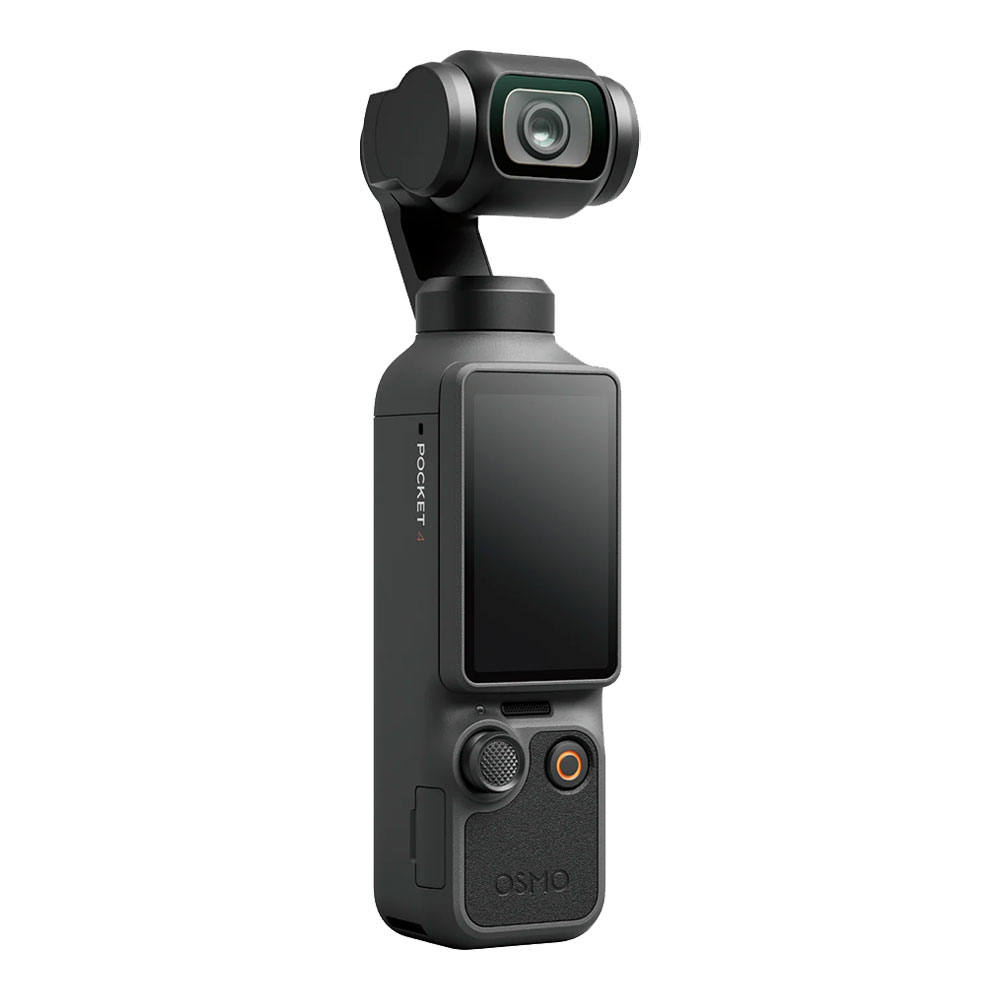
This DJI Osmo Pocket 4 review puts DJI’s newest pocket gimbal camera through real-world testing — vlogs, night shoots, tracking shots and full-day event coverage. After the Pocket 3 became the category-defining vlogging camera back in 2023, the Osmo Pocket 4 arrives with a new 1-inch sensor, 4K at 240fps, 107GB of built-in storage and ActiveTrack 7.0.
It’s still the small stick camera you know: a 3-axis mechanical gimbal on a pocketable body. But DJI has rebuilt the internals so thoroughly that this feels less like a casual gadget and more like a compact production tool. It’s a strong enough performer to earn a place on our round-up of the best action cameras of 2026, and it might just be the only vlogging camera you’ll ever need.
Our Verdict
The Pocket 4 might not deliver the headline-grabbing features some hardcore fans hoped for — there’s still no optical zoom, and portrait mode remains capped at 3K. But it’s a better camera in every way that matters: sharper video, cleaner low light, smarter tracking, longer battery life, and genuinely useful quality-of-life upgrades like physical buttons and onboard storage.
For the extra money over the Pocket 3, you’re getting image quality that will pay you back over time. The onboard storage alone effectively closes the price gap, not to mention the huge convenience that feature brings. If you’re choosing between the two today, the Pocket 4 is the one to buy.
Independent testers agree. Geek Culture awarded it 8.9/10 overall — including 9.5/10 for performance — calling it a user-friendly, all-in-one video production device for creators who need more than a smartphone offers.
What’s New Compared to the Pocket 3
DJI kept the familiar formula — 4K video, a 20mm-equivalent f/2.0 lens and a rotating 2-inch touchscreen — and upgraded almost everything around it. The new 1-inch CMOS sensor adds two stops of low-light performance and 14 stops of dynamic range, while the maximum frame rate doubles to 4K at 240fps for 10x slow motion.
Colour science moves to full 10-bit D-Log (up from the lighter D-Log M on the Pocket 3), and shutter speeds now drop to 1/4 second for slow-shutter effects. The 2x “lossless” zoom can be used at any time — including while recording and during ActiveTrack — where the Pocket 3’s zoom had to be activated first.
Hardware gains two new physical buttons below the display: a dedicated zoom control and a customisable button you can map up to three functions to. Add gesture control, six on-camera Film Tones, spatial audio with audio zoom, a magnetic modular accessory mount and 107GB of internal storage, and this is a substantial generational leap rather than a refresh.
Design and Controls
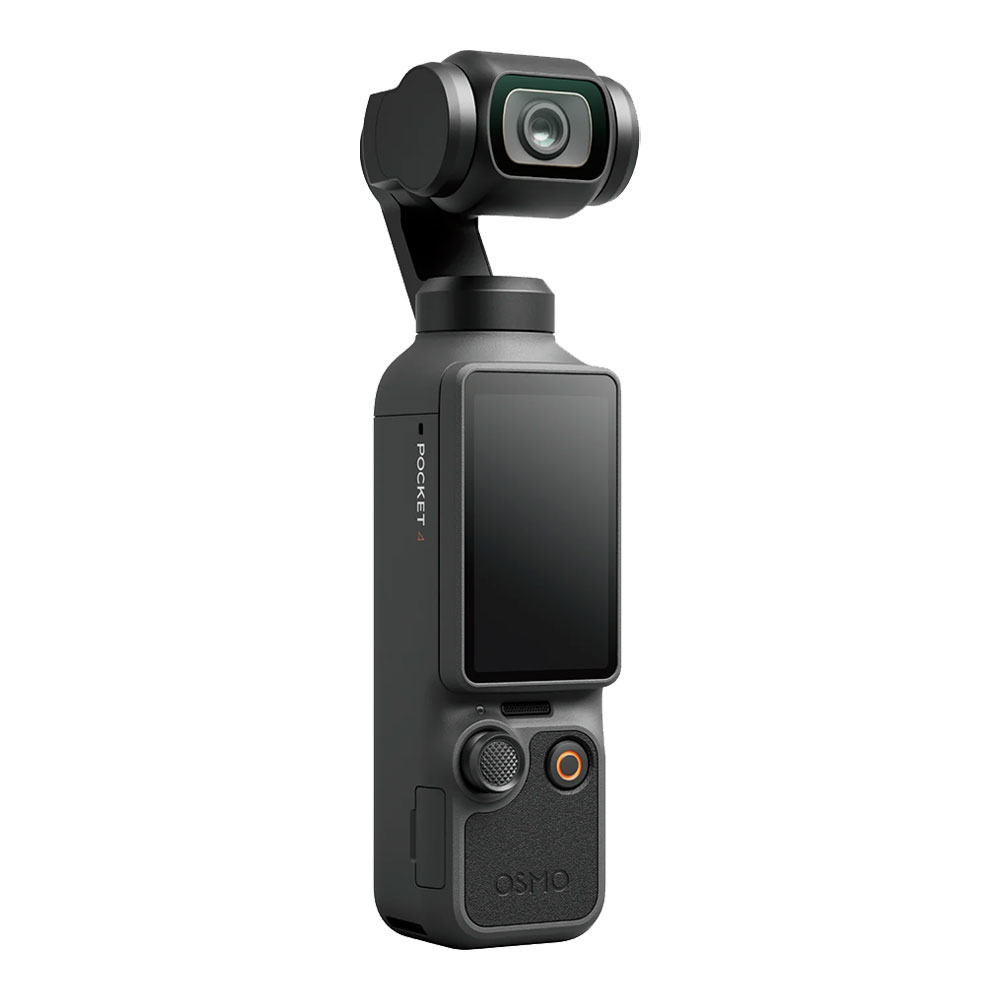
Pick up the Pocket 4 and it’s the same TV-remote-sized stick, measuring 144.2 × 44.4 × 33.5 mm and weighing under 200 grams. The 2-inch touchscreen rotates as before, but brightness jumps to 1,000 nits (up from 700), making outdoor framing far easier.
The two new buttons sit just under the display. The zoom button punches between 1x, 2x and 4x instantly — a real fix for the old joystick zoom that always looked slow and amateur. The second button is customisable: single, double and triple clicks can trigger actions like re-centring the gimbal, switching recording presets or locking the horizon, even while recording.
The 5D joystick feels more responsive for panning and tilting, and can also re-centre the gimbal and flip the camera. DJI has dropped the old protection cover in favour of a small gimbal lock tool that secures the delicate gimbal head during transport — a welcome improvement, though the gimbal itself remains fragile, so handle it with care.
Video Quality
The popularity of the Pocket series rests on high-quality video in a portable body, and the Pocket 4 builds on that formula convincingly. The new 1-inch sensor is noticeably more detailed than the Pocket 3’s, and DJI’s claim of two stops of better low-light performance holds up in night shooting: shadowed areas that come out dark and fuzzy on the Pocket 3 resolve cleanly here.
In side-by-side tests, sunlight bursting through a dark tunnel is blown out on the Pocket 3 while the Pocket 4 balances it far more naturally — the 14 stops of dynamic range at work. Colours look more natural than ever without tipping into oversaturation, and skin tones are true to life.
The 4K/240fps mode is the standout: high-frame-rate footage stays smooth and detailed when slowed down, a real step up for sports and creative transitions. Launch materials also list 1080p at up to 480fps, though that mode hasn’t been independently verified yet. Full 10-bit D-Log gives colour graders smoother gradients and far more flexibility than the Pocket 3’s D-Log M.
Photos, Film Tones and Creative Looks
Stills get a major bump: photo resolution jumps from around 9.4MP to 37MP, which is genuinely useful for architecture and landscapes. A dedicated on-screen Live photo button makes iPhone-style motion photos easier than on the Pocket 3.
The six on-camera Film Tones work like Fujifilm’s film simulations, applying different moods without any grading — Warm and Movie are the most usable, while some options run too hot or too cold. You can dial down the intensity, but that’s the extent of the control, and it’s still unclear whether these are true simulations or app filters ported to the camera.
Other creative tools include In-Camera Beautify for fine-tuning skin smoothness and tone, plus a slow-shutter video mode (down to 1/4s) for motion-blur light trails — though it will overexpose any other light source in the shot, so proceed with caution. A magnetic fill light clips to the gimbal, moves with the camera, and offers three brightness and temperature settings for night portraits within about two metres.
Stabilisation and ActiveTrack 7.0
The 3-axis mechanical gimbal remains one of the best stabilisation systems in its class. Walking and even running shots come out remarkably smooth, and refined motor control absorbs sudden movements more effectively than before. Multiple gimbal modes — including Follow, FPV and SpinShot — cover everything from steady vlogs to dramatic spins.
ActiveTrack 7.0 locks onto people, pets, vehicles and objects, holds focus through crowded or fast-moving scenes, and now works with zoom enabled. Subject Lock, Registered Subject Priority, Dynamic Framing and Spotlight Follow all reduce the chance of losing your subject mid-shot.
Real-world testing confirms the hype, with caveats: tracking works best up close with a clear view of the face. From far away — or when tracking identically uniformed players — it can lose the plot, and it may even trigger accidentally on hand gestures. Remote tracking via the phone app can also fail at longer distances. You can switch ActiveTrack off entirely to prevent misfires.
Gesture control is genuinely handy for solo shooters: show your palm to toggle tracking, flash a peace sign to take a photo or start and stop recording. Rotating the screen even starts recording immediately.
Audio: Spatial Sound, Audio Zoom and DJI Mic Support
Audio is a surprise strength. The three-microphone array records spatial audio — you’ll need headphones to hear the effect — which adds ambience for live music, though voices can sound distant and muddled, so don’t use it as a default setting.
Audio zoom boosts voices when you punch in on a subject, but it’s crude: no processing can improve on what the microphones actually receive. More useful is Vocal Boost in the Pro menu, which lowers background noise to rescue dialogue in noisy run-and-gun situations.
The serious solution is DJI’s wireless microphones. The Pocket 4 connects directly to DJI Mic 2, Mic 3 and Mic Mini transmitters, and records the external mic plus ambient sound as a single 4-channel file that video editors recognise directly — no separate files to sync. The Creator Combo includes a DJI Mic 3 transmitter, the best way to get YouTube-ready audio.
Battery Life and Charging
The 1,545mAh battery is roughly 20 percent larger than the Pocket 3’s, and the real-world gains match: up to 240 minutes of recording per charge at 1080p/24fps, or around two and a half hours at 4K. One reviewer shot all day at a trade show without killing it, and five days of cruise filming needed only one charge per day.
Charging is the real party trick: 0 to 80 percent takes about 18 minutes, buying roughly three hours of shooting. That’s fast enough to top up over lunch and keep filming all afternoon. A battery-handle accessory extends things further for marathon shoots.
Storage, Transfer and the DJI Mimo App
Here’s the upgrade reviewers call the most practical. The Pocket 4 packs 107GB of built-in storage with transfers up to 800MB/s over USB 3.1 — you can shoot for days without ever inserting a memory card. One tester recorded dozens of videos over several months without running out of room.
Offloading is blazingly fast: a 40-minute video transfers to an iPhone in seconds, noticeably quicker than the already-fast Pocket 3. Wi-Fi 6 and the DJI Mimo app handle wireless transfers, and the app’s Editor section cuts, trims and assembles 4K projects on your phone with effects, text and music — handy for pushing content to social platforms, though some of the controls take getting used to.
Price, Combos and What’s in the Box
The standard Osmo Pocket 4 starts at $499 (around £445 in the UK, just £56 more than the Pocket 3’s launch price). That buys the camera, a USB-C PD cable, gimbal clamp, wrist strap, handle with 1/4-inch thread and a carrying pouch.
The Creator Combo — the one serious creators should pick — adds a DJI Mic 3 transmitter, magnetic fill light, wide-angle lens, mini tripod, wind muffs, a magnetic mic clip and a pass-through base case. Prices vary by market: roughly $649–$749 in most regions, S$759 in Singapore and Php 37,490 in the Philippines.
One caveat: DJI can’t currently sell the Pocket 4 directly in the United States due to its FCC covered-list status, so official prices are quoted in pounds and euros. Global availability elsewhere began around 20–22 April 2026.
How It Compares: The Competition
Honestly, there’s no true like-for-like rival. The nearest competition comes from action cameras like the GoPro Mission 1 and Insta360 Ace Pro 2 — both excellent portable shooters, but they favour wide, bright, sharp action-style footage rather than the Pocket 4’s stabilised, vlog-friendly look. Lesser-known gimbal cameras from Feiyu and Agfaphoto exist but aren’t serious alternatives.
The Pocket 4’s nearest rival is still the Pocket 3, which remains a great buy at roughly $120 less if you mostly shoot in good daylight. And if you need waterproofing and rugged action footage instead of a delicate gimbal, our DJI Osmo Action 6 review covers DJI’s tougher alternative.
Note that DJI has also released the Osmo Pocket 4P, a dual-lens variant with a dedicated 60mm telephoto lens and 17 stops of dynamic range — stay tuned for our review of that one too.
Pros and Cons
Pros
- Excellent image quality for the size, with a genuinely better 1-inch sensor
- Much-improved low-light performance and 14 stops of dynamic range
- 107GB of fast built-in storage — no memory card needed
- ActiveTrack 7.0 tracking that rarely loses its subject
- Gesture controls that work well for solo shooting
- Blazing-fast 800MB/s transfers and superb 18-minute charging
- Physical buttons and a 5D joystick fix the old control frustrations
- Modular accessories, including the magnetic fill light
Cons
- Portrait mode still capped at 3K — rotate for full 4K vertical video
- No dust or water protection thanks to the exposed gimbal
- No optical zoom (digital only); consider the Pocket 4P for telephoto reach
- Not sold directly in the US
- The full Creator Combo is expensive
- Tracking weakens at long distances and with uniformed subjects
DJI Osmo Pocket 4 Review: Full Specifications
| Specification | Details |
|---|---|
| Sensor | 1-inch CMOS, approx. 9.4MP |
| Lens | 20mm equivalent, f/2.0 |
| Video | 4K up to 240fps; 1080p up to 480fps* |
| Colour profile | 10-bit D-Log |
| Dynamic range | 14 stops |
| Zoom | 2x lossless in 4K (during recording and tracking); 4x digital in 1080p |
| Photos | 37MP stills; Live photos |
| Stabilisation | 3-axis mechanical gimbal; ActiveTrack 7.0 |
| Display | 2-inch rotatable touchscreen, 1,000 nits |
| Controls | 5D joystick; dedicated zoom + customisable buttons; gesture control |
| Audio | 3-mic array; spatial audio; audio zoom; Vocal Boost; 4-channel OsmoAudio; DJI Mic 2/3/Mini support |
| Storage | 107GB built-in, transfers up to 800MB/s |
| Connectivity | Wi-Fi 6; USB-C 3.1 |
| Battery | 1,545mAh; up to 240 min at 1080p/24fps; around 2.5h at 4K |
| Charging | 0–80% in about 18 minutes |
| Dimensions | 144.2 × 44.4 × 33.5 mm |
| Weight | Under 200 g |
| Launch price | $499 (standard); Creator Combo from around $649 |
*The 1080p/480fps mode appears in launch materials but hasn’t been independently verified in recorded footage yet.
Frequently Asked Questions (FAQs)
What is the DJI Osmo Pocket 4 release date?
DJI officially announced the Osmo Pocket 4 on 16 April 2026 at 12:00 PM GMT, with global shipping beginning around 20–22 April 2026. The camera had already leaked extensively — it appeared in FCC filings at the end of 2025 — so there were few surprises left on launch day.
How much does the DJI Osmo Pocket 4 cost?
The standard Osmo Pocket 4 starts at $499 (about £445 in the UK). The Creator Combo, which adds a DJI Mic 3 transmitter, magnetic fill light, wide-angle lens, mini tripod and more, costs roughly $649–$749 depending on the market. For context, the Pocket 3 still sells for about $120 less, making it the value pick.
Does the DJI Osmo Pocket 4 have internal storage?
Yes — 107GB of built-in storage with transfer speeds up to 800MB/s over USB-C. Most creators will never need a memory card: reviewers recorded dozens of videos over several months without filling it. Wireless transfers via Wi-Fi 6 to the DJI Mimo app are equally quick.
What is the battery life of the DJI Osmo Pocket 4?
The 1,545mAh battery delivers up to 240 minutes of recording per charge at 1080p/24fps, or around two and a half hours at 4K. Fast charging takes it from empty to 80 percent in about 18 minutes, which buys roughly three hours of shooting — enough for a full day of vlogging with a lunch-break top-up.
Is the DJI Osmo Pocket 4 waterproof?
No. Like every gimbal camera, it has no dust or water protection because the 3-axis gimbal head is fully exposed. If you shoot around water or in rough conditions, use a waterproof case accessory — or choose a rugged action camera instead.
Should I upgrade from the Osmo Pocket 3?
If you own a Pocket 3 and mostly shoot in good daylight, the differences won’t transform your footage — the Pocket 3 remains an excellent camera, and you’ll save around $120. But if you shoot in mixed or low light, want 4K slow motion at 240fps, or are tired of juggling memory cards, the Pocket 4’s sensor, storage and controls make it a meaningful upgrade. New buyers should get the Pocket 4 outright.
What is the maximum video resolution and frame rate of the Pocket 4?
The Pocket 4 records 4K at up to 240fps — double the Pocket 3’s 120fps — giving 10x slow motion in full 4K. Launch materials also advertise 1080p at up to 480fps, though that mode hasn’t been independently verified in recorded footage yet. Portrait mode is capped at 3K; rotate the camera for full-sensor 4K vertical video.
Does the DJI Osmo Pocket 4 have optical zoom?
No. Zoom is digital: 2x “lossless” in 4K (usable during recording and tracking) and 4x in 1080p, where you may notice some digital artefacts. The zoom works best for static or tripod shots. If you need true telephoto reach, the dual-lens Osmo Pocket 4P adds a dedicated 60mm optical telephoto lens.
Is the DJI Osmo Pocket 4 available in the US?
Not directly. DJI can’t currently sell the Pocket 4 in the United States due to its FCC covered-list status, so official pricing is quoted in British pounds and euros (from £445 in the UK). Global availability elsewhere is unaffected.
Does the Pocket 4 work with DJI wireless microphones?
Yes. It connects directly to DJI Mic 2, Mic 3 and Mic Mini transmitters, and can record the external mic plus ambient sound as a single 4-channel file that video editors recognise directly — no separate files to sync. The Creator Combo ships with a DJI Mic 3 transmitter in the box.
