

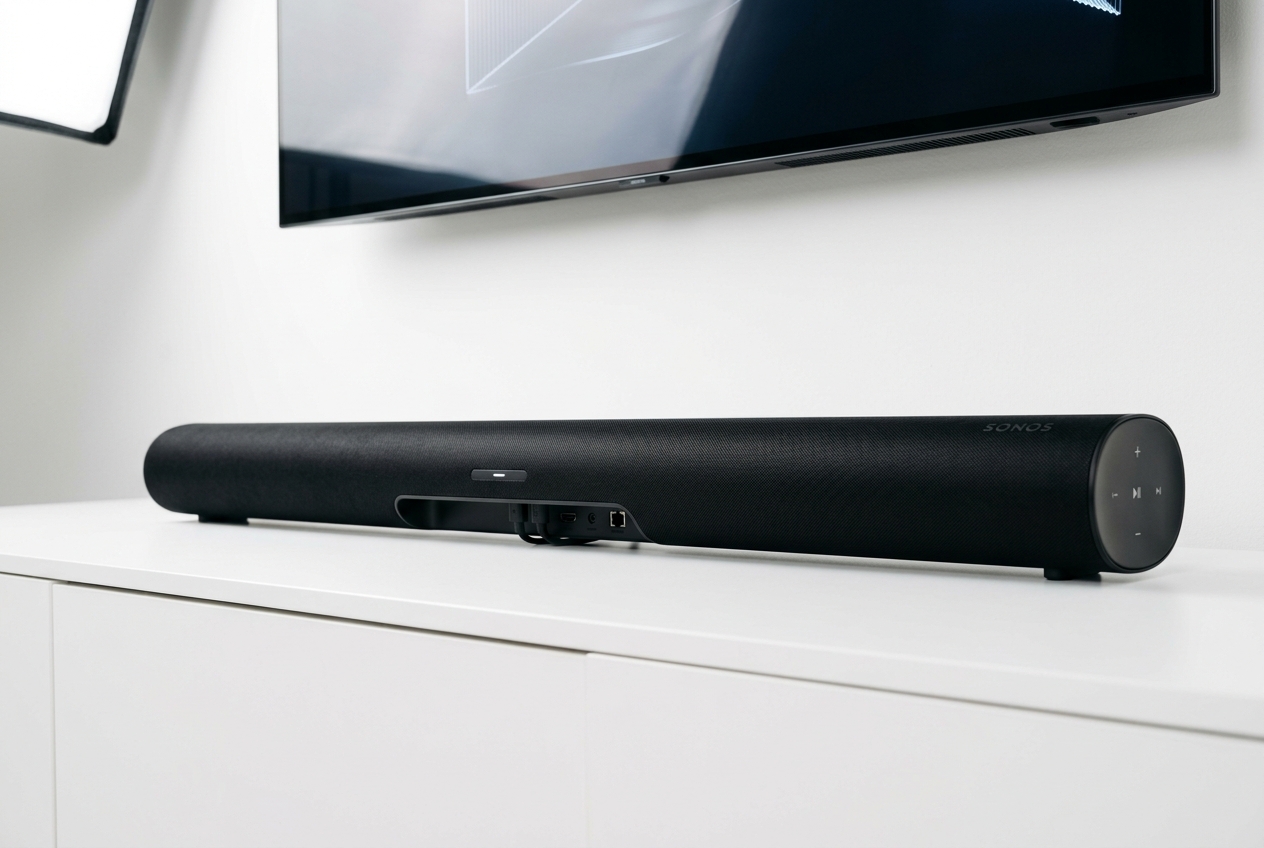
Modern TVs are so thin there’s barely room inside for a decent speaker, which is why even a great picture can feel flat. The best soundbar fixes that in minutes: clearer dialogue, deeper bass, and a bigger sense of space for movies, games, and everyday streaming. Five current expert buying guides went into this roundup, distilling the strongest picks of 2026, from single-bar flagships to complete 11.1.4 home cinema systems.
Why a Soundbar Is the Easiest Upgrade You Can Make
Sound is half the home cinema experience, yet TV speakers keep getting smaller. A soundbar replaces them over a single HDMI cable, and modern ones double as genuine music systems with streaming built in. Reviewers in 2026 agree on one pattern: single-bar designs now reach bass extension and spatial performance that was unthinkable three years ago, while multi-piece systems push discrete channel counts ever higher at increasingly competitive prices.
Room correction has become a baseline expectation rather than a premium feature, Dolby Atmos support is near-universal outside the cheapest tier, and hi-fi streaming credentials like Tidal Connect, Spotify Connect, and AirPlay now converge with home cinema performance. Pair one with a great display — something like the LG C5 OLED — and you’ve built a proper cinema corner without a receiver.
The Best Soundbars of 2026 at a Glance
- Sony Bravia Bar 9 — Best overall — 13-driver bar — Atmos, DTS:X, IMAX Enhanced, 360 Spatial Sound Mapping — Premium
- KEF XIO ($2,500) — Best premium single bar — 5.1.2 — Uni-Q drivers, 820W, no sub needed — ~$2,500
- Samsung HW-Q990F (~$1,598) — Best complete system — 11.1.4 — Wireless sub + rears, 4K/120 gaming — ~$1,598
- Sonos Arc Ultra ($999) — Best for music & multi-room — 9.1.4 — Sound Motion woofer, Trueplay — $999
- Sonos Beam Gen 2 ($449) — Best compact — 5.x Atmos (virtual) — HDMI eARC, speech enhancement — $449
- LG S80TR — Best value surround — 5.1.3 — Wireless rears + sub, WOW Orchestra — Mid-range
- Sennheiser Ambeo Max — Best ultimate all-in-one — 5.1.4 (virtual) — 13 speakers, drops to 30Hz — Flagship
- Razer Leviathan V2 ($250) — Best for gaming — Bar + sub — THX Spatial Audio, RGB — ~$250
Best Overall: Sony Bravia Bar 9
This is the all-around winner because it does the hard part well: a wide, detailed soundstage from a built-in 13-driver speaker layout, yet dialogue and effects stay sharply separated. In real use that means less fiddling with the volume and fewer moments where voices disappear under music or action.
Sony packs in the big theatre features: Dolby Atmos, DTS:X, and IMAX Enhanced, while 360 Spatial Sound Mapping creates a larger surround effect around your seating area and Sound Field Optimization tunes output to your room. Music use is strong too, with Spotify Connect, AirPlay 2, and Bluetooth, and you can add optional wireless rears and a subwoofer later — the strongest long-term upgrade path here. The catches are the premium price, add-ons costing extra, and performance that peaks in medium rooms.
Best Premium Single Bar: KEF XIO
StereoNET’s Soundbar of the Year 2026 — a remarkable result for KEF’s very first soundbar, proving sixty-plus years of loudspeaker engineering translates directly into single-enclosure performance. Inside the 1,210mm aluminium-and-fabric cabinet sit twelve Class-D amplifiers delivering 820W peak to twelve drivers, centred on six proprietary Uni-Q MX coaxial drivers with four oval bass drivers handling low frequencies with surprising weight.
Reviewers found incredible clarity in the mid and upper ranges, and bass that produces the type of low-end rumble you’d normally only expect from a small subwoofer. The KEF Connect app offers room correction and genuinely useful sound profiles, with streaming across AirPlay, Google Cast, Spotify Connect, Tidal Connect, and Qobuz. Note the absence of HDMI passthrough and no rear-speaker expansion at launch (planned via firmware). At roughly $2,500, it’s for cinephiles who want their home to be the favoured movie-night spot.
Best Complete System: Samsung HW-Q990F
If you want true surround rather than clever virtualization, this is the most comprehensive package available in 2026: a complete 11.1.4-channel system with soundbar, wireless subwoofer, and a pair of upward-firing rear surrounds in the box. Across 23 speakers it delivers a genuinely enveloping surround field with convincing height effects and deep, impactful bass.
Samsung pairs the hardware with Eclipsa Audio — a new open-source 3D format co-developed with Google — alongside Atmos and DTS:X, plus SpaceFit Sound Pro room calibration and Q-Symphony that lets compatible Samsung TV speakers work in concert with the bar. Dual HDMI 2.1 inputs with 4K/120Hz, VRR, and ALLM make it the gaming standout — a quality many pricier single bars can’t match. Samsung has announced the HW-Q990H as the 2026 flagship refresh, so watch for deals on the Q990F.
Best for Music and Multi-Room: Sonos Arc Ultra
The Arc Ultra has become the benchmark standalone Dolby Atmos soundbar since launch, and the reason is bass without a box: the new Sound Motion woofer, with four motors and a dual-membrane design developed in-house, delivers roughly double the bass of the original Arc from a comparably slim enclosure. Fourteen drivers in a 9.1.4 configuration, a completely redesigned centre channel, and speech enhancement that reviewers call class-leading make dialogue crisp and prominent.
Bluetooth 5.3, Trueplay room tuning (now on iOS and Android), and the full Sonos ecosystem make it supremely practical, with an upgrade path to a Sub 4 and Era 300 rears that transforms it into one of the most capable home cinema systems at any price. It also handles every music genre well, so it works as a proper music system too — if you’d rather go fully wireless for music, our guide to the best smart speakers covers that side of the house. The frustrations: HDMI eARC only, and no DTS support.
Best Compact: Sonos Beam (Gen 2)
For smaller rooms and TVs up to 50 inches, the Beam Gen 2 remains the default recommendation. Five front-facing driver arrays with no up-firing speakers deliver a convincing approximation of Atmos height and surround through psychoacoustic processing, and HDMI eARC brings compatibility with demanding codecs.
Five-star ratings across the press reflect a product that consistently exceeds expectations at its price: clean, balanced sound that wraps around you, surprisingly impressive bass for its size, plus night mode and speech enhancement for late viewing. Alexa and Google Assistant are built in, and it can grow into a larger system with a Sub and rear speakers. It’s the value pick to beat if you want compact dimensions and genuine Atmos performance without flagship money.
Best Value Surround Package: LG S80TR
The LG S80TR hits a sweet spot: a 5.1.3-channel layout with Dolby Atmos, DTS:X, wireless rear speakers, and a wireless subwoofer — a lot of theatre hardware for value money. The centre up-firing speaker puts extra focus on dialogue so busy scenes stay easy to follow, and if you own a compatible LG TV, WOW Orchestra lets the TV speakers and soundbar work together for a fuller presentation.
WOWCAST supports wireless Dolby Atmos with compatible setups, and the bar calibrates itself to your room using its internal microphone — less guesswork for beginners. The best extras need an LG TV, and it’s a bigger setup than a solo bar, but for strong surround performance without flagship pricing, this is the value pick to beat.
Best for Gaming: Razer Leviathan V2
Built for gamers at around $250, the Leviathan V2 pairs a bar with a subwoofer and focuses on positional audio: THX Spatial Audio helps you identify where enemies are and hear bullets fly past, with warm, punchy bass adding immersion. Customizable RGB lighting fits the gaming setup aesthetic, and feet that angle the bar upward fire audio toward your listening position.
Connect over USB audio to a PC or Bluetooth 5.2 to other devices, and tune the sound with EQ presets like Bass Boost in the Razer Synapse app. The trade-offs are real, though: no HDMI port at all, the subwoofer is too large for a desk, and Bluetooth audio is less reliable. For console gamers who need HDMI passthrough, look at the Samsung Q990F instead.
Best Budget Picks
Majority Bowfell Plus (~£65) is the no-brainer budget pick: a 38cm bar with three EQ presets (dialogue, music, movie) and an optical input that produces a wide soundstage well beyond what £65 should buy. Puriom 2-in-1 adds a detachable design that splits into two tower speakers, Bluetooth 5.3, and a full port selection (ARC, optical, USB, AUX).
The Saiyin Detachable Soundbar is the beginner-friendly step up: a detachable bar that works as one unit or two towers, 120W of output, silk dome tweeters, and 10 adjustable bass levels. At the very bottom, the Xiaomi Soundbar 2.0ch keeps it simple — a slim 2.0 stereo bar with Bluetooth 5.3, optical, AUX, and SPDIF — fine for a bedroom TV, but with no HDMI, no subwoofer, and no Atmos.
How to Choose the Best Soundbar for Your Room
Real surround versus virtual surround. A bar can claim big theatre sound, but the speaker layout matters. Real rear speakers create a more convincing wraparound effect than virtual processing alone — wireless rears cut down on long speaker wires across the room. If movies are your main use, start there; if you just want cleaner everyday TV audio, a front-only bar can be enough and takes less space.
Don’t buy the Atmos logo alone. Atmos helps most when the bar also has up-firing speakers or rear channels. A bar with Atmos branding but no helpful hardware may still sound good — just not truly overhead. Look at the speaker layout behind the logo.
Dialogue clarity is a quality-of-life upgrade. Clear speech at normal volumes is what separates a good bar from a great one: centre channels, voice-enhancement modes, and centre up-firing speakers keep voices clean without constant volume adjustments between scenes. If you watch late at night or stream a lot of drama, this matters as much as bass.
Match the connections to your TV. HDMI ARC is the minimum most people should accept — one cable for audio and simpler control. eARC is better for higher-quality audio from newer gear. Optical still works for basic setups, and Bluetooth is useful for music streaming, but don’t treat it as your main TV connection. Optical cannot carry Atmos.
Let the room decide the bass. A wireless subwoofer adds the depth and impact a slim bar can’t produce alone, which makes a big difference for films and music. But it’s too much in a small apartment — small rooms often do better with a balanced bar, while larger spaces benefit from more power and extra speakers.
Buy the complexity you’ll actually use. Some buyers want plug-and-play; others want room tuning, rear placement, and app controls. A model with optional upgrades (rears, sub) can be smarter than overbuying on day one.

Frequently Asked Questions
What is the best soundbar in 2026?
Two answers lead the expert consensus: the Sony Bravia Bar 9 is the best overall pick for most people, and the KEF XIO is the standout premium single bar — it won StereoNET’s Soundbar of the Year 2026. Your budget and room decide between them.
What is the best value soundbar?
The Sonos Beam Gen 2 delivers most of the performance of pricier rivals for far less — it’s the pick to beat for the best balance of price and quality. For full surround on a value budget, the LG S80TR’s 5.1.3 package is the one to beat.
How much should I spend on a soundbar?
Capable soundbars start around £400–500, with £800–1,700 buying premium systems with wireless subwoofers and Dolby Atmos. Above that you’re paying for larger multi-speaker systems and higher build quality. Around $100 gets a real upgrade at the budget end.
Do I need a soundbar with a subwoofer?
A subwoofer adds the depth and impact a slim bar can’t produce alone, which makes a big difference for films and music. Many premium bars include a wireless sub, and some let you add one later. If you’re short on space, though, the Sonos Beam Gen 2 proves a good bar can do without.
What’s the best soundbar without a subwoofer?
The Sonos Beam Gen 2 is the excellent compact choice with its wide soundstage and detailed voices. If you have room for a bigger bar, the Sennheiser Ambeo Soundbar Plus or Sony’s premium bars are fine options.
Are wireless rear speakers worth it?
Yes, if you care about movie immersion. Wireless rears usually create a much more convincing surround effect than a single front bar, and they cut down on long speaker wires across the room.
Do I need Dolby Atmos in a soundbar?
Not always. Atmos helps most when the bar also has up-firing speakers or rear channels. If you mainly watch news, sitcoms, or casual streaming, clear dialogue and good tuning may matter more than height effects.
Can a soundbar make dialogue easier to hear?
Yes. Many of the best soundbars improve speech with centre channels, voice-enhancement features, or better driver separation. That can make a bigger day-to-day difference than extra bass.
Soundbar or an AV receiver with separate speakers?
A soundbar is simpler, tidier, and ideal for most living rooms. A receiver with separate speakers delivers greater scale, power, and flexibility for a dedicated home cinema, at the cost of more space, wiring, and setup.
Final Word
The 2026 soundbar market rewards every kind of buyer: genuine Atmos from a compact bar, hi-fi-grade musicality from a single enclosure, and complete 11.1.4 systems that cost less than many premium bars alone. Start with your room, your budget, and how you actually watch — then pick the hardware that fits, not the biggest spec sheet.
