

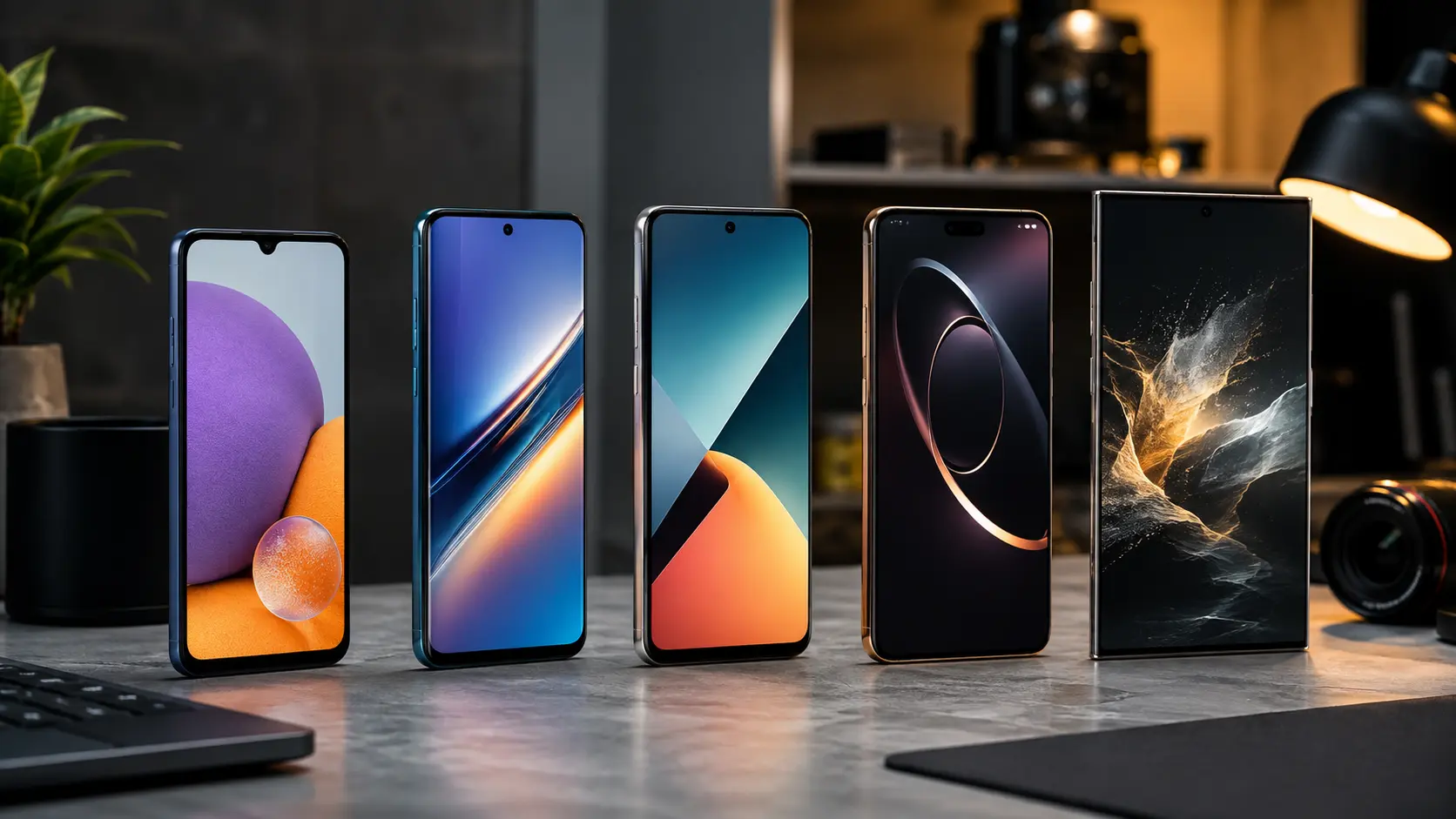
Buying a smartphone in 2026 is less about finding the phone with the longest specification sheet and more about finding the right balance of performance, cameras, battery life, software support and price. A $200 phone can now handle everyday tasks surprisingly well, while phones around $500 can deliver features that once belonged exclusively to flagships.
This guide breaks down the best phones under every budget in 2026, from affordable handsets to premium flagships. The recommendations focus on practical value rather than simply choosing the most expensive model. Prices and availability can vary significantly by country, retailer, taxes and promotions, so treat the budget ranges as general buying categories rather than fixed local prices.
Best Phones by Budget in 2026
The right budget depends on what you actually need. Spending more can improve cameras, gaming performance, displays and long-term usability, but the jump in real-world experience is not always proportional to the price.
| Budget | Recommended Pick | Best For |
|---|---|---|
| Under $200 | Motorola Moto G 2026 | Basic everyday use |
| Under $300 | Motorola Moto G Power 2026 | Battery and value |
| Under $500 | Google Pixel 10a | Camera and overall value |
| Around $600–$700 | Samsung Galaxy A57 | Balanced Android experience |
| Around $800–$900 | Google Pixel 11 / comparable premium models | Overall value |
| $900+ | Samsung Galaxy S26 / iPhone 17 | Premium performance |
| $1,000+ | Galaxy S26 Ultra / iPhone 17 Pro Max | Maximum capability |
Tom’s Guide’s August 2026 budget-phone testing similarly places the Pixel 10a among the strongest options under $500, while Motorola’s Moto G models are notable choices in the lower price ranges.
Best Phones Under $200
At this level, the priority should be reliability rather than flagship-style specifications. You should look for a usable display, dependable battery life, sufficient storage and software that does not make the phone frustrating to use.
1. Motorola Moto G 2026
The Motorola Moto G 2026 is a strong example of how inexpensive smartphones have improved. It is aimed at users who primarily need messaging, social media, browsing, streaming and basic photography without paying for unnecessary premium hardware.
Its biggest advantage is value. If your daily workload is light, spending several hundred dollars more may not produce a proportionate improvement.
Best for: Students, basic users and secondary phones.
Watch out for: Intensive gaming, demanding photography and heavy multitasking.
Best Phones Under $300
Moving toward $300 gives you more flexibility. Battery capacity, screen quality and processing power generally improve, making this range suitable for people who expect their phone to remain comfortable for several years.
1. Motorola Moto G Power 2026
The Moto G Power 2026 is particularly attractive for users who prioritize endurance. A large battery is useful for commuters, travelers and people who frequently use navigation, video and social apps throughout the day.
The important point is that battery life should be considered alongside charging speed and software efficiency. A huge battery is useful, but efficient hardware can be just as important.
Best for: Battery-focused buyers and everyday users.
Watch out for: Buyers wanting flagship-level cameras or gaming performance.
Best Phones Under $500
This is arguably the most interesting smartphone category in 2026. Phones under $500 can now offer excellent displays, capable processors, strong cameras and long software support.
1. Google Pixel 10a
The Google Pixel 10a is one of the clearest value recommendations in this category. Google lists it from $499, with a 6.3-inch 120Hz pOLED display, 5,100mAh battery, Tensor G4 processor and 8GB of RAM. It also includes a 48MP main camera and 13MP ultrawide camera.
Its strongest appeal is the combination of camera processing and Google’s software experience. For someone who wants good photographs without learning manual camera controls, the Pixel approach remains compelling.
The 10a is also a good reminder that megapixel counts do not tell the whole story. Image processing, stabilization, HDR and software can have a major effect on final photos.
Best for: Photography, clean software and long-term value.
Watch out for: Serious gamers who prioritize maximum sustained graphics performance.
Best Phones Around $600–$700
The upper mid-range segment is where buyers can often get the best combination of premium design and sensible pricing.
1. Samsung Galaxy A57
Samsung’s Galaxy A-series remains an important choice for people who want a familiar Android experience without paying flagship prices. The Galaxy A57 is particularly appealing when battery life, display quality and mainstream software features matter more than having the fastest possible processor.
It is also worth considering Samsung’s broader ecosystem. Someone already using Galaxy Buds, a Galaxy tablet or other Samsung products may gain more practical value from staying within the ecosystem.
Best for: Balanced Android use and Samsung ecosystem buyers.
Watch out for: Heavy gamers and enthusiasts who want flagship camera hardware.
Best Phones Around $800–$900
This range is increasingly competitive because previous-generation flagships and newer premium models can overlap in price.
1. Google Pixel 11
The Pixel 11 represents the type of premium phone that can make more expensive Pro models difficult to justify for average users. Recent testing from The Verge describes the $899 Pixel 11 as a particularly strong value proposition, with 12GB of RAM, 256GB of storage, Qi2 charging and a telephoto camera while retaining the newer Tensor G6 platform.
For buyers who care about photography, software intelligence and a relatively clean Android experience, it deserves serious consideration.
The important lesson here is to compare the standard premium model with Pro versions before spending extra. Many users will never use the specialized hardware that makes the most expensive phones cost significantly more.
Best for: General users who want premium features without going all the way to Ultra or Pro Max pricing.
Best Premium Phones in 2026
If budget is less important and you want maximum performance, camera capability and display quality, the flagship market offers several excellent choices.
1. Samsung Galaxy S26
The Galaxy S26 is a compact premium Android option with a 6.3-inch Dynamic AMOLED 2X display and 120Hz refresh rate. Samsung’s Pakistan specifications list a 50MP main camera, 10MP telephoto with 3x optical zoom, 12MP ultrawide camera and a 4,300mAh battery.
It is particularly attractive to users who want a premium Android phone without carrying one of the largest Ultra models.
Samsung also lists security support for the S26 through February 2033, which makes software longevity an important part of its value proposition.
Best for: Premium Android users, compact-phone buyers and Samsung ecosystem users.
2. Apple iPhone 17
The standard iPhone 17 is much more capable than the traditional idea of a “base” iPhone suggests. Apple lists a 6.3-inch OLED display with ProMotion up to 120Hz, an A19 chip, 256GB or 512GB storage options and IP68 water and dust resistance.
Its video capabilities, ecosystem integration and long-term software support make it a strong choice for users already invested in Apple devices.
The iPhone 17 is especially appealing if your priorities include video recording, social-media content, gaming performance and a polished overall experience.
Best for: iOS users, video creators and Apple ecosystem buyers.
Read More: Best Mobile Phones to Buy in 2026
Best Phones for Cameras
Camera quality is no longer determined simply by the number of lenses. Computational photography, sensor quality, stabilization and telephoto performance can matter more.
1. Samsung Galaxy S26 Ultra
For Android users who want maximum camera versatility, the Galaxy S26 Ultra is one of the strongest choices in 2026. Current camera-phone testing highlights its combination of zoom, ultrawide photography and consistent image processing.
It makes the most sense for photographers who regularly use different focal lengths rather than simply taking casual snapshots.
2. iPhone 17 Pro Max
The iPhone 17 Pro Max is particularly strong for video and natural-looking photography. TechRadar’s August 2026 camera testing ranks it among the leading camera phones, especially for users who value high-quality video capture and realistic image rendering.
Camera buying tip: Do not buy a phone because it has the highest megapixel number. Look at the complete camera system, stabilization, telephoto capability, video features and image processing.
Best Phones for Gaming
Gaming changes the buying equation. A phone that is excellent for photography may not be the best option for sustained high-performance gaming.
1. Samsung Galaxy S26
The S26 offers flagship-class processing and a 120Hz display, making it suitable for demanding games while remaining relatively compact. Samsung lists a deca-core processor configuration and 120Hz display for the model.
2. Premium Performance Phones
If gaming is your main priority, compare flagship chip performance, cooling, sustained performance and battery endurance rather than focusing only on benchmark scores.
A phone may achieve an impressive peak benchmark result but still throttle during long gaming sessions. For serious players, thermal management can be as important as the processor itself.
What to Look for Before Buying
The best phone for you depends on more than its price tag.
1. Processor and RAM
For normal users, a modern mid-range processor is usually sufficient for browsing, streaming, messaging and social media. Gamers and creators should consider higher-end silicon and adequate RAM.
2. Display
A 120Hz refresh rate makes scrolling and animations feel smoother. OLED or AMOLED panels also generally provide stronger contrast than conventional LCD screens.
3. Battery and Charging
Battery capacity is only one part of the equation. Check charging speed, efficiency and your expected daily workload. A 5,000mAh-class battery can be excellent for a mid-range phone, while efficient software can further extend endurance.
4. Software Support
A cheaper phone that receives updates for years can provide better long-term value than a slightly faster phone with poor software support.
5. Storage
128GB may be enough for light users, but 256GB is a safer choice if you take lots of photos, download games or record high-resolution video.
Common Smartphone Buying Mistakes
1. Buying More Power Than You Need
Not everyone needs an Ultra phone. If your activities are mostly messaging, YouTube, browsing and photography, a quality mid-range model can be a smarter purchase.
2. Ignoring Software Support
Hardware can remain fast enough for years, but outdated software can eventually become a bigger problem. Check the manufacturer’s update policy before buying.
3. Focusing Only on Camera Megapixels
A 200MP camera is not automatically better than a 50MP camera. Sensor size, lenses, stabilization and image processing all influence results.
4. Forgetting Local Compatibility
Before purchasing an imported phone, check network-band compatibility, warranty coverage, SIM functionality and whether the device is officially approved for your market.
FAQ’s About Best Phones Under Every Budget
What is the best phone under $500 in 2026?
The Google Pixel 10a is one of the strongest choices under $500, particularly for buyers who prioritize photography, software and overall value. Google lists its starting price at $499.
Which phone is best for photography in 2026?
The Samsung Galaxy S26 Ultra and iPhone 17 Pro Max are among the strongest high-end camera choices, with different strengths in zoom, photography and video.
Is a $300 phone good enough in 2026?
Yes. A good $300-class phone can comfortably handle everyday communication, social media, streaming and browsing. The main compromises are usually in camera quality, premium materials and high-end performance.
Should I buy an iPhone or Android phone?
Choose iPhone if you value Apple’s ecosystem, video capabilities and simple device integration. Android is generally better for buyers who want more hardware variety, customization and choice across different price ranges.
How much RAM does a phone need in 2026?
For normal use, 8GB is a sensible target. Heavy multitasking and premium Android models can benefit from 12GB or more, but RAM should not be considered in isolation from processor and software optimization.
Is a flagship phone worth buying?
A flagship is worthwhile if you care about top-tier cameras, gaming performance, displays, premium construction or long-term high-end performance. Otherwise, a strong mid-range phone can offer considerably better value.
Conclusion
The best phone in 2026 is not necessarily the most expensive one. Buyers under $200 should focus on reliability and battery life, while the $300–$500 range offers some of the strongest value for everyday users. The Pixel 10a is particularly compelling around the $500 mark, while premium choices such as the Galaxy S26 and iPhone 17 provide a substantial step up in performance and features.
At the very top of the market, the Galaxy S26 Ultra and iPhone 17 Pro Max make sense for buyers who genuinely need exceptional cameras, video, performance and premium hardware. For everyone else, the smartest strategy is to identify your most important feature first, set a firm budget and compare phones within that category rather than automatically buying the highest-priced model.
