

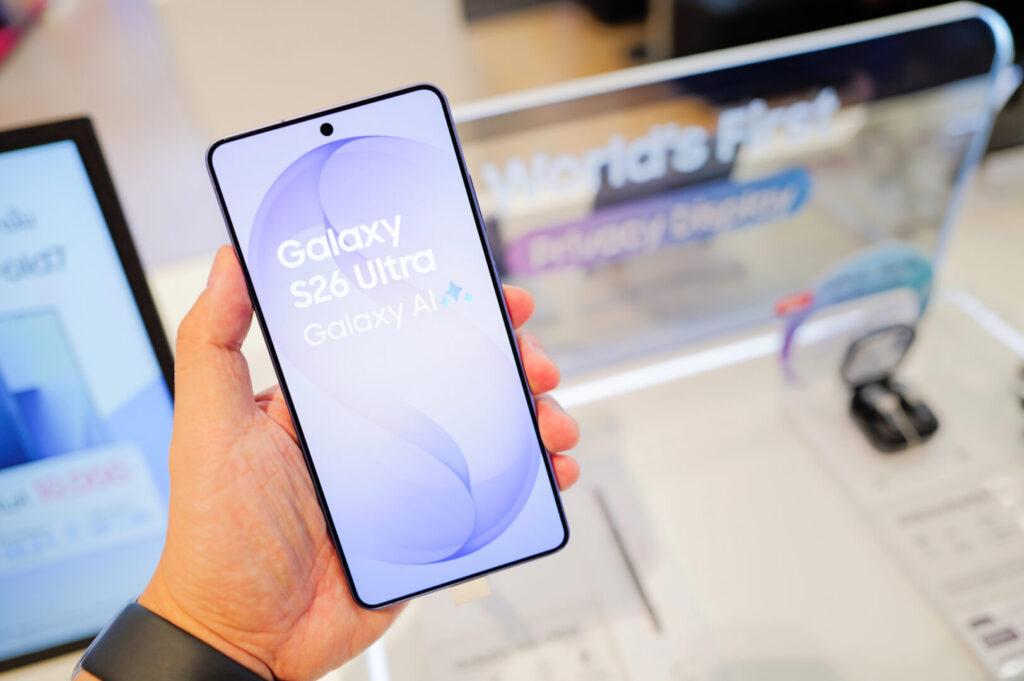
Artificial intelligence has quietly become the operating system of the modern flagship, and the best AI phones 2026 has to offer prove it. A top phone is now judged less by megapixels and more by how well its assistant understands you, edits your photos, and translates a conversation in real time.
Dedicated neural processing units run large language models directly on the device, so the smartest features work instantly and privately. This guide rounds up the ten phones that do AI best in 2026 — Galaxy AI, Apple Intelligence, and Google’s Gemini-first approach, plus the mid-range and foldable standouts that punch above their price.
Our Quick Picks
- Best overall: Samsung Galaxy S26 Ultra — the most complete AI toolkit, with your choice of assistant.
- Smartest AI brain: Google Pixel 10 Pro XL — Magic Cue, Camera Coach, and the best call-screening AI.
- Best for iOS users: iPhone 17 Pro Max — Apple Intelligence: private, polished, deeply integrated.
- Best battery life: OnePlus 15 — 7,300mAh cell with flagship-grade AI efficiency.
- Best for AI photography: Xiaomi 15 Ultra — an AI Creativity Assistant for serious photographers.
- Best AI button: HONOR Magic8 Pro — one-press AI tools with deepfake and voice-clone detection.
- Best for productivity: OPPO Find X9 Pro — AI Mind Space turns screenshots and notes into plans.
- Best for creators: vivo X300 Pro — AI Image Studio plus AI-generated video with sound.
- Best foldable: Motorola Razr 60 Ultra — Moto AI on a foldable canvas.
- Best affordable: Nothing Phone 3a — a clever AI hub for a quarter of flagship money.
What Makes a Phone an AI Phone in 2026?
A true AI phone is defined by its silicon, not its marketing. Every 2026 flagship ships with a dedicated Neural Processing Unit — a specialised chip inside the main processor that handles machine-learning tasks directly on the device, without phoning home to the cloud.
These NPUs process tens of trillions of operations per second, enough to run large language models locally. Real-time translation, computational photography, and predictive suggestions happen instantly, privately, and often offline.
The differentiator this year is how each maker stitches on-device and cloud AI together. Apple keeps almost everything local, routing the rest through Private Cloud Compute. Google built the Tensor G5 around its on-device Gemini Nano model, sending only the heaviest generative jobs to the cloud. Samsung goes furthest, offering a “process data only on device” toggle and your choice of assistant: Gemini, Perplexity, or Bixby.
Top AI Features to Look for in 2026
Proactive assistance. The best AI no longer waits for commands. Magic Cue pulls flight details from your inbox while you are on a call; Samsung’s Now Brief greets you with your schedule, reservations, and reminders each morning. The phone acts before you ask.
AI photography and editing. Scene recognition, generative editing, object removal, and AI-boosted zoom now define camera quality more than sensor size. Pixel’s Camera Coach even teaches you to frame better shots before you press the shutter.
Real-time translation and call AI. Live translation, call screening, and automatic call summaries are now standard on flagships — and Pixel’s fully automated Call Screen remains the benchmark.
AI battery management. Phones learn your sleep and work patterns to optimise charging speeds and power draw, actively extending how long the hardware lasts.
Writing and productivity tools. Summarising articles, rewriting text, transcribing meetings, and drafting emails are baked into every platform now — system-wide, not inside one app.
1. Samsung Galaxy S26 Ultra — Best Overall AI Phone
Samsung pairs its most powerful hardware ever with the deepest, most flexible AI toolkit of any phone here. Unveiled on 25 February 2026 and on shelves since 11 March, it is Samsung’s third-generation AI flagship, and it shows.
Key specs: $1,299.99 for 256GB (512GB/1TB tiers above); Snapdragon 8 Elite Gen 5 for Galaxy, whose bigger neural engine runs Generative Edit on-device; 6.9-inch QHD+ Dynamic AMOLED 2X at 120Hz; 200MP main, 50MP ultra-wide, 50MP 5x periscope telephoto, and 10MP 3x telephoto cameras; up to 16GB RAM; 5,000mAh battery with 60W wired and fast wireless charging; 7 years of OS and security updates.
The Galaxy AI suite is the most useful on any phone: Now Brief delivers a personalised daily digest; Now Nudge understands what is on your screen and suggests actions; Photo Assist accepts written prompts; and Advanced Audio Eraser strips background noise from video in real time, even inside Instagram and YouTube. Best of all, you choose your assistant — Gemini, Perplexity, or an upgraded Bixby with real-time web search. Add the debuting Privacy Display, which blocks side-angle viewing without a screen protector.
Verdict: The most complete AI phone on the market — for those who want everything and do not mind a big, heavy phone.
2. Google Pixel 10 Pro XL — Best for Pure AI Intelligence
If the Galaxy is the Swiss Army knife, the Pixel 10 Pro XL is the scalpel. The first phone with Google’s Tensor G5 chip, built specifically to push more of Gemini’s smarts on-device, it is arguably the “smartest” phone of 2026.
Key specs: $1,199 for 256GB, often discounted to $899–$949; Tensor G5 chip; 6.8-inch OLED at 120Hz; 50MP main, 48MP ultra-wide, and 48MP 5x telephoto cameras with up to 100x Pro Res Zoom; 16GB RAM; 5,200mAh battery with 45W wired and Qi2.2 wireless charging; 7 years of OS, security, and Pixel Drop updates.
Magic Cue surfaces the right information at the right moment — like pulling flight details from Gmail while you call the airline — all processed locally. Camera Coach teaches framing, lighting, and composition step by step. Gemini with Veo generates short video from a text description, and the Magic Editor tools (Magic Eraser, Best Take, Add Me, Super Res Zoom) remain class-leading. Call AI is where Pixel still dominates: Call Notes summaries, Hold for Me, and fully automated Call Screen.
Verdict: The best AI phone for photographers and Google-service users. Cheaper than its rivals, smarter in daily use, and unmatched at calls.
3. Apple iPhone 17 Pro Max — Best AI Phone for iOS Users
Apple does AI the Apple way: tightly integrated into every iOS app, privacy-first, and polished to a fault. Apple Intelligence runs as much as possible on-device and routes the rest through Private Cloud Compute, which Apple says is cryptographically prevented from retaining your data.
At $1,199 for 256GB (up to $1,999 for the first-ever 2TB iPhone), it runs the A19 Pro with a 16-core Neural Engine. Note that US models are eSIM-only.
Key specs: 6.9-inch Super Retina XDR OLED; three 48MP cameras (main, ultra-wide, telephoto with 4x and 8x optical-quality zoom) plus a Center Stage front camera; 12GB RAM with up to 2TB storage; around 39 hours of video playback.
Live Translation works across Messages, FaceTime captions, and the Phone app, plus compatible AirPods. Visual Intelligence identifies objects, translates menus, and creates calendar events from posters. Writing Tools summarise, proofread, and rewrite text system-wide and can call up ChatGPT directly. Photos has a Clean Up option like Magic Eraser, natural-language search, and Memories animations — and Siri is more conversational, tapping ChatGPT for tougher queries.
Verdict: Choose Apple if you want powerful AI without compromising on privacy, and you already live in the iPhone, Mac, and Apple Watch ecosystem.
4. OnePlus 15 — Best Battery Life with AI Smarts
OnePlus has gone all-in on endurance: a 7,300mAh silicon-nanostack battery delivers a 25+ hour rating, the longest of any flagship. AI efficiency is the story here — adaptive battery management and smart refresh-rate control optimise performance without draining the cell.
The Snapdragon 8 Elite chipset delivers NPU performance on par with Samsung’s flagship silicon, so the AI smarts are no downgrade. The 6.82-inch AMOLED display reaches 4,500 nits peak brightness, exceeding even Samsung’s brightest panels.
AI highlights: AI Scan for capturing documents at difficult angles; AI Portrait Glow and AI Perfect Shot for smarter photography; AI Recorder and Intelligent Search; and Mind Space, which saves information and uses Gemini to turn it into tasks and plans.
Verdict: If outright battery endurance with flagship-grade AI is your priority, the OnePlus 15 is hard to beat.
5. Xiaomi 15 Ultra — Best for AI-Powered Photography
Xiaomi’s AI Creativity Assistant integrates directly into the camera and gallery, and it is the most photographer-focused AI suite outside Pixel and Samsung: AI Image Enhancement, AI Reflection Removal, AI Film creation, and AI Erase Pro for object removal, with AI Image Expansion promised in future updates.
For videographers, it records 4K 120fps cinematic slow motion on main and telephoto cameras, with Dolby Vision across all focal lengths. The 1-inch sensor gives shallower depth of field and superior dynamic range. HyperOS folds AI into everyday use too — AI Writing, AI Speech Recognition, AI Search, AI Dynamic Wallpapers, and Gemini Live that can converse about what your camera sees.
Verdict: Professional-grade imaging AI at a competitive price, best for users who prioritise camera versatility — though availability varies by region.
6. HONOR Magic8 Pro — Best AI Button Experience
HONOR’s approach is all about speed of access. A dedicated AI Button gives one-press entry to AI tools, AI Screen Suggestions recommend actions based on what is on your display, and the AI Settings Agent changes settings for you via voice commands.
The AI Photos Agent handles object removal, enhancement, expansion, and style application. The phone works fully with Gemini and Gemini Live, and HONOR includes AI security tools designed to detect deepfakes and voice cloning — a genuinely useful safeguard in 2026.
Verdict: A smart pick for instant AI access and scam protection. The anti-deepfake tools are a real differentiator.
7. OPPO Find X9 Pro — Best for AI Productivity
OPPO built the Find X9 Pro around AI Mind Space, a digital memory assistant. Press the Snap Key to save screenshots, voice notes, and images, and the AI organises them for later retrieval — it can even work with Gemini to turn travel details into a full itinerary.
AI Recording transcribes conversations, identifies speakers, and creates summaries automatically, while AI Writer helps draft emails and social posts. For knowledge workers, this is one of the most practical AI suites on any phone.
Verdict: The productivity phone of 2026. Choose it if your phone is your office.
8. vivo X300 Pro — Best for AI Creators
vivo targets creators with AI Image Studio for editing and object removal, and — uniquely — supports Google’s Veo 3 through Gemini to generate videos with sound. DocMaster summarises, rewrites, expands, and translates documents, while AI Search and AI Captions transcribe conversations and translate videos or meetings.
Verdict: The creator’s AI phone — generative video with sound plus a full document suite makes it a one-person studio.
9. Motorola Razr 60 Ultra — Best Foldable AI Phone
Foldables add a new dimension to AI: more screen means more room for AI-powered multitasking. The Razr 60 Ultra brings Moto AI to the flip form factor — Catch Me Up summarises notifications and missed updates, Pay Attention records and summarises meetings, and Remember This saves important information for later recall.
Gemini integration adds creative tools on top, and the foldable design makes AI-assisted photography and split-screen multitasking genuinely more useful than on a slab phone.
Verdict: The best way to get flagship AI on a foldable — ideal for multitaskers who want a big screen in a pocketable body.
10. Nothing Phone 3a — Best Affordable AI Phone
You do not need flagship money for real AI. The Nothing Phone 3a costs roughly a quarter of the phones above, yet it carries Essential Space — a smart scrapbook that stores and sorts your notes, screenshots, and saved links.
Press the dedicated Essential Key once for a screenshot, or hold it to record a voice memo. AI analyses each entry: pulling text from photos, transcribing voice recordings, and making everything searchable. Essential Search digs through your calendar, contacts, gallery, and apps, answering natural-language questions. Standard Android AI features like Circle to Search and Gemini Live come along as well.
Verdict: The best cheap AI phone, period — a genuinely useful AI hub with Nothing’s signature glyphs and widget-based OS.
AI Features Head-to-Head: Galaxy AI vs Apple Intelligence vs Gemini
Specs do not tell the whole story. Here is how the three leading platforms handle the jobs you will actually use every day:
| AI job | Galaxy S26 Ultra | iPhone 17 Pro Max | Pixel 10 Pro XL |
|---|---|---|---|
| Assistant | Your choice: Gemini, Perplexity, or Bixby | Siri + ChatGPT handoff | Gemini, deepest system integration |
| Call screening | Call Assist text-based answering | Call Screening answers unknown callers, plus Hold Assist | Best in class: automated Call Screen, Hold for Me, Call Notes |
| AI photo editing | Generative Edit, Sketch to Image | Clean Up (lighter touch, most natural) | Magic Editor, Add Me, Best Take, Ask Photos edits |
| Live translation | Calls, chats, Interpreter mode, incl. Galaxy Buds | Messages, FaceTime captions, Phone app, AirPods | Live Translate in calls, chat, and camera |
| Proactive help | Now Brief daily briefing | Priority Notifications, smart summaries | Magic Cue surfaces context mid-call and mid-chat |
On-Device vs Cloud AI: Why It Matters
All three companies advertise “on-device AI,” but the split is real and worth understanding. On-device features run on the phone’s NPU: they work in aeroplane mode, respond instantly, and your data never leaves the phone. Cloud features are more powerful but need a connection and send your request to a server.
Apple is the strictest: most Apple Intelligence tasks run on-device, and heavier jobs go through Private Cloud Compute, which Apple says cannot retain your data. Google built the Tensor G5 around its on-device Gemini Nano model — Magic Cue, Call Notes, and summaries process locally — while big generative jobs like Veo video go to the cloud. Samsung is the most configurable: a “process data only on device” toggle forces everything local for maximum privacy.
How AI Improves Your Everyday Phone Experience
Beyond the headline features, AI quietly upgrades the basics. Photos improve automatically — lighting, colour balance, and focus are adjusted before you notice. Battery life improves because smart power management learns your habits and cuts wasted energy. Security gets stronger: AI detects unusual activity, screens scam calls, and even flags deepfakes and voice cloning.
Assistants are simply smarter. They understand context, remember preferences, predict needs, and suggest follow-ups after business calls. Communication gets easier, with real-time translation breaking down language barriers across calls, chats, and video. And even mid-range phones now produce flagship-level photos — in 2026, camera quality is driven by software, not just hardware.
How to Choose the Right AI Phone in 2026
Choosing among the best AI phones 2026 offers depends on your priorities. Pick Google for the smartest, most intuitive assistant. Pick Samsung for the best productivity and ecosystem connectivity. Pick Apple for powerful AI without compromising on privacy. Pick Xiaomi or vivo for specialised needs like photography or content creation.
Budget matters too. Each maker’s cheaper flagship runs the same AI platform with modest trade-offs: the Pixel 10 at $799, the iPhone 17 at $799, and the Galaxy S26 at $899.99. If you are weighing the ultra flagships on more than just AI, our roundup of the best ultra phones of 2026 shows where each top-tier model stands overall.
For the fundamentals beyond AI — screen quality, battery, chipset, and cameras — our complete smartphone buying guide for 2026 walks through every decision step by step.
Cheaper AI Picks: Flagship Brains, Smaller Bills
You do not need a $1,200+ flagship for real AI. Each maker’s cheaper flagship runs the same AI platform with only modest hardware trade-offs:
- Google Pixel 10 ($799): the best cheap AI phone, period. Same Tensor G5 chip, so Magic Cue, Call Screen, and Gemini Nano run identically. You mainly give up RAM, zoom hardware, and screen size — and it gets the same 7 years of updates.
- Apple iPhone 17 ($799): the A19 chip runs the full Apple Intelligence suite. You lose the telephoto camera and some battery, not any AI.
- Samsung Galaxy S26 ($899.99): the complete Galaxy AI toolkit, including Now Brief and Generative Edit, in a smaller body with the same 7-year update promise.
One warning: avoid true budget phones in the $200–$400 range if AI is why you are buying. They typically lack the NPU muscle, so features run in the cloud, run slowly, or do not ship at all.

Frequently Asked Questions (FAQs)
What is the best overall AI phone in 2026?
The Samsung Galaxy S26 Ultra takes the crown for the most comprehensive AI package: Galaxy AI with Gemini integration, a 200MP camera system, the exclusive Privacy Display, and your choice of assistant — Gemini, Perplexity, or Bixby. The Pixel 10 Pro XL is arguably the “smartest” device if deep, AI-first software is your priority.
Which AI phone has the best camera in 2026?
The Pixel 10 Pro XL has the smartest camera AI — Camera Coach, on-device generative editing, and up to 100x Pro Res Zoom. The Galaxy S26 Ultra counters with the highest resolution: a 200MP main sensor plus a four-lens zoom system, so it wins on raw versatility. Both beat the iPhone 17 Pro Max for AI photo editing, though the iPhone’s triple 48MP system shoots excellent, natural-looking photos.
How do AI phones improve camera performance?
AI phones use machine learning to recognise scenes, optimise settings, reduce noise, stabilise footage, and suggest creative compositions. Features like Magic Eraser, Best Take, and generative editing can rescue flawed shots entirely — better photos and videos without professional skills.
Do AI features on smartphones drain the battery faster?
Surprisingly, no. Most modern AI features actually extend battery life thanks to adaptive power systems that learn your habits. Older devices running AI-heavy apps may drain faster, but new AI phones — especially the OnePlus 15 with its 7,300mAh cell — are more efficient than their predecessors.
Do you need a flagship phone to get good AI features in 2026?
Not necessarily. Even mid-range phones now produce flagship-level photos thanks to AI image pipelines. The Nothing Phone 3a and cheaper flagships — Pixel 10, iPhone 17, Galaxy S26 — run the full AI suites of their bigger siblings. Only true $200–$400 budget phones lack the NPU power for real on-device AI.
What makes a smartphone an “AI phone” in 2026?
AI phones are designed with advanced on-device intelligence: a dedicated neural processing unit, AI-driven photography, predictive assistants, real-time translation, and adaptive system optimisations. The key marker is whether the phone can run meaningful AI tasks locally, privately, and quickly.
Do I have to pay for AI on my smartphone?
Currently, most brands are in a “the first hit is free” phase: AI features are baked into each handset from the factory with no extra charge. That is changing, though — tasks needing heavy cloud processing, like image generation, may soon require paid-for tokens or subscriptions.
Is on-device AI better than cloud AI on smartphones?
Each has its place. On-device AI is faster, works offline, and keeps your data private — which is why Apple and Google prioritise it. Cloud AI is more powerful and handles heavy generative tasks phone chips cannot. The best AI phones 2026 has to offer give you a smart blend of both, with the option to lock everything on-device if privacy matters most.
Can I keep all AI processing on my phone, rather than the cloud?
Yes, mostly. Most phones let you restrict AI processing to on-device only — Samsung even has a dedicated “process data only on device” toggle. This may lock you out of certain features, and some tasks may process more slowly. How much stays local varies between brands and apps.
Do AI features work without an internet connection?
Many do. Most 2026 AI phones use on-device AI for core tasks like camera enhancements, predictive typing, transcription, and summaries, so they keep working offline. Features needing cloud processing — generative video, some translation languages, web-connected assistants — still need a connection.
How many years of updates do the best AI phones get?
Samsung and Google both promise 7 years of OS and security updates for the Galaxy S26 Ultra and Pixel 10 Pro XL, so new AI features keep arriving via One UI updates and Pixel Drops into the 2030s. Apple makes no formal commitment, but recent iPhones have historically received roughly 6–7 years of iOS updates. Long support matters more on AI phones than ever, because many headline features ship in software updates rather than with the hardware.
Should I wait for the next AI phone or buy now?
Buy now if you need a phone. Current flagships already run mature AI platforms, and their 7-year update promises mean new AI features will keep arriving long after purchase. Waiting only makes sense if a specific launch is weeks away — otherwise you are just delaying months of useful AI for incremental gains.
