

Choosing between iPhone vs Samsung in 2026 is harder than ever, because both companies now make genuinely excellent flagships. Apple leans on camera control, video quality and ecosystem polish, while Samsung pushes zoom range, productivity hardware and AI flexibility.
This guide merges what the five best comparison reviews of the year found, so you get every important difference in one place — from displays and chips to battery life, prices and long-term value. Both brands dominate the review charts — see our tech reviews of 2026 for more head-to-head verdicts.
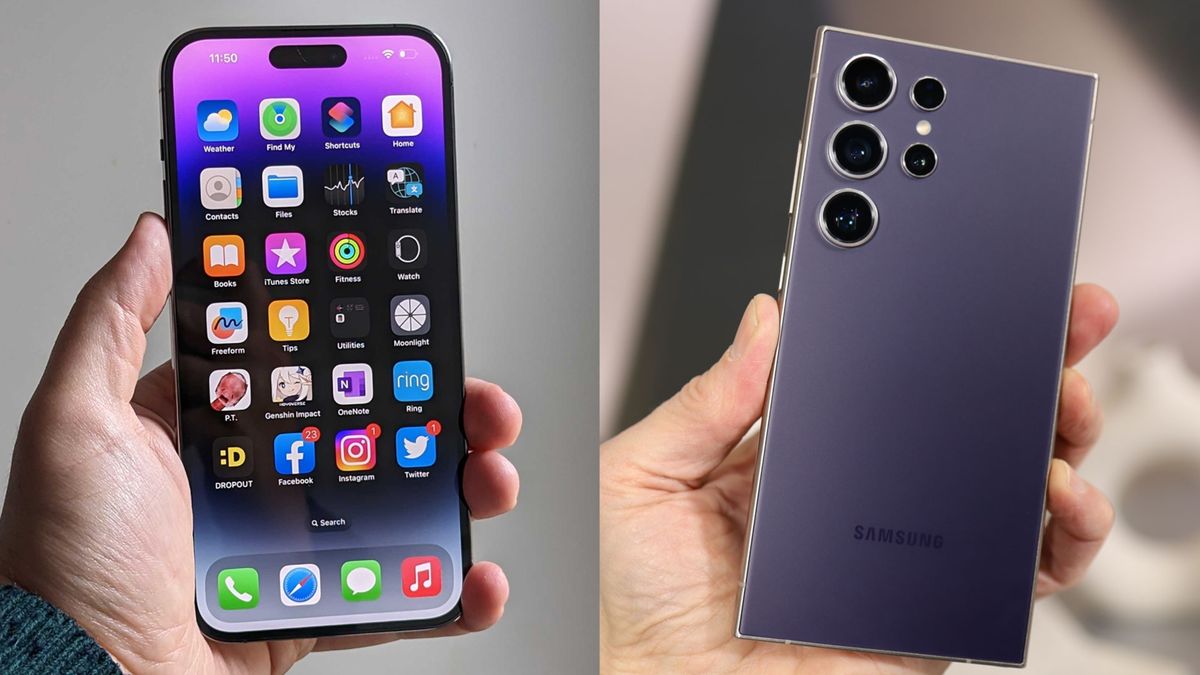
iPhone vs Samsung at a Glance
There is no single winner in the iPhone vs Samsung debate this year — every major review lands in the same place: the better phone is the one that fits how you actually use it. The list below puts the two top flagships side by side so you can see exactly where each one spends its $1,299.
- Starting price: $1,299 (iPhone 18 Pro Max, 256GB) vs $1,299.99 (Galaxy S26 Ultra, 256GB)
- Display: 6.9-inch OLED, 120Hz, 3,000 nits (iPhone) vs 6.9-inch QHD+ AMOLED, 120Hz, 2,600 nits (Samsung)
- Weight: 249g vs 214g
- Chip: A20 Pro (2nm) vs Snapdragon 8 Elite Gen 5 for Galaxy
- RAM: 12GB vs 12GB / 16GB
- Storage: up to 2TB vs up to 1TB
- Main camera: 48MP variable aperture vs 200MP
- Zoom: 4x telephoto (8x optical-quality) vs dual 3x + 5x periscope (10x optical-quality)
- Battery: 5,567mAh (45h video claim) vs 5,000mAh (31h video claim)
- Charging: 50% in about 15 minutes vs about 75% in 30 minutes
- Extras: Camera Control button vs S Pen + DeX + Privacy Display
- Water resistance: IP68 on both
Design and Build Quality
Samsung wins the portability battle this year. At 214 grams and 7.9mm thin, the Galaxy S26 Ultra is noticeably easier to carry and use than the 249-gram, 8.75mm iPhone 18 Pro Max — a difference you feel within the first hour, especially reading in bed. Apple spent that extra weight on a much bigger battery, so it is a deliberate tradeoff, not sloppy engineering.
Both phones are properly premium: Apple uses an aluminum unibody with Ceramic Shield 2 glass, Samsung an aluminum frame with Gorilla Armor 2, and both carry IP68 dust and water resistance. The iPhone feels denser and more solid in hand with better scratch resistance, while Samsung’s anti-reflective coating keeps the screen readable outdoors. One quirk worth knowing — the standard Galaxy S26’s raised camera island makes it wobble on a flat table.
Display: Brightness, Smoothness and Privacy
Apple’s panel goes brighter — 3,000 nits outdoors against Samsung’s 2,600 — and drops to 1 nit for its Always-On display, so it wins for sunlight readability. Samsung answers with a sharper QHD+ resolution and an anti-reflective coating that cuts glare, plus a trick no iPhone has: the Privacy Display.
That Privacy Display narrows the viewing angle so seatmates on a train or plane cannot read your screen, and you can enable it per app — genuinely useful for banking on the go. Both flagships run at 120Hz, so scrolling is equally smooth. One warning from the budget end: the standard iPhone 16 is still stuck at 60Hz, which reviewers call hard to justify in 2026 — stick to the Pro models if refresh rate matters to you.
Performance: Chips, RAM and Everyday Speed
The A20 Pro is the first iPhone chip built on a 2nm process, with a GPU Apple claims is 40% faster than the A19 Pro and a redesigned vapor chamber for sustained gaming and video exports. Samsung’s Snapdragon 8 Elite Gen 5 for Galaxy counters with 12GB of RAM standard (16GB on the 1TB model), which keeps a dozen apps alive in the background without reloading.
In daily use both are so fast the difference disappears — Apple tends to lead in sustained graphics and video work, Samsung in heavy multitasking and DeX desktop workflows. Thermals differ slightly: iPhones warm gradually under load while Galaxies heat faster but cool quickly. For most buyers, either chip will feel effortless for years.
Camera Systems: Variable Aperture vs 200MP
Apple’s headline upgrade is a 48MP Fusion main camera with a true variable aperture — six physical blades shifting between f/1.48 and f/4.0. Wide open, you get brighter low-light shots; stopped down, sharper group photos and landscapes with real depth-of-field control from the Camera app.
Samsung bets on brute resolution instead: a 200MP main sensor behind a bright f/1.4 lens that captures enormous detail you can crop into later and still print. If you enjoy manual control and depth effects, the iPhone is more fun; if you want maximum detail from every frame, Samsung wins. Note Samsung’s processing can run vivid — colors pop, but not always accurately.
Zoom: One Telephoto vs Two
Zoom is Samsung’s clearest hardware win. The S26 Ultra carries two telephotos — a 10MP 3x for portraits and a 50MP 5x periscope — delivering 10x optical-quality shots and up to 100x digital. The iPhone 18 Pro Max has a single excellent 48MP 4x telephoto that crops to 8x optical-quality.
Apple’s 4x lens is superb for portraits and everyday reach, but for concerts, sports or wildlife, Samsung’s longer lenses capture usable shots the iPhone simply cannot. The gap is even wider on standard models: the base iPhone 17 has no telephoto at all, while the Galaxy S26 includes a proper 3x lens.
Video Recording
Video remains Apple’s fortress. The iPhone 18 Pro Max records 4K Dolby Vision HDR at up to 120fps, with ProRes and Log for professional editing and Cinematic effects you can adjust after shooting. Color consistency across lenses is the best in the business.
Samsung offers 8K recording and 4K at 120fps with very good stabilization, which looks great on paper. But creators editing in Final Cut or DaVinci Resolve still pick the iPhone for its pro formats and predictable color. If video is your job, this category alone can decide the purchase.
Battery Life and Charging
Apple fitted its biggest battery ever — 5,567mAh, rated for up to 45 hours of video playback — while Samsung’s 5,000mAh cell is rated for 31 hours. Treat those numbers cautiously: they come from different test methods, so it is not a clean win. In real-world use both comfortably survive a full day, with the iPhone holding more reserve on heavy days and better standby efficiency.
Charging favors Samsung for wired speed: about 75% in 30 minutes on a 60W charger, versus roughly 50% in 15 minutes for the iPhone. Both do 25W wireless. Heavy users who top up in short bursts will appreciate Samsung’s pace; everyone else will be fine either way.
AI Features and Productivity Tools
Samsung’s Galaxy AI is the more mature toolkit right now — Photo Assist, Now Brief, Now Nudge, Circle to Search, Live Translate and Chat Assist, with built-in access to Gemini and Perplexity. The S Pen lives inside the phone, needs no pairing or charging, and handles notes, signatures and precise photo edits; DeX turns the phone into a desktop on an external monitor.
Apple’s answer is ecosystem depth rather than feature count: Apple Intelligence with on-device processing plus Private Cloud Compute, and the new Siri AI in beta on iOS 27. One catch — upcoming on-device Siri features are expected to need 12GB of RAM, which would exclude the base iPhone 17’s 8GB configuration. Buyers invested in Mac, iPad and Apple Watch may still get more daily value from cross-device continuity than from any single AI trick.
Software, Ecosystem and Long-Term Updates
This is usually the deciding factor, and it has little to do with hardware. iOS brings tighter integration with Mac, iPad, AirPods and Apple Watch — AirDrop, Handoff, iMessage and FaceTime — with 6 to 7 years of software support. Android 16 with One UI offers deeper customization, sideloading, default app choices and better multitasking gestures, and Samsung now promises 7 years of OS updates too.
Beginners tend to adapt faster to iOS; power users usually prefer Samsung’s flexibility. Privacy defaults are stronger on iPhone, while Android gives you control over the file system and defaults. Ecosystem lock-in is real on both sides — most buyers should simply stay with whatever their other devices already run.
Price and Value for Money
Both top flagships open at $1,299 with 256GB, but the value story diverges fast. Samsung routinely discounts — a $200 instant rebate is common — and its aggressive trade-in bundles make street prices much friendlier. Apple’s 2TB ceiling ($2,499) serves heavy video shooters, but storage upgrades are expensive.
Long-term, iPhones hold resale value far better, while Galaxies depreciate faster but become better deals as prices settle. In the UK the gap is stark: £1,449 for the S26 Ultra against £1,199 for the iPhone 17 Pro Max. Check carrier and bank offers before deciding on list price alone — both brands run frequent promotions.
Final Verdict: Which Should You Buy in 2026?
Buy the iPhone if you want the best video recording, the longest battery headroom, the brightest display, a variable-aperture camera, more than 1TB of storage — or you already live in Apple’s ecosystem. It is the refinement pick: polished, predictable, and effortless for years.
Buy the Samsung Galaxy if you want long-range zoom, the S Pen, DeX desktop mode, heavier multitasking, Android flexibility, or the Privacy Display. It is the capability pick: more features, more versatility, more control.
Neither choice is wrong. Reviewers across all five comparisons agree on one thing — the best phone is not the one with the longest spec sheet, but the one that fits your life long after the novelty fades.

Beyond phones, our best gadgets of 2026 covers the ecosystem gear — watches, buds and tablets — that pairs with each platform.
Frequently Asked Questions
Is the Samsung Galaxy S26 Ultra better than the iPhone 18 Pro Max?
It depends on your priorities. Samsung packs in more features — zoom, stylus, DeX and AI tools — while Apple delivers more consistency in video, battery efficiency and long-term polish. Match the strengths to your daily use, not the marketing.
Which phone has the better camera?
Samsung leads in zoom range and versatility thanks to its dual telephoto system and 200MP sensor. Apple leads in video quality, color accuracy and the creative control of its variable-aperture main camera. For stills at a distance pick Samsung; for video pick iPhone.
Which phone lasts longer — iPhone or Samsung?
Both now promise around seven years of software updates, but iPhones historically receive support the longest and hold resale value better. On battery, the iPhone 18 Pro Max’s larger cell gives it more headroom on heavy days, though both last a full day.
Should I switch from iPhone to Samsung (or vice versa)?
Switching costs are real: apps, accessories, watches and services tie you to an ecosystem. Only switch if the other side offers something you will genuinely use daily — like the S Pen or DeX on Samsung, or Apple’s video and continuity features on iPhone. Otherwise, stay and upgrade within your ecosystem.
Which offers better value for money?
Samsung usually wins on upfront value thanks to frequent discounts and trade-in bundles, and its prices improve over time. Apple wins on total cost of ownership because iPhones depreciate slower. Buy Samsung on sale; buy iPhone for the long hold.
