

Finding the best portable projectors 2026 has to offer means looking past the spec sheet — because in this category, the marketing sheet and the wall rarely agree. We studied the leading expert rankings and hands-on reviews, merged everything they cover, and rebuilt it into one complete guide: top picks for travel, outdoors, and home theater, a plain-English buying breakdown, and honest answers to the questions shoppers actually ask.
Best Portable Projectors of 2026 at a Glance
The short answer: the LG CineBeam Q (~$800) delivers the best picture quality in a portable form, the Anker Nebula Capsule 3 (~$500) is the travel pick that fits in a jacket pocket, the XGIMI MoGo 4 ($499) is the best smart-TV-like value, the Nebula Mars 3 Air (~$600) owns backyard movie nights, and the BenQ GP100A (~$899) is the brightness king for rooms that are not pitch dark.
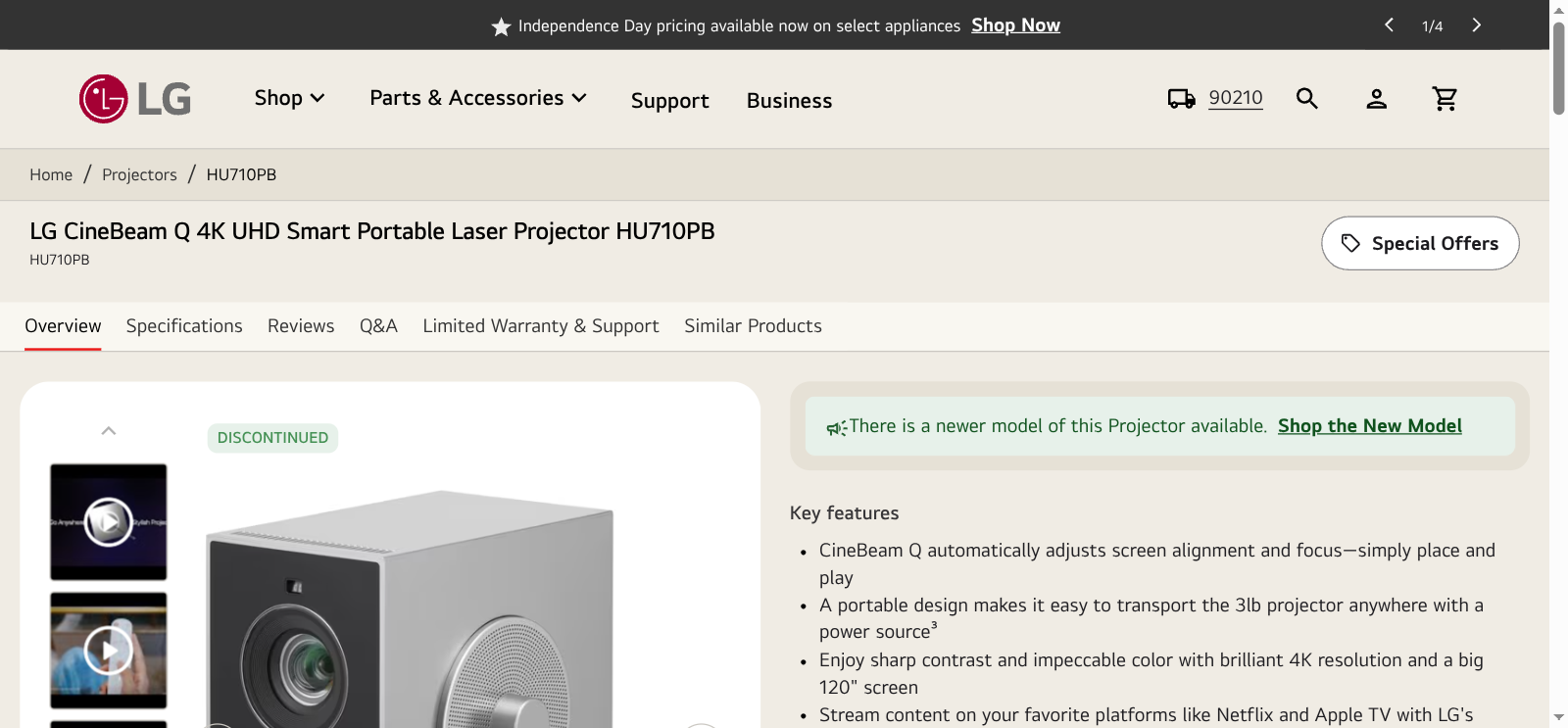
Best Overall Picture: LG CineBeam Q
Three and a half pounds for 4K — that is the headline. The CineBeam Q packs a pixel-shifted 4K RGB laser engine into an ultra-compact body, and the colors are visibly richer than anything LED-based portables manage. In dark scenes, shadow detail shows texture and depth where cheaper projectors render gray blobs.
Independent testing found it retains over 92% of its brightness at 1,000 hours of use, while sub-$300 projectors fall to around 70% in the same period. Auto-focus and auto-keystone square up the image in seconds, and webOS brings streaming apps built in. The catch: 500 ANSI lumens means dark rooms only, and there is no built-in battery. For night viewing, though, nothing portable looks better.
Best for Travel: Anker Nebula Capsule 3
The size of a tall soda can at 0.85kg, the Capsule 3 is the projector you actually bring places. The laser light source pushes 300 ANSI lumens at 1080p — noticeably sharper than older LED Capsule models — and the built-in battery lasts about 2.5 hours, enough for a full movie without hunting for an outlet. USB-C charging means a power bank extends that further.
Google TV is built in with native Netflix, which matters more than it sounds — Netflix licensing trips up half the portable projectors on the market. Keep the screen between 60 and 80 inches for the sharpest image, pair a Bluetooth speaker for movie night, and accept the dark-room limitation. For a deeper look at travel-ready tech, see our best tech gadgets to buy in 2026.
Best Value Smart Projector: XGIMI MoGo 4
The MoGo 4 is the projector for people who want it to work exactly like a smart TV. Google TV runs natively with the full app store and Chromecast built in — plug it in, connect to Wi-Fi, and you are browsing Netflix within two minutes. No dongles, no HDMI cables, no input-source fiddling.
At 450 ISO lumens and 1080p with a 2.5-hour battery, it sits in the sweet spot between underpowered pico models and bulky home theater units. Harman Kardon audio sounds better than it has any right to at this size. A $799 Laser variant bumps brightness to 550 ISO lumens for ambient-light tolerance, but the standard $499 model is the better value for nighttime viewing.
Best for Outdoors: Anker Nebula Mars 3 Air
Backyard cinema lives or dies on two things — brightness and battery — and the Mars 3 Air delivers both. Its 1,000-lumen output stays visible during late-afternoon setups before full dark, and the battery holds over 2 hours at full brightness: a full movie with no extension cord across the yard. The built-in handle and 4-pound body make it genuinely grab-and-go.
Google TV with licensed Netflix, auto-focus, and speakers loud enough for a small gathering complete the package. Deal trackers have repeatedly pulled it to the $420–470 range, at which point a portable 1080p projector with real streaming apps becomes an easy call. Just do not expect it to fight actual daylight — no battery projector at this size does.
Brightest Portable: BenQ GP100A
Most portables top out at 300–550 lumens. The GP100A hits 1,000 ANSI lumens — nearly double — which means you can watch with lamps on and curtains open without the image turning into a ghost. The 4LED light source covers 90% of the DCI-P3 color gamut for accurate, not oversaturated, color at native 1080p.
At 6.4 pounds it is portable in the room-to-room sense, not the backpack sense, and there is no battery — this is a plug-in portable. Android TV arrives via a bundled dongle. If your priority is a bright, color-accurate image over pocketability, this is the one bright-room buyers should shortlist.
Brightness: Why the Lumen Numbers Lie
Here is the trap the whole category sets: “lumens,” “ANSI lumens,” and “ISO lumens” are measured differently, and every brand quotes whichever reads highest. A projector advertising 1,000 unqualified lumens might be dimmer than one rated 400 ANSI lumens. Treat every brightness figure as a rough tier, not a head-to-head spec.
The tiers that matter: under 200 lumens is unusable outside a cave; 200–400 handles dark rooms; 400–800 copes with some ambient light; 1,000+ works in bright rooms. Match the tier to your room before anything else — a dim projector in a bright room is the number one buyer regret, and no other feature compensates for it.
Resolution: The “4K Compatible” Trap
“4K compatible” does not mean 4K. Many budget projectors accept a 4K signal and display it on a 1080p (or worse) chip — the label is technically true and practically meaningless. True 4K portables use pixel-shifting (XPR) DMD chips that build a 4K image from a 1080p panel, like the LG CineBeam Q and JMGO N1S 4K.
The honest rule from independent reviewers: below about $700, a good native 1080p projector with real contrast beats a bargain-bin “4K” panel almost every time. The $700–1,000 band is where 4K starts earning its keep. Do not pay the 4K premium on a $200 no-name box — you are buying a label, not pixels.
Light Source: Lamp vs LED vs Laser
The light engine decides brightness, color, lifespan, and running costs. Lamp projectors (like the ViewSonic PX701-4K) are cheapest up front and often brightest per dollar, but bulbs dim over time and eventually need replacing — a real cost LED and laser owners never face.
LED engines are maintenance-free and compact but generally dimmer, which is why most pico projectors use them. Laser — including RGB triple-laser flagships like the Hisense M2 Pro — delivers the best combination of brightness, color volume, and lifespan, with 20,000+ hour ratings. Single-chip DLP laser models can show “rainbow effect” fringes; 3LCD designs like Epson’s avoid it entirely.
Contrast: The Number That Actually Decides Picture Quality
Brands shout about lumens and whisper about contrast, but in a dark room contrast is what makes an image look like cinema instead of a washed-out slideshow. Black levels, shadow detail, that sense of depth — all contrast. The BenQ HT2060, “only” 1080p, beats pricier 4K rivals on contrast and looks better in a dark theater because of it.
DLP projectors tend toward grayish blacks; 3LCD and good LED/LCOS designs do better. HDR support (HDR10, Dolby Vision on premium models like the XGIMI Horizon Ultra and Leica Cine Play 1) helps tone mapping, but a projector’s native contrast sets the ceiling. If you watch mostly at night, prioritize contrast over the resolution number.
Smart Platform and the Netflix Problem
A portable projector without easy streaming is a beautiful brick. Google TV / Android TV offers the best app support; Samsung’s Tizen and LG’s webOS are decent but thinner; no-name boxes with hacked-together launchers are a support nightmare. Check the app list before buying, not after.
Netflix is the specific tripwire: its licensing restrictions mean many portable projectors cannot run it natively, forcing workarounds. Models with officially licensed Netflix — the Mars 3 Air, the Capsule 3 (New), the MoGo series — save real frustration. When in doubt, budget a $30–50 streaming stick; it is cheaper than discovering your projector cannot play the one app you use daily. For more on streaming-ready gear, see our latest tech reviews and expert recommendations.
Battery Life and Real Portability
True battery portables cluster around 2–2.5 hours of video at full brightness — enough for one film, not a double feature. Claims rarely account for max-brightness playback, so expect less if you crank the lumens. The Capsule 3, MoGo 4, and Mars 3 Air all land in this zone.
Many “portable” models have no battery at all — the CineBeam Q, Freestyle 2, BenQ GP100A, and Dangbei Atom all need USB-C or wall power. That is fine for room-to-room use but disqualifies them for camping. USB-C power input is the feature that bridges the gap: with a beefy power bank, the Capsule 3 and Freestyle 2 become genuinely off-grid capable.

Setup: Focus, Keystone and Throw Distance
Modern portables have nearly eliminated setup pain. Auto-focus, auto-keystone, obstacle avoidance, and automatic screen fitting mean you can set the projector down at an angle and get a square, focused image in seconds. The Samsung Freestyle 2 goes further with a 180-degree swivel cradle — point it at the ceiling above your bed with no tripod at all.
Throw distance still matters in small rooms: short-throw models like the BenQ X300G cast a big image from close up, while standard portables need 2+ meters for 100 inches. Check the throw ratio against your room before buying — the best projector is useless if your wall is too close. Motorized zoom (Hisense M2 Pro) lets you resize without moving the unit.
Audio: Plan for External Sound
Built-in projector speakers are, with few exceptions, an afterthought — thin, quiet, and easily overwhelmed. The exceptions prove the rule: Harman Kardon-tuned units (XGIMI, ViewSonic M2e) and Yamaha-powered Epsons sound genuinely decent, and the Mars 3 Air carries a small backyard gathering.
For everyone else, plan on a Bluetooth speaker or soundbar from day one — most portables pair over Bluetooth in seconds, and several offer HDMI eARC for a proper setup. Do not let weak audio sour a great picture; a $50 Bluetooth speaker transforms the experience more than any picture setting.
How to Choose: Match the Projector to the Room
Start with light, not lumens marketing. Dark dedicated room: prioritize contrast and color (CineBeam Q, BenQ HT2060-class). Living room with some light: 800+ ANSI lumens minimum (BenQ GP100A, Dangbei Atom). Bright room or daytime: 1,000+ ANSI and realistic expectations, or buy a TV instead.
Then use case: travel and camping demand battery plus pocketability (Capsule 3); backyard nights want battery plus brightness (Mars 3 Air); bedroom ceilings love the Freestyle 2’s swivel; gaming needs low input lag (BenQ X300G at 4ms, ViewSonic PX701-4K). Big screen from a small room: check short-throw options. Answer those and the shortlist writes itself.
Frequently Asked Questions
Can a mini projector replace a TV?
Yes — especially models like the Epson EF12 or ViewSonic M2e. They easily project 100–120 inch screens with a true theater feel, at a fraction of the cost per inch of a big TV. You trade some daytime usability and need external audio.
Is 300 ANSI lumens enough?
Only for dark rooms. If you have any ambient light, look for 400+ ANSI lumens minimum; for bright rooms, 1,000+. Brightness is the single spec most buyers underestimate.
Do I need external speakers?
Usually yes. Models with Harman Kardon or Yamaha tuning (MoGo series, M2e, Epson EF12) sound decent alone; tiny pico projectors need a Bluetooth speaker for anything beyond casual viewing.
Can I watch Netflix easily on a portable projector?
Only if it has Google TV / Android TV with licensed Netflix, or you add a Fire Stick / Chromecast. Netflix licensing blocks many no-name projectors — verify before buying.
Are smart streaming features worth paying extra for?
If you stream daily, absolutely — built-in apps with Wi-Fi and Bluetooth save setup time every use. If you already own a streaming stick you love, a “dumb” projector plus your stick is the cheaper path.
Is battery life or brightness more important outdoors?
Both, but they trade off: max brightness drains batteries fast. For backyard movies, prioritize a model that balances the two (Mars 3 Air’s 2+ hours at full brightness) over a dimmer projector that lasts longer.
What is the difference between ANSI, ISO and LED lumens?
They are different measurement standards, and brands quote whichever reads highest. Use them to sort projectors into rough brightness tiers — dark-room, dim-room, bright-room — not for precise head-to-head comparison.
Do portable projectors work in daylight?
Not really. Even the brightest portables (1,000–1,200 ANSI lumens) need dimmed rooms for a satisfying image; 3,000-lumen premium units like the Leica Cine Play 1 cope better but still prefer shade. For sunny patios, wait for dusk.
The Bottom Line
Buy the LG CineBeam Q if picture quality is everything and you watch after dark. Buy the Nebula Capsule 3 if the projector needs to fit in a backpack. Buy the XGIMI MoGo 4 if you want the smart-TV experience at a fair price. Buy the Mars 3 Air for backyard movie nights, and the BenQ GP100A if your room refuses to go dark. Whatever you choose, match brightness to your room first — that one decision matters more than every other spec combined.
