

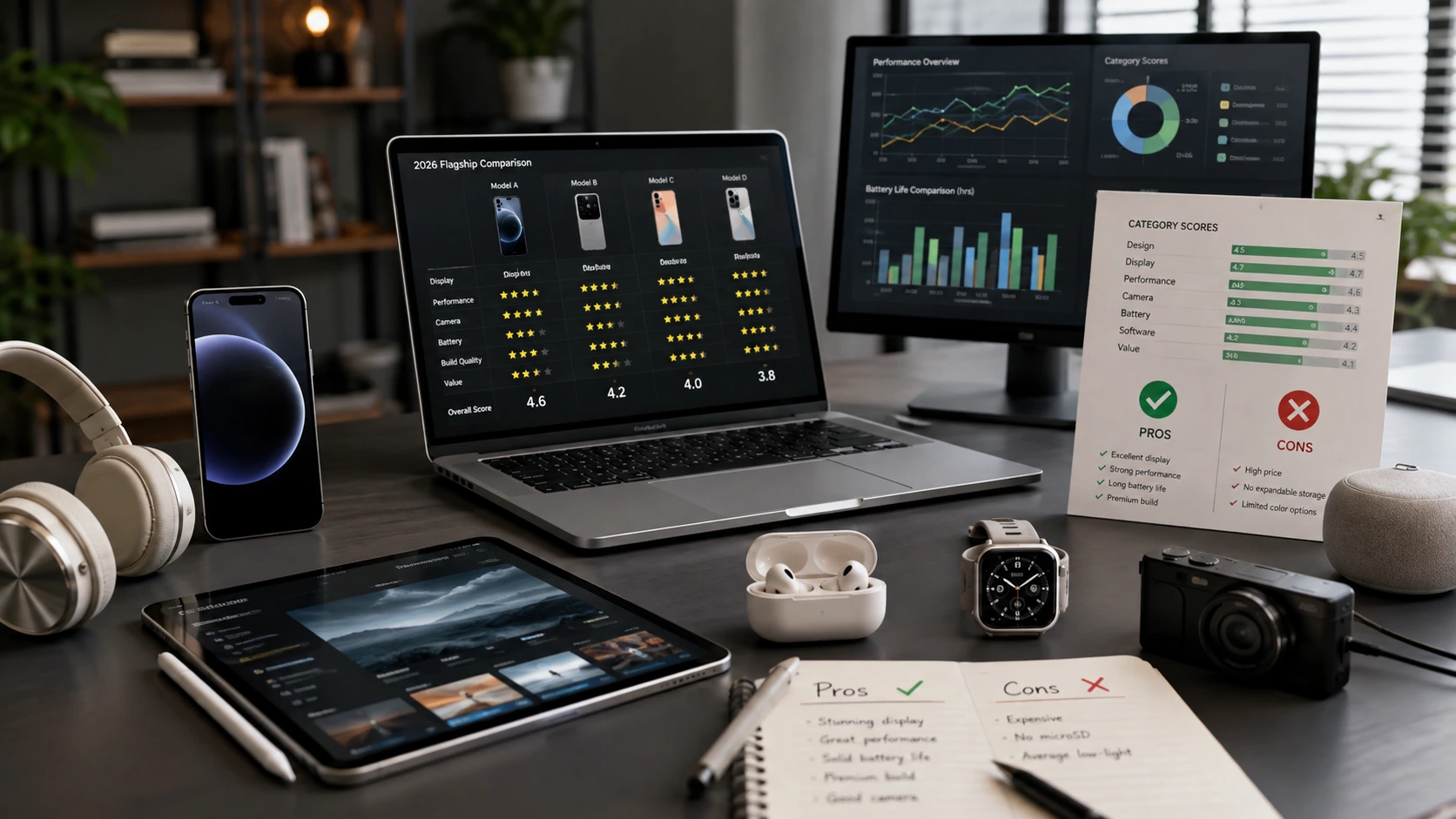
Buying technology has become harder, not easier. New phones, laptops, tablets, headphones, monitors, smartwatches, and accessories arrive constantly, while manufacturers compete with increasingly similar specifications and marketing claims. A product can look impressive on paper yet feel disappointing after weeks of everyday use.
That is why latest tech reviews should do more than repeat specifications. A useful review explains what a device actually does well, where it falls short, who should buy it, and when a cheaper or competing product may make more sense.
This guide focuses on the principles behind trustworthy technology reviews. Instead of treating benchmark numbers or feature lists as the whole story, it examines performance, usability, durability, software, value, privacy, compatibility, and long-term ownership. The goal is simple: help readers make technology purchases based on practical needs rather than hype.
What Makes a Tech Review Truly Useful?
A good technology review answers a basic question: Is this product worth your money for your particular needs?
Specifications provide useful context, but they rarely tell the complete story. Two laptops with similar processors and memory can deliver very different experiences because of cooling, display quality, keyboard design, battery management, software optimization, and build quality.
A trustworthy review therefore considers several dimensions at once:
- Performance: How well does the product handle its intended workload?
- Usability: Is it comfortable and intuitive during everyday use?
- Build quality: Does the hardware feel appropriate for its price?
- Features: Are the advertised features genuinely useful?
- Software: Is the operating system or companion app reliable?
- Battery life: Does it comfortably meet realistic usage needs?
- Compatibility: Does it work well with the user’s existing devices?
- Value: Does the overall package justify the price?
The most important factor is context. A powerful gaming laptop may be excessive for someone who mainly browses the web, while an inexpensive notebook may frustrate a professional who regularly edits video.
How to Evaluate the Latest Technology
1. Look Beyond the Specification Sheet
Specifications are an excellent starting point, but they should not be mistaken for a complete buying recommendation.
For example, a phone with more cameras is not automatically better for photography. Image processing, lens quality, stabilization, color consistency, autofocus, and software controls can matter just as much.
The same principle applies across technology. More RAM, higher refresh rates, larger batteries, and faster processors can be valuable, but only when they translate into meaningful improvements for the intended user.
2. Consider Real-World Performance
Performance should be evaluated according to the product’s purpose.
For a laptop, that could mean opening applications, multitasking, handling large files, running creative software, or playing games. For a smartphone, everyday responsiveness, camera processing, network performance, and sustained battery life may matter more than a short benchmark result.
A strong review distinguishes between peak performance and consistent performance. Some devices perform exceptionally during short workloads but reduce performance when heat builds up. That difference can become important during extended gaming, rendering, or other demanding tasks.
3. Examine Everyday Usability
Technology is something people interact with repeatedly, so small design decisions can have a surprisingly large impact.
A laptop with an excellent processor may still be frustrating if its keyboard is uncomfortable. A smartwatch can have impressive sensors yet be inconvenient if notifications are poorly organized. Wireless earbuds may sound excellent but lose some of their appeal if their controls are awkward.
Good reviews therefore consider details such as menus, physical controls, ergonomics, display readability, connectivity, setup, charging, and software behavior.
Key Factors to Compare Before Buying
1. Hardware and Build Quality
The physical construction of a product affects both ownership experience and longevity.
Look at materials, weight, hinges, buttons, ports, screen protection, thermal design, and general fit and finish. Premium materials are not automatically necessary, but a device should feel appropriately constructed for its price category.
Repairability can also matter. Products with replaceable components or accessible service options may be easier to maintain over time, while sealed designs can make certain repairs more complicated.
2. Software and Ecosystem
Hardware rarely exists in isolation. Software updates, companion applications, operating-system integration, and ecosystem compatibility can determine whether a product remains useful.
Before buying, check whether the device works with your existing phone, computer, cloud services, accessories, and preferred applications. A technically impressive product may not be the right choice if it creates unnecessary compatibility problems.
Software support is especially important for connected devices. Security updates, bug fixes, and feature updates can influence the practical lifespan of a product.
3. Battery and Charging
Battery claims should be interpreted carefully because real-world endurance depends heavily on usage.
Screen brightness, wireless connections, processor workload, background applications, gaming, video playback, and camera use can all change battery performance.
Charging speed is another consideration. A device that charges quickly can be more convenient than one with slightly better theoretical endurance but a much slower recharge cycle.
4. Price and Overall Value
The most expensive product is not necessarily the best product.
Value comes from the relationship between price, performance, features, reliability, and usefulness. A mid-range device that performs every required task comfortably can be a better purchase than a premium model whose additional features will rarely be used.
When comparing prices, also consider accessories, storage upgrades, subscriptions, chargers, replacement parts, and other ownership costs.
Pros and Cons Matter More Than Hype
1. Why the Pros Should Be Specific
Weak reviews often describe products using vague terms such as “excellent,” “powerful,” or “premium.” Strong reviews explain why a product deserves those descriptions.
Instead of saying a laptop has great performance, a useful review should identify the types of workloads it handles particularly well. Instead of calling a camera excellent, it should explain whether it delivers better results in low light, portraits, video, or everyday photography.
Specific advantages make a review easier to trust and easier to apply.
2. Why Honest Cons Build Trust
Every product has trade-offs. Even an outstanding device may have limitations involving price, weight, software, battery endurance, ports, accessories, or compatibility.
A review becomes more useful when it clearly identifies those limitations instead of hiding them.
The presence of disadvantages does not automatically make a product bad. The important question is whether those disadvantages matter to the intended buyer.
For example, limited ports may be irrelevant to a casual laptop user but extremely important to a professional who connects multiple external devices.
How to Choose the Right Product for Your Needs
1. Define Your Main Use Case
Start with what you actually intend to do.
Ask yourself:
- What tasks will I perform most often?
- How frequently will I use the device?
- Which features are essential?
- Which features would simply be nice to have?
- What devices and services must it work with?
- How long do I expect to keep it?
These questions can eliminate many unsuitable products before specifications become overwhelming.
2. Set a Realistic Budget
A budget should include more than the advertised starting price.
Consider whether you need additional storage, memory, accessories, warranties, subscriptions, or replacement equipment. A product that initially appears affordable can become considerably more expensive after necessary upgrades.
At the same time, avoid paying for specifications that do not improve your actual experience.
3. Compare Alternatives
Never evaluate a product entirely by itself.
A review should place it in context by asking what competing products offer at a similar price. Sometimes a competitor provides better battery life, software support, camera performance, display quality, or connectivity.
Alternatives are particularly valuable when a product has one major weakness. A reader should know whether that weakness is common across the category or whether another option solves it.
Read More: Best Tech Reviews 2026
Common Mistakes People Make When Buying Technology
1. Choosing Based Only on Specifications
Numbers are easy to compare, which makes them attractive. But specifications can hide important differences in optimization and implementation.
Use specifications to create a shortlist, then investigate how those specifications affect actual use.
2. Buying More Power Than Necessary
Extra performance can be useful, but it can also increase cost, weight, heat, power consumption, or complexity.
A casual user may benefit more from a comfortable keyboard, reliable battery, good display, and strong software support than from an unnecessarily powerful processor.
3. Ignoring Long-Term Ownership
A device should be evaluated beyond its first day.
Think about software support, repair options, accessory availability, storage needs, battery replacement, and resale value. These factors can influence the total cost and convenience of ownership.
4. Trusting Marketing Language Without Context
Terms such as “professional,” “AI-powered,” “next-generation,” or “pro-grade” can sound impressive but require interpretation.
The useful question is not whether a product has a particular marketing label. It is whether the underlying feature provides a meaningful advantage for the buyer.
A Practical Tech Review Comparison Framework
| Factor | What to Check | Why It Matters |
|---|---|---|
| Performance | Speed and sustained workloads | Determines practical capability |
| Display | Resolution, brightness, refresh rate | Affects viewing comfort |
| Battery | Realistic endurance and charging | Influences mobility |
| Software | Usability and update support | Affects long-term experience |
| Build | Materials, design, durability | Influences ownership quality |
| Connectivity | Ports, wireless standards, compatibility | Determines flexibility |
| Price | Total purchase and ownership cost | Determines overall value |
This framework can be applied to almost any technology category. The weighting simply changes according to the product.
For example, display quality may be critical for a monitor, while battery life could matter more for a smartphone. A gaming device may prioritize sustained performance, whereas a productivity laptop may place greater emphasis on keyboard quality and portability.
When Should You Trust a Tech Recommendation?
A recommendation is strongest when its reasoning is transparent.
Look for reviews that explain the criteria used, distinguish facts from opinions, identify limitations, and avoid treating every product as suitable for everyone. Current pricing and specifications should also be checked before making a purchase because technology products and their configurations can change.
Readers should be particularly cautious with reviews that make absolute claims without explaining the testing conditions or intended use. “Best” is rarely universal. The best product for a creator, student, traveler, gamer, or business professional can be completely different.
A trustworthy recommendation ultimately answers three questions: Who is this product for? Who should avoid it? And what alternatives deserve consideration?
FAQ’s About Latest Tech Reviews
What should I look for in the latest tech reviews?
Look for reviews that cover real-world performance, usability, build quality, software, battery life, compatibility, price, pros, cons, and suitable alternatives. Specifications should support the evaluation rather than replace it.
Are specifications enough to choose a technology product?
No. Specifications are useful for comparison, but they do not fully describe thermal performance, software optimization, ergonomics, reliability, or everyday usability. These factors can significantly change the ownership experience.
How important are pros and cons in a tech review?
They are essential because they reveal trade-offs. A product’s weaknesses may not matter to one buyer but could be deal-breakers for another. Clear pros and cons make recommendations more practical.
Should I always buy the newest technology?
Not necessarily. Newer products may offer improved hardware or features, but an older model can sometimes provide better value if it meets your needs and remains properly supported.
How can I tell whether a tech product is good value?
Compare its total cost with the features, performance, quality, software support, and expected usefulness you receive. Also compare competing products in the same price range rather than judging the product in isolation.
Why do different tech reviews reach different conclusions?
Reviewers may prioritize different factors or evaluate products for different audiences. A device can be excellent for one type of user while being a poor choice for another. Differences in testing methods can also affect conclusions.
Conclusion
The best latest tech reviews are not simply lists of specifications. They translate technical information into practical buying guidance.
When evaluating a phone, laptop, tablet, wearable, accessory, or other device, look beyond headline features. Consider real-world performance, software, build quality, battery behavior, compatibility, long-term ownership, and total value. Most importantly, judge those factors against your own requirements.
A genuinely useful recommendation does not try to convince everyone to buy the same product. It explains the trade-offs clearly so you can decide whether those trade-offs work in your favor.
Before purchasing new technology, define your priorities, set a realistic budget, compare alternatives, and pay close attention to meaningful disadvantages. That approach will usually lead to a better decision than choosing a product simply because it is newer, more expensive, or more heavily marketed.
