

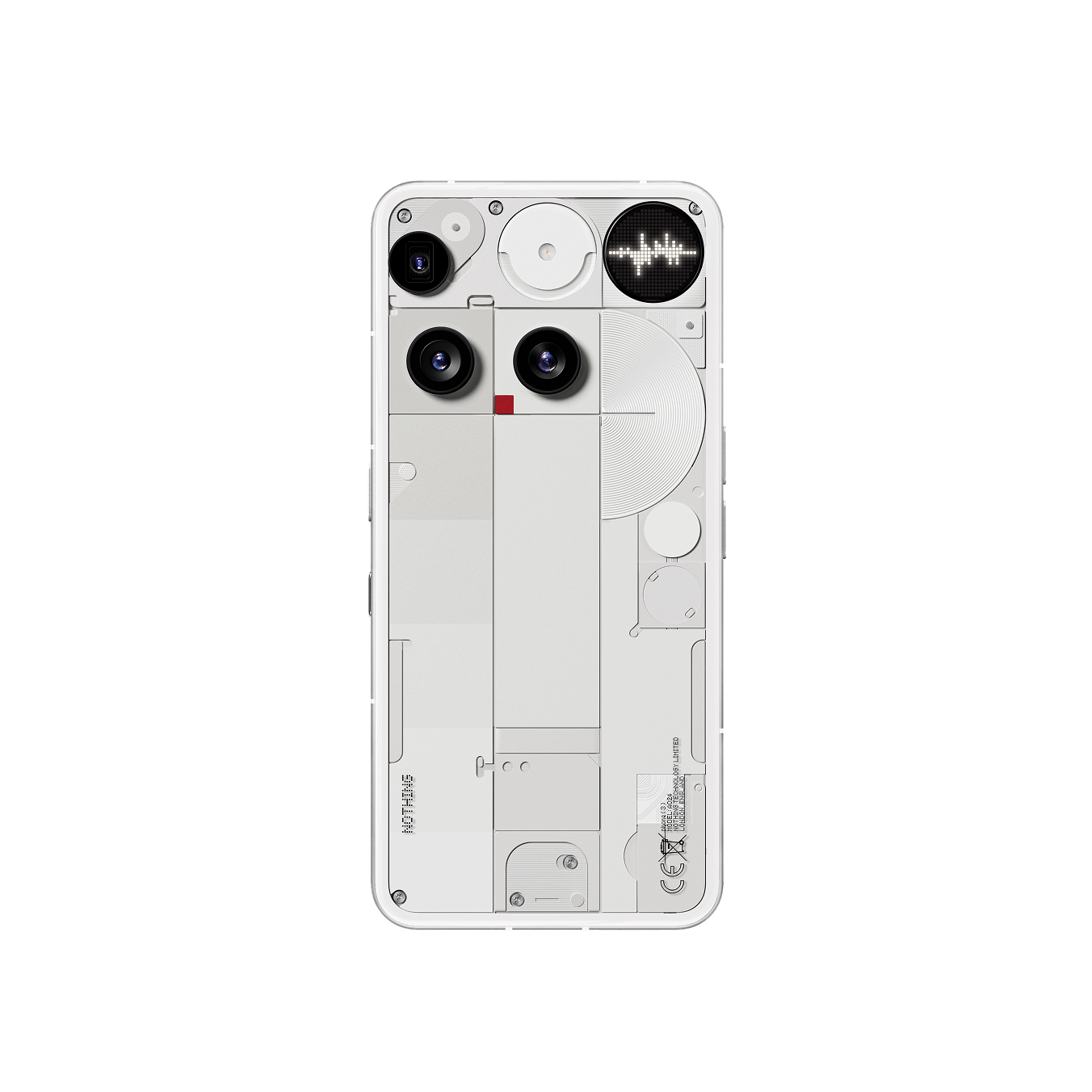
In this Nothing Phone 3 review, we dig into the British brand’s first true flagship — a phone that looks like nothing else but ships with a decidedly mid-range heart.
Announced on July 2, 2025 and released on July 15, the Phone (3) pairs a transparent design and the new Glyph Matrix with a triple 50MP camera system, a 120Hz OLED display, and the Snapdragon 8s Gen 4. It is equal parts striking and divisive.
Design and Build Quality: Personality Over Convention
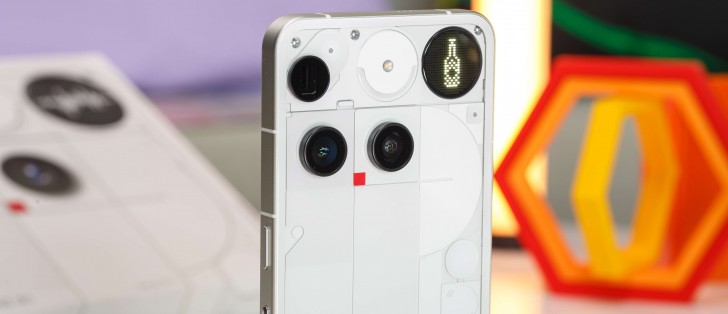
Flip the Phone (3) over and you know exactly what it is. The transparent rear reveals a wave-pattern block beneath the surface, with screws and camera lenses scattered in a deliberately asymmetrical layout that some find charming and others call chaotic.
The handset measures 160.6 x 75.6 x 9mm and weighs 218g, with a Gorilla Glass Victus back, an aluminum frame, and Gorilla Glass 7i protecting the front. An IP68 rating means it survives 1.5m of water for 30 minutes.
Build quality is excellent and it comes in Black or White, though the glossy transparent back is a fingerprint magnet — expect constant wiping or a case. Speaking of cases, pick one that keeps the rear interface visible, or you lose half the point of the phone.
Glyph Matrix: Gimmick, Tool, or Both?
Replacing the old light strips is a circular grid of 489 micro LEDs in the top corner of the back. It can show the time, battery level, notifications, and custom icons for specific contacts — a heart when your partner texts, for example.
A pressure-sensitive button on the rear cycles through Glyph Toys: a clock, a Magic 8 Ball, and even Rock, Paper, Scissors against your phone. Place the phone face down and it can trigger Do Not Disturb, making the Matrix most useful when the screen is hidden.
The catch is usability. Cycling needs a short press and activating needs a long one, which forces you to stare at the back of the phone. It is fun and genuinely cool to look at, but more party trick than essential tool.
Display: Bright, Sharp, Missing LTPO
The 6.67-inch OLED panel runs at 120Hz with a 1260 x 2800 resolution (about 460 ppi), HDR10+ support, 10-bit color, and 960Hz PWM dimming. Peak brightness hits 4,500 nits, keeping it readable in harsh sunlight.
Colors are punchy without going overboard, and HDR content from Netflix or YouTube looks genuinely pleasant. It is a display that competes well with the best Android flagships.
The one real omission is LTPO, meaning less flexible refresh-rate management than rivals at this price. For everyday scrolling and video it hardly matters, but it counts when comparing against similarly priced devices.
Performance: Strong Bursts, Weaker Sustained Results
Qualcomm’s Snapdragon 8s Gen 4 (4nm) powers the phone, with an octa-core CPU led by a 3.21 GHz Cortex-X4 and an Adreno 825 GPU. It ships in 12GB/256GB or 16GB/512GB configurations with UFS 4.0 storage.
In daily use it feels snappy — apps launch fast and multitasking is smooth. But this is not Qualcomm’s top-tier silicon, and launch-era stress testing found heavy throttling under sustained load, including trouble finishing demanding graphics benchmarks. Some owners also report overheating during intensive use.
Gamers should care: quick benchmark bursts are a different experience from holding performance through a long session. Check results for your specific titles rather than trusting the chip name alone.
Cameras: Triple 50MP Versatility With Caveats
All three rear cameras use 50MP sensors: a main wide (f/1.7, 1/1.3-inch, OIS), a 3x periscope telephoto (f/2.7, OIS), and an ultra-wide (f/2.2, 114 degrees). The front camera is also 50MP with autofocus, and both sides shoot 4K at up to 60fps with gyro-EIS.
In good light the results are impressive — detailed, vibrant but not unrealistic, with solid dynamic range. The dedicated periscope adds real versatility for portraits and distant subjects, and a macro mode handles close-ups nicely.
Challenging light is where it falters, with low-light shots lacking detail according to multiple testers. The shutter can also lag on moving subjects, so kids and pets may blur. Video lacks some refinements like seamless 4K switching. Matching megapixel counts do not guarantee identical results across lenses.
Software and Updates: Nothing OS Done Right
Nothing OS layers restrained styling, distinctive typography, and custom widgets over Android 15. It feels deliberate and cohesive rather than chaotic — a genuine reason to pick this phone over rivals.
The Essential button is the headline software feature. A short press captures a screenshot you can annotate, a long press records a voice note with automatic transcription, and face-down recording shows an audio waveform on the Glyph Matrix. The Essential Space app organizes it all with AI, including 300 minutes of analysis per month.
Update support is strong: five major Android upgrades and seven years of security patches. The only annoyance is the button’s placement next to the power key, which triggers accidental screenshots far too often.
Battery and Charging: Full-Day Endurance, BYO Charger
The international model packs a 5,150mAh silicon-carbon battery (India gets a 5,500mAh variant). In real testing it consistently lasts a full day, even with heavy camera use, gaming, and streaming — though it will not stretch to multiple days for power users.
Wired charging tops out at 65W, reaching around 60% in 30 minutes, with a full charge in roughly an hour on a compatible PPS charger. There is also 15W wireless charging and 7.5W reverse wireless.
The bad news: no charger in the box. To hit those 65W speeds you must buy one separately, which stings at this price.
Price and Value: Flagship Money, Mid-Range Chip
The 12GB/256GB model launched at US$799 (around $749 in some listings), while the Indian price sits near ₹80,000. In Australia it carried a steep $1,509 RRP, though it has dropped as low as $999 in sales.
At full price the value argument is tough. Rivals like the Samsung Galaxy A56 and Google Pixel 10a press it on cameras and long-term support, and phones like the OnePlus and Vivo flagships offer more raw power for the money.
A solid discount changes the equation completely. If the price gives you pause, compare it against other options in our guide to the best mobile phones to buy before deciding.
Nothing Phone 3 Review: Our Verdict
The Phone (3) is a characterful premium alternative, not an automatic spec-sheet winner. Its strengths — distinctive hardware, a versatile triple camera, clean software with long update support — are real.
But the compromises are equally real: a chip below the flagship tier, sustained-performance concerns, no LTPO, no charger, and a design premium that rivals undercut on hardware value.
Buy it if you want a phone with genuine personality and can grab it on sale. Skip it if you prioritize gaming, the absolute best cameras, or maximum hardware per dollar — and check how it ranks in our 10 best smartphones of 2026 before you commit.
Frequently Asked Questions
What is the Glyph Matrix on the Nothing Phone (3)?
It is a circular grid of 489 micro LEDs on the rear that displays the time, battery level, and notifications, or assigns custom icons to contacts. A touch-sensitive rear button controls it, cycling through functions with a short press and activating them with a long press.
How long does the Nothing Phone (3) battery last?
The 5,150mAh international battery reliably delivers a full day of typical use, and even heavy days of gaming, cameras, and streaming leave charge to spare by evening. It will not stretch to multiple days for demanding users, though.
Does the Nothing Phone (3) come with a fast charger?
No. While it supports 65W wired charging — about 60% in 30 minutes — no charger is included in the box. You will need to purchase a compatible 65W PPS charger separately. It also supports 15W wireless charging and reverse wireless charging.
What software updates will the Nothing Phone (3) receive?
Nothing promises five major Android upgrades and seven years of security updates, which keeps the device supported well into the 2030s. It launched on Android 15 with Nothing OS and is upgradeable onward.
How does the Essential button work?
It sits on the side of the phone. A short press takes a screenshot you can annotate with notes, while a long press records a voice note with automatic transcription. Placed face down, a long press starts recording with the audio waveform shown on the Glyph Matrix.
What processor does the Nothing Phone (3) use?
The Qualcomm Snapdragon 8s Gen 4, a 4nm chip with a 3.21 GHz Cortex-X4 prime core and Adreno 825 GPU. It is a strong upper-mid-range processor, but a step below Qualcomm’s top flagship-tier silicon.
Is the Nothing Phone (3) good for gaming?
For casual and moderate gaming it is fine — apps and games run smoothly day to day. For long, intensive sessions, launch-era testing showed heavy throttling and heat buildup, so serious mobile gamers should look at alternatives with better sustained performance.
Is the Nothing Phone (3) worth buying?
At its $799 launch price it is a hard sell against more powerful or better-supported rivals. At a discount — it has sold for as low as $999 AUD and around $749 USD — the distinctive design, versatile cameras, and long software support make it a far more convincing buy.
