

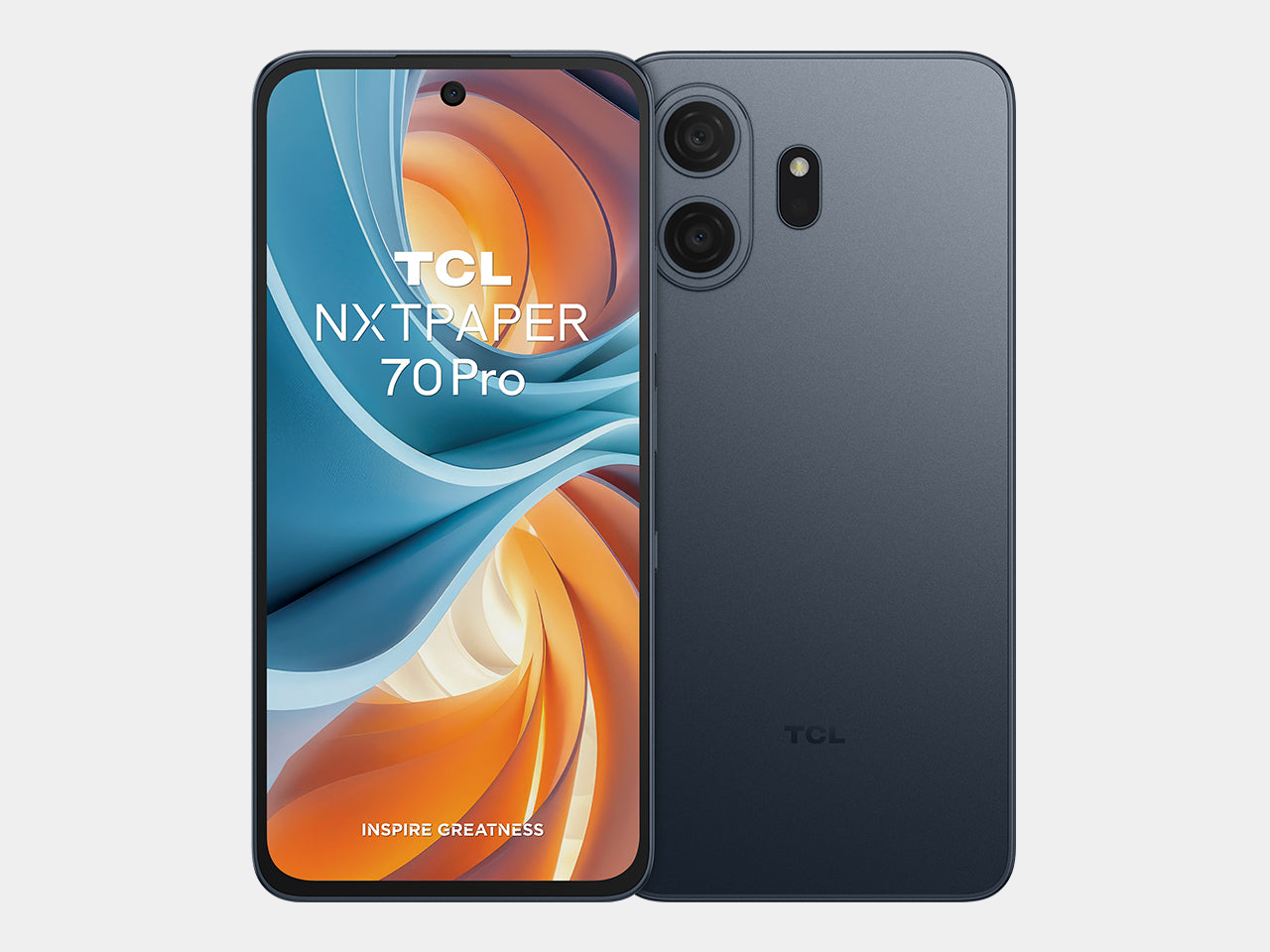
This TCL NXTPAPER 70 Pro review is about a phone that refuses to play the usual budget game. Instead of chasing flagship specs, TCL built a $199–$380 smartphone around one radical idea: a matte, paper-like display that’s genuinely easier on your eyes. With four switchable screen modes, a battery that can stretch past two days, and full access to every e-book app, it’s the most interesting cheap phone of 2026 — as long as reading matters more to you than photography.
TCL NXTPAPER 70 Pro Review: The Display That Defines It
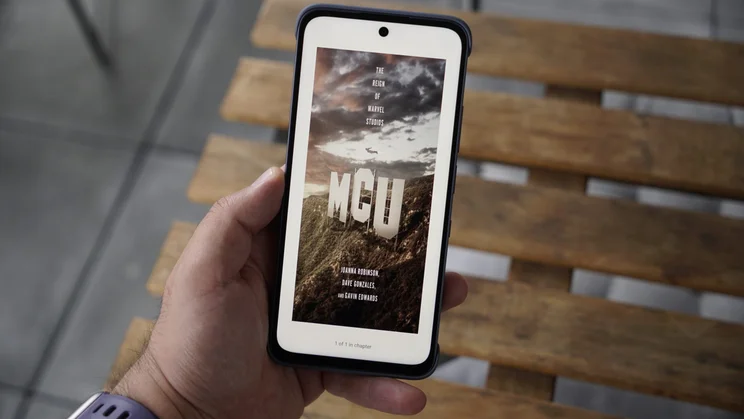
The screen is the entire reason this phone exists. A dedicated physical switch on the right edge cycles between four modes: Standard for normal full-color phone use, Color Paper with muted saturation that’s ideal for comics, Ink Paper with a black-and-white newspaper look for e-books and long articles, and Max Ink — a distraction-free mode that limits background processes and apps to stretch battery life toward 200 hours.
In practice, reviewers lived in the paper modes. One read Marvel Unlimited comics in Color Paper mode and called it ideal for long trips; another did bedtime reading in Ink Paper mode and found the reduced blue light made late-night scrolling far less disruptive to sleep. The matte nano-textured finish kills reflections so effectively that one reviewer found it better at glare reduction than an actual Kindle. Switching modes triggers a subtle shimmer animation with a sound effect that makes the transition feel a little magical.
The trade-offs are real. The matte finish washes out under bright sunlight — cranked to maximum brightness it still can’t match a flagship OLED outdoors. Rapid scrolling can cause text to shift color slightly, and the display uses temporal dithering to boost color output, which may bother users who are sensitive to flicker. The Asahi protective glass also scratches more easily than Gorilla Glass, so a screen protector is strongly advised — even if it slightly dulls the paper effect.
Design, Build and Everyday Practicality
For a $199 phone, the build embarrasses plenty of pricier handsets. The 6.9-inch panel stretches nearly edge to edge in a body just under 8mm thin, and the whole package carries an IP68 rating for dust and water resistance — a first for TCL’s Nxtpaper line. It ships in Stellar Blue and Nebula Gold with a matte plastic frame that resists fingerprints.
Practical details are mostly thoughtful. There’s a side-mounted fingerprint sensor in the power button that reviewers found fast and accurate, NFC for payments, dual SIM plus eSIM, and a microSD slot that accepts cards up to 2TB — a rarity in 2026. The stereo speakers are loud enough for Netflix without headphones. On the downside, the phone only supports Wi-Fi 5, which is now two generations behind, and there’s no 3.5mm headphone jack.
The optional T-Pen stylus divides opinion: writing on the matte surface feels more like a Kindle Scribe than an iPad, but the fine tip can feel imprecise on a phone-sized screen. The bundled hard case doubles as a kickstand, which is genuinely useful for propping the phone up to read.
Performance: Dimensity 7300 in Daily Use
The MediaTek Dimensity 7300 — four performance cores plus four efficiency cores — won’t win benchmark trophies. Geekbench 6 scores of around 1,069 single-core and 3,190 multi-core land it firmly in mid-range territory, and heavy multitaskers will notice it isn’t as snappy as phones with more RAM.
But for the job this phone is designed to do, it’s enough. Android 16 with TCL’s UI 9.0 runs smoothly, reading apps like Kindle, Kobo, and Instapaper open instantly, and casual games play without complaint. The 8GB of RAM can be supplemented with up to 16GB of virtual RAM borrowed from storage. TCL promises two years of updates, though its long-term support policy remains vaguer than Samsung’s or Google’s, and you’ll want to delete the pre-installed bloatware (AliExpress, ReelShort) during setup.
AI features are present but low-key: live transcription, AI-assisted note-taking, PDF summarization, and text translation all work, but TCL doesn’t shove them in your face the way some brands do.
Battery Life: The Quiet Superpower
The 5,200mAh battery is the phone’s second-best feature. In a looping video test it lasted just over 25 hours, and in real-world use reviewers consistently got more than two full days — roughly double what flagship Samsung and Google phones manage. Charging is 33W wired (about 50% in 38 minutes), with no wireless charging.
The real magic is Max Ink mode. By limiting apps and background processes, the phone sips power so slowly that one reviewer saw an estimated 46 hours remaining with just 21% battery left; TCL claims up to 200 hours in this mode. For travelers and heavy readers, that’s a genuine Kindle-like proposition: a phone that can outlast a long weekend without a charger.
Cameras: Fine, and That’s It
TCL clearly spent the budget on the display, and the cameras show it. The 50MP main camera with optical stabilization takes bright, detailed photos in good daylight, and the 8MP autofocus ultra-wide is serviceable in a pinch. Video tops out at 4K and 30fps from the main lens only, and the 32MP front camera is passable for video calls.
Push beyond casual shooting and the limits appear quickly. Digital zoom falls apart past 2x, outdoor shots can look over-contrasty and over-saturated, indoor shots wash out, and night photos lack detail. The selfie camera renders skin tones inaccurately. For a reader’s phone this is acceptable — nobody buys this device for photography — but anyone who cares about cameras should look at the Nothing Phone (3a) or CMF Phone 2 Pro instead, which offer telephoto lenses at similar prices.
Price and Value: The $199 Headline
Pricing is where the 70 Pro becomes hard to ignore. T-Mobile sells it for $199, the 128GB unlocked model goes for around $280–$330, and the 256GB and 512GB versions top out near $430. UK pricing sits at £269–£319, and US buyers ordering direct from TCL have even received free earbuds worth nearly $100.
That undercuts basically everything: the Samsung Galaxy A56 at $499, the Nothing Phone (3a), the Galaxy A36 — and no brand-new iPhone costs under $300 at all. If you’re weighing a cheap new phone against a second-hand flagship, our new vs refurbished buying guide walks through the trade-offs. And if 5G on a budget is the priority, see our roundup of the best 5G phones for every budget in 2026.
TCL NXTPAPER 70 Pro Review: Frequently Asked Questions
What is the NXTPAPER display?
It’s TCL’s matte, paper-like screen technology. A nano-textured surface cuts glare and reflections, blue-light output is reduced, and a dedicated switch cycles between Standard, Color Paper, Ink Paper, and Max Ink modes — the last two mimicking an e-reader’s look and extending battery life dramatically.
Can the TCL NXTPAPER 70 Pro replace a Kindle?
Almost, for disciplined readers. It runs every e-book app (Kindle, Kobo, Libby, Hoopla), and Max Ink mode removes distractions while sipping battery. But TikTok and Instagram remain one swipe away, so if you need enforced focus, a dedicated e-reader still wins.
How much does the TCL NXTPAPER 70 Pro cost?
From $199 at T-Mobile for the base model, $280–$330 unlocked depending on storage and sales, up to about $430 for 512GB. In the UK it sells for £269–£319.
Does it support wireless charging?
No. Charging is 33W wired only, reaching about 50% in 38 minutes. There’s no wireless charging at any speed.
How long does the battery last?
Over two days of normal use from the 5,200mAh battery — roughly 25 hours of looping video. In Max Ink mode, TCL claims up to 200 hours of reading time.
Verdict: The Reader’s Budget Champion
The TCL NXTPAPER 70 Pro is the rare budget phone with a genuine point of view. Review scores from 70% to 90% all orbit the same conclusion: the paper-like display is a standout, the price is remarkable, and the compromises (average cameras, Wi-Fi 5, no wireless charging) are fair at $199. It’s not a flagship killer — it’s a lifestyle fixer. If you read for hours a day and your eyes are tired of glossy screens, this is the easiest recommendation in the budget segment.
