

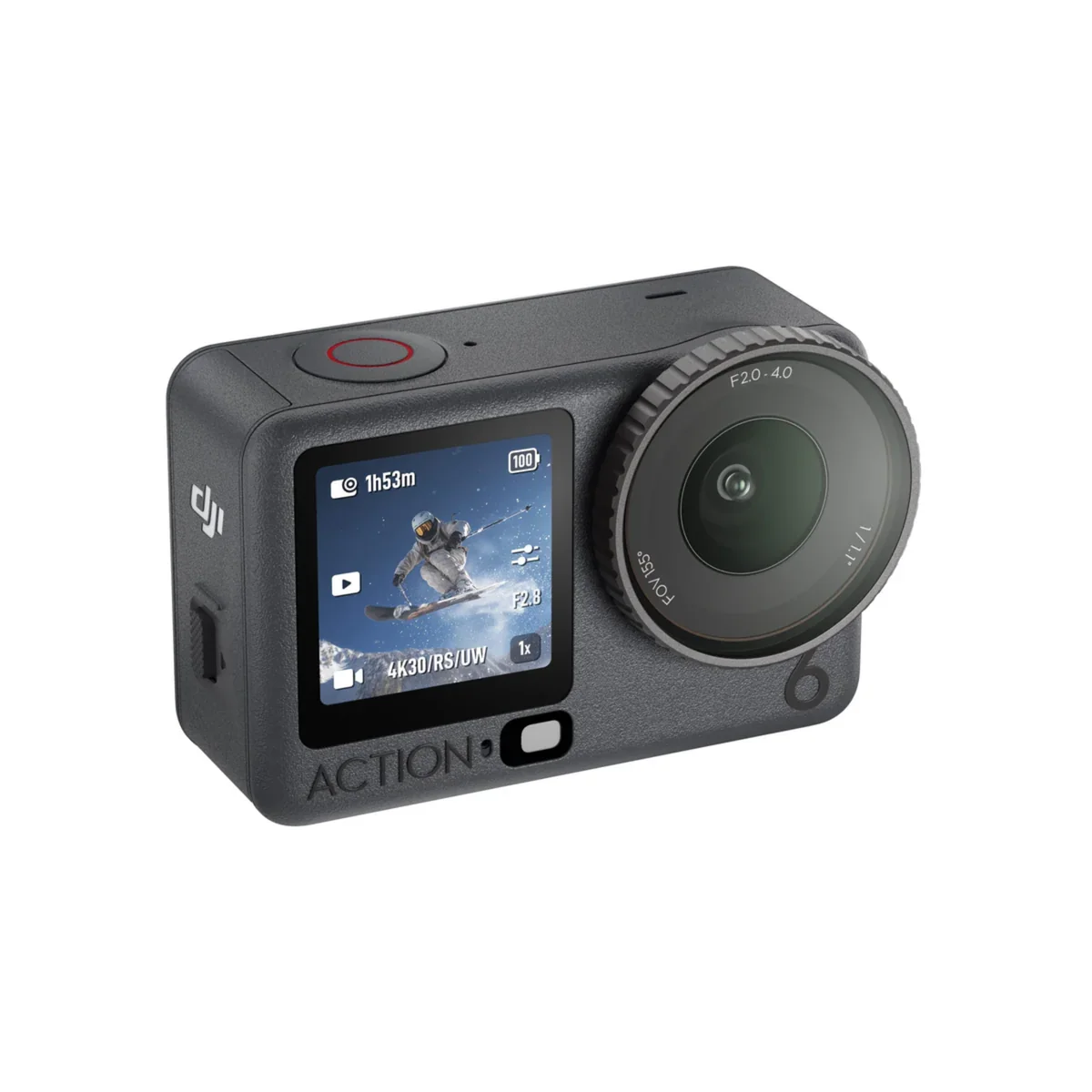
This DJI Osmo Action 6 review is for creators who are tired of choosing between horizontal and vertical. DJI’s new flagship action cam brings two genuine firsts to the category: a 1/1.1-inch square sensor and a variable aperture, both aimed squarely at people who publish to YouTube and TikTok from the same shoot.
After weeks of testing across vlogging, cycling, night scenes and underwater dives, the picture is clear. This is the best action camera for low light and multi-platform creators — but daylight shooters may find the upgrade harder to justify.
Design and Build Quality
The Action 6 looks familiar at first glance, but it is slightly larger in every dimension to house the bigger sensor. Weight lands at 149 grams, just 3 grams more than the Action 5 Pro, and the body still feels compact and solid in hand.
The front carries a 1.46-inch OLED touchscreen and the rear a 2.5-inch OLED, both bright enough to read in strong sunlight. Branding text is now black instead of white for a subtler look, and a larger colour-temperature sensor sits on the front for more accurate white balance.
DJI reworked the small details too. The battery and USB-C doors now unlock with a push-to-the-side motion before lifting, and the magnetic quick-release works in both directions — though reversed magnetic poles mean older accessories mount awkwardly and new ones are worth buying. The camera is waterproof to 20 metres without a case and 60 metres with one.
One annoyance: pairing with the DJI app is mandatory during setup, and the camera keeps reminding you to connect on boot even after that.
Square Sensor and Free Crop Mode
The defining feature is the 1/1.1-inch square CMOS sensor. Because it is as tall as it is wide, you can shoot 4K in both horizontal and vertical orientations without rotating the camera — tap a button, keep your grip, and switch formats mid-vlog.
The Custom 1:1 mode records true 3840 x 3840 square video at up to 4K 60fps, making this the only current action camera with 4K vertical resolution at 60 frames per second. In DaVinci Resolve, exporting one timeline horizontally and copying it to a vertical timeline takes minutes, with full-resolution crops in both directions.
Free Crop mode records the entire square frame so you can reframe to 16:9 or 9:16 later and fix composition mistakes without reshooting. One bug to know: if you enable the corner reference markers, they burn into the footage as black corners. Double-tap the grid icon to switch them off before recording.
Variable Aperture: f/2.0 to f/4.0
This is the first variable aperture ever fitted to an action camera, and it is mostly about depth control rather than replacing ND filters. The larger sensor naturally produces shallower depth of field, so DJI uses f/2.8 to f/4.0 in daylight to keep close subjects sharp.
In low light, the camera can open to f/2.0, gathering roughly 78 percent more light than the fixed f/2.8 of the Action 5 Pro. Auto mode ramps between stops in fine steps — f/2.1 to f/2.2 and so on — with no visible exposure jumps. Fixed modes are limited to f/2.6, f/2.8 and f/4.0 “starburst”; frustratingly, f/2.0 cannot be locked manually.
Where the aperture genuinely pulls ahead of the 5 Pro is bright, high-contrast scenes, where it exposes more evenly instead of leaning on shutter speed and ND filtering. But it cannot replace ND filters: f/4.0 is nowhere near small enough for snow or beach, where you would need f/16 or beyond.
Video Quality and Recording Modes
At launch the camera tops out at 4K/120fps, with 1080p reaching 240fps for slow motion. A December 2025 firmware added 8K/30fps recording. Footage is encoded in H.265 at up to 120 Mbps, with a 10-bit D-Log M profile that holds noticeably more shadow detail in contrasty scenes like sun-dappled trails.
DJI softened the over-processed “electronic” look of earlier generations: skin tones look more natural and skies hold their highlights longer. A Natural Wide field of view keeps vertical lines straight without the usual fisheye distortion, and Dewarp mode cleans up the edges further for more serious shots.
There is also a subject-tracking mode up to 2.7K that detects a person and crops within the sensor to keep them centred — genuinely handy for walk-and-talk shorts where you want to skip reframing in the edit.
Daytime Performance
In good light, the Action 6 delivers sharp, colour-accurate video that is perfectly usable straight out of the camera. Compared with the Action 5 Pro, the improvement is real but modest: slightly better detail and highlight retention, not a generational leap.
If you shoot mostly daylight and publish horizontally, rivals still have an argument. The GoPro Hero 13 captures 5.3K (5312 x 2988) at 60fps, which supersamples to sharper 4K and gives more room to reframe in post. For casual 16:9 shooting, the differences between the Action 6 and its predecessor are barely noticeable.
Low-Light and SuperNight Performance
This is where the Action 6 earns its price. The roughly 30 percent larger sensor plus the wider aperture produce visibly cleaner footage at ISO 6400 and above, with less noise in shadows and street lights that blow out less aggressively than on the Action 5 Pro.
DJI also reworked the Night setting itself: noise reduction is applied less aggressively, so footage looks more natural. In standard mode the gains over the Action 4 are small, but the dedicated SuperNight mode brightens dark scenes dramatically — at the cost of a somewhat “watercolour” processed look, so reserve it for genuinely dark situations.
Higher shutter speeds in dim conditions also give the stabilization system an easier time, producing sharper night footage with less pixelation than rivals.
Stabilization
RockSteady 3.0+ handles handheld running and jumping with ease, delivering footage that looks almost gimbal-shot. The 4K HorizonSteady mode now locks the horizon through full 360-degree rotations at full resolution — something the Action 5 could only manage at lower resolutions.
The improvement over the Action 5 Pro is subtle, but against the older Action 4 it is obvious: a jogging test showed noticeably steadier footage from the 6 while the 4 introduced visible shake. Only a stiff, unsuspended bike handlebar still produced jitter, which no digital stabilization fully solves.
Battery Life
The camera uses the same 1,950mAh Extreme Battery Plus as the Action 5 and Osmo 360, so existing DJI owners can swap batteries across cameras. Official claims are 195 minutes at 4K/30 and 240 minutes at 1080p/24.
Real-world testing lands a bit lower: expect roughly 90 to 120 minutes of active 4K recording. Thirty minutes of 4K/60 drained 33 percent in testing, slightly worse than the Action 5’s 29 percent. Fast charging reaches 80 percent in about 25 minutes and full in around 50.
For full shooting days, three batteries is the practical number — which is exactly what the Adventure Combo bundles, alongside a triple charger. Note the charger’s LEDs only show orange-to-green status, with no percentage readout.
Audio
The built-in microphones are better than expected, and the wind-noise-reduction mode keeps voices usable in gusty conditions, though it can thin out ambient sound. The real strength is wireless: the camera pairs directly with up to two DJI transmitters — Mic 2, Mic 3 or Mic Mini — with no receiver needed, recording dual-channel audio.
On-screen level meters for each mic appear on both displays, so you can confirm both channels are recording at a glance. There is also support for a wired microphone adapter carried over from the Action 4 and 5. The only gap: DJI’s Mic 3 supports four channels, but the camera records just two.
Storage and Connectivity
You get 50GB of built-in storage (about 50GB usable) plus a microSD slot supporting cards up to 1TB — handy when you inevitably forget the card. Transfers are fast: USB-C 3.1 moves data at up to 800MB/s and Wi-Fi 6 doubles wireless transfers to around 80MB/s.
Two quirks to know. The camera does not automatically switch between internal storage and the SD card when one fills up; it just warns you and waits. And a firmware bug on some SD cards stopped recording at the 17GB file-segment limit instead of rolling into a new file — DJI is aware and a fix is expected, so keep the firmware updated.
Convenience Features
Beyond imaging, DJI added several workflow touches. In-camera style filters apply colour looks during recording for instant social posts, though they are limited to 4K 60fps 16:9 and cannot be customized. The separate Film Tone feature borrows Fujifilm-style simulations, but the option list is thin — black-and-white and sepia are notably missing.
Gesture control lets you wave at the camera to start and stop recording, which is genuinely useful when the camera is mounted out of reach or when voice control would fail in noise. Voice control itself is retained from previous models.
Underwater Performance
Underwater is a quiet standout. Down to 20 metres without a housing, the Action 6 holds colour and detail far better than most action cameras, which tend to go washed-out or green. Freediving footage kept recognisable blue water, decent skin tones, and highlights that did not blow out when the sun broke through the surface.
Exposure transitions from surface to depth are smooth, without abrupt jumps. Just remember that lens accessories — macro, ND and FOV-boost lenses — are not designed for submersion, so leave them on dry land.
DJI Osmo Action 6 Review: Rivals Compared
Against the GoPro Hero 13 Black ($309), the Action 6 wins on low light, the square sensor and variable aperture, while GoPro counters with higher resolution, a broader accessory ecosystem and a longer track record. Against the Insta360 Ace Pro 2 ($449), DJI takes sensor flexibility and aperture control; Insta360’s flip screen and AI features remain tempting for self-shooters.
If you fly DJI gear already, the shared battery ecosystem is a real plus — and if aerial footage is your thing, our roundup of the best drones of 2026 covers the top picks for every budget.
DJI Osmo Action 6 Review: Price and Value
Pricing starts at $399 for the Standard Combo ($369 in some regions at launch), with the Adventure Combo — three batteries, extension pole and mounts — at €479. The older Action 5 Pro at $349 saves you $50 if you only shoot horizontal daylight footage.
For multi-platform creators and night shooters, the square sensor and low-light gains justify every penny of the premium. For everyone else, the value case is thinner.

FAQs
Is the DJI Osmo Action 6 worth upgrading to from the Action 5 Pro?
Only for specific shooters. In flat, well-lit conditions the two are genuinely close, and the aperture is the real reason to move — not the sensor or stabilization alone. Multi-platform creators and night shooters benefit most; everyone else can save $50.
What is new on the DJI Osmo Action 6?
The world’s first variable aperture (f/2.0–f/4.0) on an action camera and a 1/1.1-inch square sensor enabling Free Crop and true 4K vertical video. Everything else — battery, waterproofing, storage — builds incrementally on the Action 5 Pro.
Does the Action 6 fix the Action 5 Pro’s weaknesses?
Partially. Exposure control in mixed and high-contrast light is more forgiving thanks to the aperture, and night footage is cleaner. It does not change the fundamentals of sensor size or stabilization inherited from the 5 Pro.
Should I buy the Action 6 or the GoPro Hero 13?
Buy the Action 6 if you shoot at night or publish to both YouTube and TikTok. Buy the Hero 13 if you mainly shoot daylight horizontal video and want the sharpest possible 4K after supersampling.
Verdict
The DJI Osmo Action 6 is the best action camera for night shooting and the most flexible one for multi-platform creators. The square sensor genuinely changes how you shoot for YouTube and TikTok, and the variable aperture delivers real low-light gains — not marketing fluff.
It is not a revolution for everyone: daylight quality over the Action 5 Pro is incremental, manual aperture control is limited, and the launch price sits above rivals. But for the specific problems it solves, it solves them better than anything else right now. Rating: 9/10.
Phone-first shooters who care more about computational photography should also check our Xiaomi 17 Ultra review — a different kind of camera king.
