

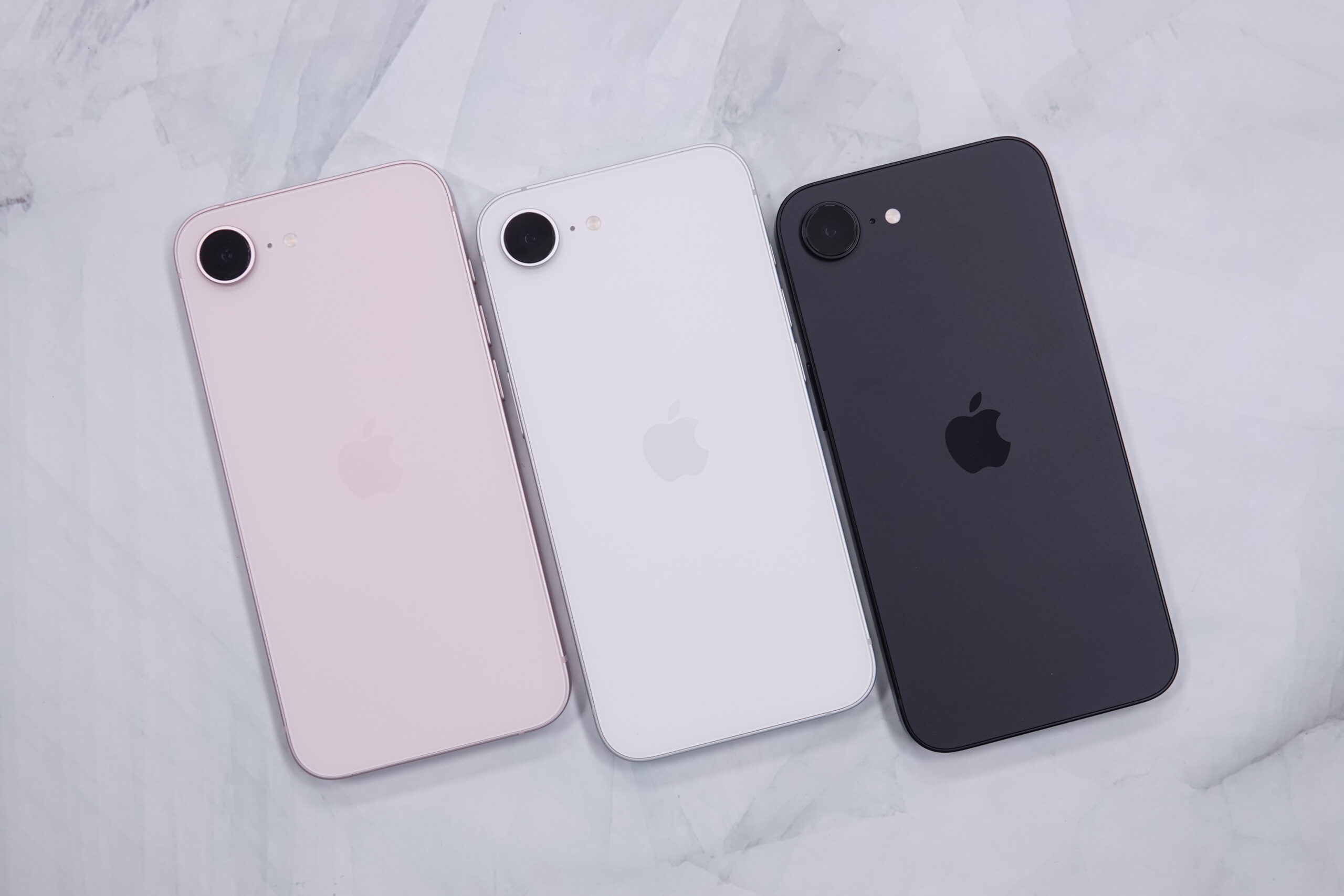
This iPhone 17e review tackles Apple’s second attempt at a mid-cycle, mid-price iPhone. Launched in March 2026 at $599, it keeps the price of the iPhone 16e but doubles base storage to 256GB, adds the A19 chip and brings MagSafe to the “e” line for the first time.
On paper it looks like the value iPhone done right. In practice, a few deliberate cutbacks — the 60Hz notch display chief among them — decide whether this phone is for you.
Design and Build
The 17e reuses the familiar 16e design: flat aluminium sides, a frosted glass back and a compact 146.7 x 71.5 x 7.8mm body at 169 grams. It feels solid and well-balanced, with a matte finish that resists fingerprints.
Colours are restrained — black, white, and a new soft pink. Durability is a strong point: Ceramic Shield 2 improves scratch resistance and the phone carries the same IP68 water and dust rating as the flagships. The customisable Action button replaces the old mute switch.
One correction worth making, because many spec sheets got it wrong: there is no Dynamic Island. Apple kept the notch, leaving the 17e as the only current iPhone without the pill cutout — check photos before ordering if the front design matters to you.
Display
The 6.1-inch Super Retina XDR OLED is sharp and colour-accurate, with 800 nits typical brightness and 1,200 nits peak in HDR — adequate outdoors, though not class-leading. Anti-reflective coatings help with glare.
The limitation is the 60Hz refresh rate, unchanged from the 16e. Scrolling is fine in isolation, but anyone coming from a 120Hz phone will feel the step back every single time they swipe. There is also no always-on display, so glanceable lock-screen info is missing.
Performance: A19 Power
The A19 is the star of the show. It uses the same CPU layout as the standard iPhone 17 — two performance cores, four efficiency cores and a 16-core Neural Engine — with 8GB of RAM. Apple disables one GPU core, leaving four against the 17’s five; that is the entire silicon difference.
Day-to-day, the gap is invisible. Apps open instantly, multitasking is fluid and on-device Apple Intelligence runs at effectively flagship speed. Indicative Geekbench 6 scores sit near 3,300 single-core and 9,200 multi-core. Only sustained console-style 3D gaming exposes the missing GPU core.
The chip also brings hardware-accelerated ray tracing, improving lighting in supported games — though the reduced GPU means you will not always run them at peak settings.
Camera
There is one rear camera: a 48MP f/1.6 Fusion sensor with a 2x sensor crop and 4K Dolby Vision recording. No ultra-wide, no telephoto, no spatial capture. The 12MP front camera handles Face ID and selfies.
In the main, the single camera produces great photos — natural colours, solid dynamic range and dependable results in good light. Low-light shots are decent but not class-leading, and the lack of versatility is the real cost: you simply cannot go wide or zoom optically.
For many buyers one good camera beats two mediocre ones, but photographers should look up the range.
Battery and Charging
Apple claims up to 26 hours of video playback from the roughly 4,005mAh cell (Apple does not publish the mAh figure; it comes from regulatory filings). Real-world reports split: some reviewers call battery life merely mediocre, while owners routinely end heavy days near 30 percent.
MagSafe arrives on the “e” line for the first time, with 15W magnetic wireless charging — double the 16e’s 7.5W Qi — unlocking Apple’s whole magnetic accessory ecosystem. Wired charging is 20W over USB-C.
The catch: the USB-C port runs at USB 2.0 speeds (480Mb/s). Moving a large photo library to a computer over cable is genuinely slow, and it is worth knowing before you buy.
Connectivity
The Apple-designed C1X modem is the sleeper upgrade most reviews skipped: roughly twice as fast as the C1 in the 16e while drawing less power, which partly explains the solid battery life. Elsewhere you get Wi-Fi 6, Bluetooth 5.3, satellite features and eSIM-only connectivity.
Software and Longevity
The 17e ships with iOS 26 and the full Apple Intelligence feature set — 8GB of RAM is Apple’s minimum for it, and the 17e qualifies. Like its predecessors, expect seven to eight years of OS and security updates with no pre-installed bloatware.
iPhone 17e Review: Price and Value
At $599 for 256GB, the 17e is $200 cheaper than the standard iPhone 17. That saving costs you ProMotion, the ultra-wide camera, the Dynamic Island, one GPU core and about four hours of claimed video playback. Analysts read the doubled storage as an effective $100 price cut in a year when memory prices are pushing costs up everywhere.
The resale picture is honest rather than rosy: the 16e retained about 48.6 percent of its value at twelve months versus 59.6 percent for the standard iPhone 16. Budget iPhones hold value best in their class but depreciate roughly ten points faster than flagships. Note that at 512GB ($799), the 17e costs the same as a base iPhone 17 — the $200 saving only exists at 256GB.
Power users eyeing the top of the range should read our iPhone 17 Pro Max review for the full flagship picture.

FAQs
Should I buy the iPhone 17e instead of the iPhone 17?
For most people, yes. The 17e shares the A19 CPU, Neural Engine and 8GB RAM with the iPhone 17 at $200 less. Choose the 17 only if 120Hz, the ultra-wide camera or stronger resale value matter to you.
Does the iPhone 17e have the Dynamic Island?
No. Despite pre-launch leaks, Apple kept the notch. It is the only current iPhone without the Dynamic Island.
Does the iPhone 17e support MagSafe?
Yes — MagSafe and Qi2 at up to 15W arrive on the “e” line for the first time, unlocking magnetic wallets, stands and battery packs.
Why is file transfer slow on the iPhone 17e?
The USB-C port is limited to USB 2.0 speeds (480Mb/s). Fine for charging and syncing, but slow for moving large photo and video libraries.
How much RAM does the iPhone 17e have?
8GB — the same as the iPhone 17 and the minimum for Apple Intelligence. 12GB is reserved for the Pro models.
Verdict
The iPhone 17e is the smartest iPhone most people can buy: flagship day-to-day speed, a capable main camera, MagSafe and double the storage at the same $599. The 60Hz notch display and single camera are the honest compromises, and neither is a dealbreaker at this price.
Buy the standard iPhone 17 if you need 120Hz or an ultra-wide; otherwise this is the value pick of the lineup. Rating: 4/5.
Still deciding? Our complete smartphone buying guide for 2026 walks through every factor that matters.
