

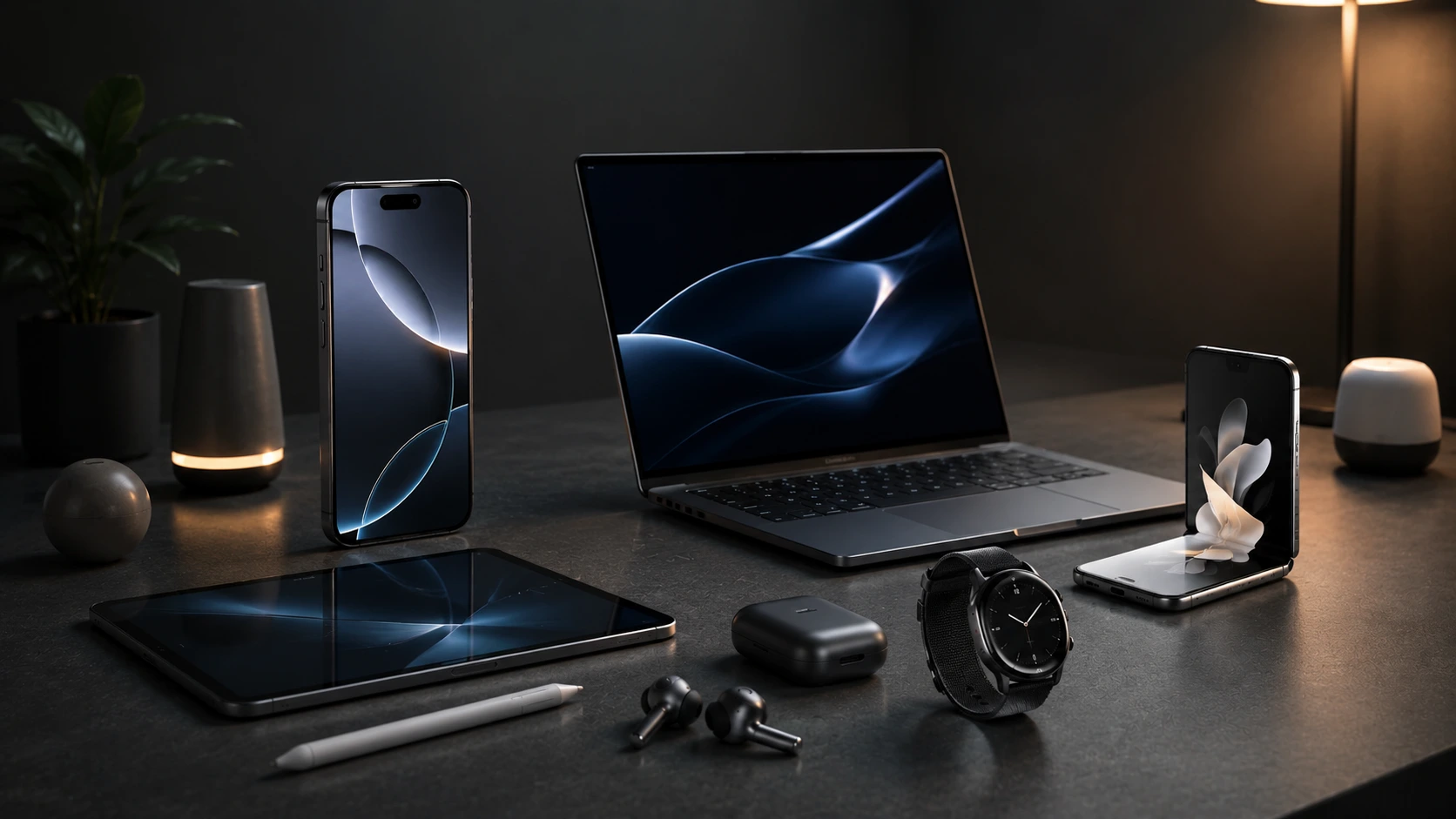
Technology in 2026 is less about adding another specification to a box and more about making devices genuinely useful. The best gadgets now combine fast hardware, smarter software, artificial intelligence, better displays, longer battery life, and increasingly connected ecosystems. That makes choosing the right device harder than simply picking the newest model.
This guide looks at the top gadgets of 2026 across phones, laptops, foldables, wearables, earbuds, and everyday technology. Rather than treating every new release as an automatic upgrade, the focus is on what actually matters when buying: performance, usability, longevity, ecosystem compatibility, and value.
Several major 2026 launches demonstrate the direction of the market. Apple has introduced products including the MacBook Neo, iPhone 17e, M5-powered MacBook Air and MacBook Pro, and M4 iPad Air, while Samsung has expanded its flagship range with the Galaxy S26 Ultra and new Galaxy Z Fold8 and Flip8 devices.
What Makes a Gadget Worth Buying in 2026?
The latest technology can look impressive on a specification sheet, but specifications do not always translate into a better daily experience.
A worthwhile gadget should solve a real problem, perform reliably, receive meaningful software support, and fit naturally into the devices you already own. AI features are increasingly important, but they should be considered alongside battery life, ergonomics, repairability, privacy, and compatibility.
For most buyers, the best choice is not necessarily the most expensive flagship. A well-balanced midrange product can provide everything needed for communication, entertainment, productivity, photography, and everyday tasks.
Top Gadgets to Consider in 2026
1. Samsung Galaxy S26 Ultra
The Galaxy S26 Ultra is one of the clearest examples of how flagship smartphones are evolving. Samsung positions it as an AI-focused device with a 6.9-inch display, a 200MP main camera, built-in Privacy Display, S Pen support, and a customized Snapdragon 8 Elite Gen 5 for Galaxy processor.
Its appeal is particularly strong for users who want one device for photography, productivity, gaming, communication, and content consumption. The Privacy Display is also a practical feature for people who frequently use their phone in public spaces.
The important buying consideration is size. A phone this large may be excellent for productivity but less comfortable for users who prefer compact devices.
2. Apple MacBook Air with M5
Apple’s 2026 MacBook Air lineup brings the M5 chip to 13-inch and 15-inch models. Apple also highlights expanded AI capabilities and Wi-Fi 7 and Bluetooth 6 connectivity through its N1 chip.
For students, professionals, writers, developers, photographers, and general users, the MacBook Air remains attractive because it focuses on portability without moving into the heavier professional-laptop category.
The 15-inch version makes more sense for multitasking and larger workspaces, while the 13-inch model is easier to carry.
3. Samsung Galaxy Z Fold8 Ultra
Foldable phones have moved beyond being novelty products. Samsung’s latest Galaxy Z lineup includes the Z Fold8 Ultra, Z Fold8, and Z Flip8, with the new Fold models designed around larger flexible displays and productivity.
The Z Fold8 Ultra is especially interesting for people who regularly read documents, manage multiple applications, edit content, or travel with limited space for additional devices.
However, foldables still require a different buying mindset. You are paying for flexibility as much as raw specifications. If you rarely use the larger internal display, a conventional flagship may offer better value.
4. Google Pixel 10 Series
Google’s Pixel ecosystem continues to demonstrate how software can be as important as hardware. Google’s current lineup includes the Pixel 10, Pixel 10 Pro and Pro XL, Pixel 10 Pro Fold, and Pixel 10a.
The Pixel approach places considerable emphasis on Google’s AI services, photography tools, and integration between phones and other devices.
For buyers who prioritize computational photography, Google services, and AI-assisted features, Pixel devices are worth considering. The best model depends largely on whether you need flagship camera hardware, a foldable form factor, or a more affordable phone.
5. MacBook Neo
The MacBook Neo is particularly notable because it brings Apple’s laptop experience into a lower-cost category. Apple describes it as its most affordable laptop, with a 13-inch Liquid Retina display, fanless design, and up to 16 hours of battery life.
This makes it an interesting choice for students and everyday users who mainly browse the web, stream content, write documents, communicate, and perform lighter creative work.
It should not automatically be treated as a replacement for a MacBook Pro. Buyers working with demanding video projects, professional 3D applications, or sustained high-performance workloads should consider higher-tier hardware.
Wearables Are Becoming More Useful
Smartwatches and fitness devices increasingly work as extensions of phones rather than isolated gadgets.
Samsung’s 2026 Galaxy Watch lineup includes the Watch9 and Watch Ultra2. Samsung describes the Watch9 as an everyday health and activity companion, while the Ultra2 targets outdoor and higher-performance use.
Google’s Pixel Watch 4 also emphasizes health, fitness, safety, battery improvements, and Gemini-based assistance.
The practical lesson is simple: buy a wearable based on the information and interactions you actually want. If you primarily need notifications and basic activity tracking, an expensive premium model may be unnecessary. Outdoor users and serious fitness enthusiasts have stronger reasons to consider rugged or advanced models.
Earbuds and AI Assistants
Wireless earbuds are becoming another interface for AI.
Google’s Pixel Buds 2a, for example, support hands-free Gemini interactions, including asking for information, getting directions, and interacting with messages.
That is useful because it reduces the need to pull out a phone for simple tasks. But audio quality, comfort, microphone performance, battery life, and noise cancellation still matter more than an impressive AI feature list.
For daily use, the best earbuds are the ones you can comfortably wear for extended periods and that remain reliable across calls, music, video, and commuting.
How AI Is Changing Gadgets
Artificial intelligence is now integrated across phones, computers, watches, earbuds, and operating systems.
Apple’s 2026 software announcements include a new generation of Apple Intelligence and a substantially redesigned Siri AI experience intended to work across iPhone, iPad, Mac, Apple Watch, and Apple Vision Pro.
Google is also integrating Gemini more deeply into Pixel devices, while Samsung uses Galaxy AI across its flagship ecosystem.
The important distinction is between useful AI and decorative AI.
Useful AI can summarize information, edit photographs, assist with writing, translate content, automate repetitive actions, or help users navigate information. Decorative AI is a feature that looks impressive in demonstrations but rarely changes how you use the product.
Before buying, ask whether you would actually use the AI feature several times a week.
Read More: Best Tech Gadgets to Buy in 2026
Quick Comparison of 2026 Gadget Categories
| Gadget | Best For | Main Strength | Main Consideration |
|---|---|---|---|
| Galaxy S26 Ultra | Power users | Camera, AI, productivity | Large and premium |
| MacBook Air M5 | Professionals & students | Performance and portability | macOS ecosystem |
| Galaxy Z Fold8 Ultra | Multitasking | Foldable productivity | Premium form factor |
| Pixel 10 series | AI and photography | Google software | Model-specific differences |
| MacBook Neo | Everyday computing | Lower-cost Apple laptop | Not for demanding workloads |
| Galaxy Watch9 | Everyday users | Health and activity features | Android-focused ecosystem |
| Pixel Watch 4 | Pixel users | AI and fitness integration | Best within Google ecosystem |
| Pixel Buds 2a | Everyday audio | AI assistance and portability | Feature priorities vary |
Buying Advice Before You Spend Money
1. Start With Your Actual Use Case
Do not begin with a product name. Begin with the task.
If you need a laptop for writing and browsing, you probably do not need a workstation-class machine. If photography is your priority, camera processing and lens flexibility matter more than gaming performance.
2. Check Ecosystem Compatibility
A gadget should work well with the products you already use.
Apple users may benefit from staying within Apple’s ecosystem, while Android users can gain additional convenience from Samsung or Google devices. Cross-platform accessories can be useful, but ecosystem integration often reduces friction.
3. Compare Long-Term Value
A cheap device is not automatically good value, and an expensive device is not automatically future-proof.
Consider software updates, storage, battery replacement possibilities, accessories, warranty coverage, and resale value. Also check whether the features you are paying for are available in your country.
4. Avoid Buying for Specifications Alone
More megapixels, more processor cores, higher refresh rates, and larger storage numbers can be useful, but only when they improve your actual workflow.
A balanced device that performs consistently can be a better purchase than a specification-heavy product with features you never use.
Common Mistakes to Avoid
One of the biggest mistakes is upgrading every year simply because a new generation has launched. If your current device remains fast, receives security updates, and meets your needs, keeping it longer can make more financial sense.
Another mistake is ignoring accessories. A laptop may require a charger or hub, a phone may need a case and screen protection, and a smartwatch may involve additional bands or charging accessories.
Buyers should also verify regional compatibility. Network bands, warranty terms, payment features, AI availability, and local pricing can differ between countries.
FAQ’s About Top Gadgets of 2026
What are the top gadgets of 2026?
The leading gadgets span flagship smartphones, AI-focused laptops, foldable phones, smartwatches, and wireless earbuds. Strong examples include the Galaxy S26 Ultra, MacBook Air with M5, Galaxy Z Fold8 series, Pixel 10 lineup, and current premium wearables.
Which gadget category is changing the most in 2026?
AI integration is one of the biggest changes. Phones, computers, earbuds, and watches are increasingly designed to provide contextual assistance rather than simply running individual applications.
Are foldable phones worth buying in 2026?
They can be worthwhile for people who genuinely use the larger screen for multitasking, reading, or productivity. For users who mainly want a conventional smartphone experience, a standard flagship may offer better value.
Should I buy a laptop with AI features?
AI capabilities can be useful, particularly for productivity, image editing, communication, and software-assisted workflows. However, prioritize processor performance, battery life, display quality, keyboard comfort, storage, and software compatibility first.
Is the most expensive gadget always the best?
No. The best gadget is the one that matches your requirements. Premium models usually offer more advanced hardware, but midrange and lower-cost devices can provide better value for everyday tasks.
What should I check before buying technology in Pakistan?
Check local warranty coverage, official or reliable seller status, network compatibility, taxes or duties where applicable, replacement options, and whether the advertised software features are available in your region.
How often should I upgrade my gadgets?
Upgrade when your existing device no longer meets your needs, has become unreliable, lacks important software support, or offers a meaningful performance improvement that justifies the cost. Annual upgrades are rarely necessary for everyone.
Conclusion
The best gadgets of 2026 are not defined by one specification or one brand. The strongest products combine capable hardware with useful software, AI features, reliable connectivity, good battery performance, and an ecosystem that fits the user’s everyday life.
Flagship phones such as the Galaxy S26 Ultra appeal to users who want maximum smartphone capability, while products such as the MacBook Air with M5 focus on portable computing. Foldables offer a different approach to multitasking, and newer earbuds and smartwatches are becoming more intelligent companions.
The smartest buying strategy is therefore straightforward: identify what you actually need, compare products within that category, check regional availability and support, and pay for features you will genuinely use. That approach will usually lead to a better purchase than simply chasing the newest gadget.
