

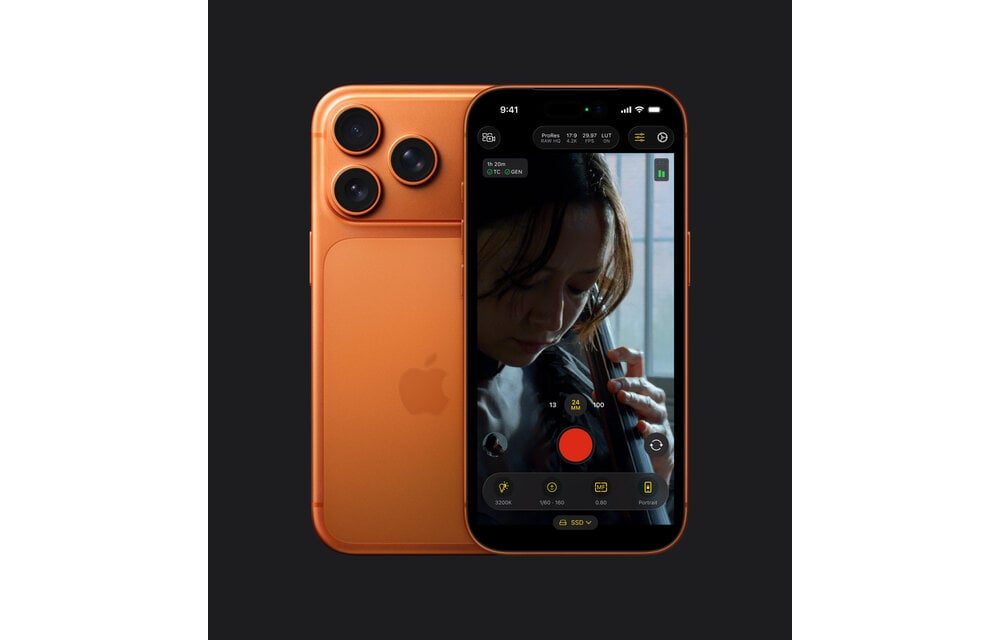
The best phones for video recording in 2026 have quietly made dedicated cameras optional for most people. Flagships now shoot 4K at 120fps, record 8K footage, stabilize walking shots without a gimbal, and capture usable video in near darkness. But they don’t all do it equally well — iPhones lead on consistency and pro formats, Samsung dominates zoom and resolution, and Pixel wins on computational low light. Here’s how the top picks compare, and what actually matters when you choose.
Best Phones for Video Recording 2026: Our Top Picks
iPhone 17 Pro Max — Best Overall ($1,199)
Apple’s flagship remains the safest choice for video. All three rear cameras are now full 48MP Fusion sensors, with the main sensor roughly 56% larger than the iPhone 16 Pro’s, and the telephoto reaches 8x optical zoom — effectively eight focal lengths in your pocket. You get 4K ProRes Log recording, Cinematic mode, Action mode stabilization, and an 18MP Center Stage front camera that auto-reframes selfies. Color accuracy and exposure consistency are still the industry benchmark.
Samsung Galaxy S26 Ultra — Best Zoom and 8K ($1,299)
Samsung’s answer is resolution and reach: a 200MP main camera with a brighter f/1.4 aperture, a 50MP 5x periscope telephoto (now f/2.9), and 8K recording in the cinematic APV codec. A new Horizontal Lock feature keeps footage level even when you tilt the phone mid-shot. It’s the pick for wildlife, concerts, and anything shot from far away — though it costs $100 more than the iPhone and still trails Apple on color science in tricky light.
Google Pixel 10 Pro — Best Low Light and AI ($999)
The Pixel’s strength is computational: Night Sight Video brightens dark scenes without drowning them in noise, and Google’s AI editing tools (Magic Eraser, Camera Coach, Auto Best Take) make post-production nearly effortless. If you shoot mostly after sunset or want the phone to do the thinking, this is your pick.
vivo X300 Pro and Xiaomi 15 Ultra — Optical Specialists (~$949–$999)
For zoom purists, the Chinese flagships go further on glass. The vivo X300 Pro’s Zeiss-tuned periscope delivers exceptional 5x–10x clarity with studio-grade portrait bokeh, while the Xiaomi 15 Ultra’s Leica-branded triple telephoto stack offers the best macro-to-super-telephoto continuity of any phone. Our Xiaomi 17 Ultra review dives deep into what this camera-first philosophy delivers in practice.
Stabilization: The Make-or-Break Feature
Nothing ruins phone footage faster than shake. The iPhone’s combination of sensor-shift optical stabilization and Action mode handles walking shots remarkably well; Samsung pairs OIS with AI motion stabilization; and the Pixel’s Video Boost with Cinematic Pan mode is purpose-built for handheld movement. Samsung’s new Horizontal Lock is a clever addition for keeping horizons straight.
That said, physics still favors dedicated hardware. A compact gimbal from DJI, Zhiyun, or Hohem — many now with AI subject tracking — produces visibly cleaner results than any phone alone, and a basic tripod remains the cheapest way to nail static shots, interviews, and time-lapses.
Low-Light Video: Where Phones Differ Most
This is the category that separates great video phones from good ones. The Pixel leads on computational processing, using Night Sight Video to lift shadows without excessive grain. The iPhone counters with a genuinely larger sensor and Log recording for manual control in post. Samsung’s brighter f/1.4 aperture gets more light to the sensor before software has to compensate.
Technique matters as much as hardware here: shoot at 24fps rather than 60fps to let each frame gather more light, avoid digital zoom in dark scenes (noise compounds dramatically when you crop), and whenever possible, just add light — the golden hour after sunrise or before sunset remains free and unbeatable.
Zoom: Optical Reach Beats Digital Every Time
Pinch-zoom is the enemy of quality — it crops the sensor and degrades the image, especially in low light. Real optical zoom uses glass, and 2026’s flagships offer more of it than ever: 8x on the iPhone 17 Pro Max, 5x periscope on the Galaxy S26 Ultra, and up to 10x on the vivo and Xiaomi flagships. Samsung even replaced its old 10x lens with a 5x periscope plus intelligent cropping, betting that a brighter, sharper 5x beats a dimmer true 10x. For concerts, wildlife, and sports, optical reach is the spec that matters most.
Pro Video Formats and Manual Control
If you edit your footage, formats matter. iPhones record ProRes and ProRes Log — including direct to an external SSD over USB-C, which eliminates both storage anxiety and overheating on long takes. The Galaxy S26 Ultra answers with 8K in the APV codec. For manual control, the free Blackmagic Camera app (plus Filmic Pro and Moment Pro Camera) unlocks frame-rate control, focus peaking, and audio metering that rival dedicated cameras.
As for settings: 4K at 24fps gives the classic cinematic look, 1080p at 60fps is ideal for smooth slow motion in post, and 4K at 120fps on the iPhone opens up dramatic slow-mo at full resolution.
Audio: The Overlooked Half of Video
Viewers forgive average video far more readily than bad audio. A wireless lapel system like the Rode Wireless Go III or DJI Mic 2 transforms dialogue clarity, and the Rode Wireless Pro’s 32-bit float recording can even rescue clipped audio when someone suddenly shouts. On a tight budget, a $25 wired lavalier like the Boya BY-M1 is a massive upgrade over built-in mics — just budget for a windscreen outdoors. A directional shotgun mic such as the Rode VideoMicro 2 is the better choice for run-and-gun shooting.
Accessories That Multiply What Your Phone Can Do
A phone cage or rig gives you somewhere to mount a mic, light, and lens at once, and makes handheld shooting comfortable over long sessions. Clip-on anamorphic lenses from Moment add genuine cinematic character. For lighting, a 5-in-1 reflector costs almost nothing and fills shadows beautifully outdoors; indoors, a small bi-color LED panel is the single best investment after audio. And the oldest trick still works: position your subject facing a large window for soft, flattering natural light.
Budget and Used Picks That Still Deliver
You don’t need $1,200 for great phone video. The Pixel 10a ($499) brings flagship-level processing to a budget price, the base iPhone 16 ($799) shoots 4K/60 with Cinematic mode, and Samsung’s S25 FE ($599) adds a 3x telephoto for less. The used market is even kinder: an iPhone 13 Pro ($400–$550) still shoots 4K ProRes with Cinematic mode and covers 90% of what newer iPhones do, while a used Galaxy S22 Ultra brings 8K and 10x zoom for half the price of current flagships. For vloggers who want hands-free angles, Samsung’s Z Flip 6 folds into its own tripod.
For the full photography picture beyond video, see our guide to the best camera phones of 2026 for photos, video and zoom.

Best Phones for Video Recording: FAQs
Which phone is the best for video recording?
The iPhone 17 Pro Max and Samsung Galaxy S26 Ultra are the top two. The iPhone wins on consistency, color science, and pro formats like ProRes Log; the Samsung wins on 8K resolution and optical zoom reach.
Do I need 8K video recording?
Rarely. Most platforms compress everything to 4K or 1080p anyway. 8K is genuinely useful if you crop heavily in editing or want to future-proof footage — otherwise, excellent 4K matters far more.
Is a high megapixel count important for video?
Not really. Most 200MP sensors pixel-bin down to 12MP for video and photos to improve light capture. Sensor size, aperture, stabilization, and software tuning decide video quality far more than megapixels.
Do I need a telephoto lens?
Only if you regularly shoot distant subjects — concerts, wildlife, sports, architecture. For family, food, travel, and street scenes, a strong main and ultra-wide camera is plenty.
Should I enable AI video enhancement?
For quick social sharing, yes — it improves exposure and composition automatically. For professional or archival work, shoot in a flat/Log profile with AI off to keep full control in the edit.
Verdict: Pick for Your Shooting Style
For most people, the iPhone 17 Pro Max is the best phone for video recording in 2026 — consistent, color-accurate, and edit-friendly. Zoom-obsessed shooters should take the Galaxy S26 Ultra, night owls the Pixel 10 Pro, and budget buyers the Pixel 10a or a used iPhone 13 Pro. Whichever you choose, remember the real hierarchy: good audio and good light will improve your footage more than any phone upgrade.
