

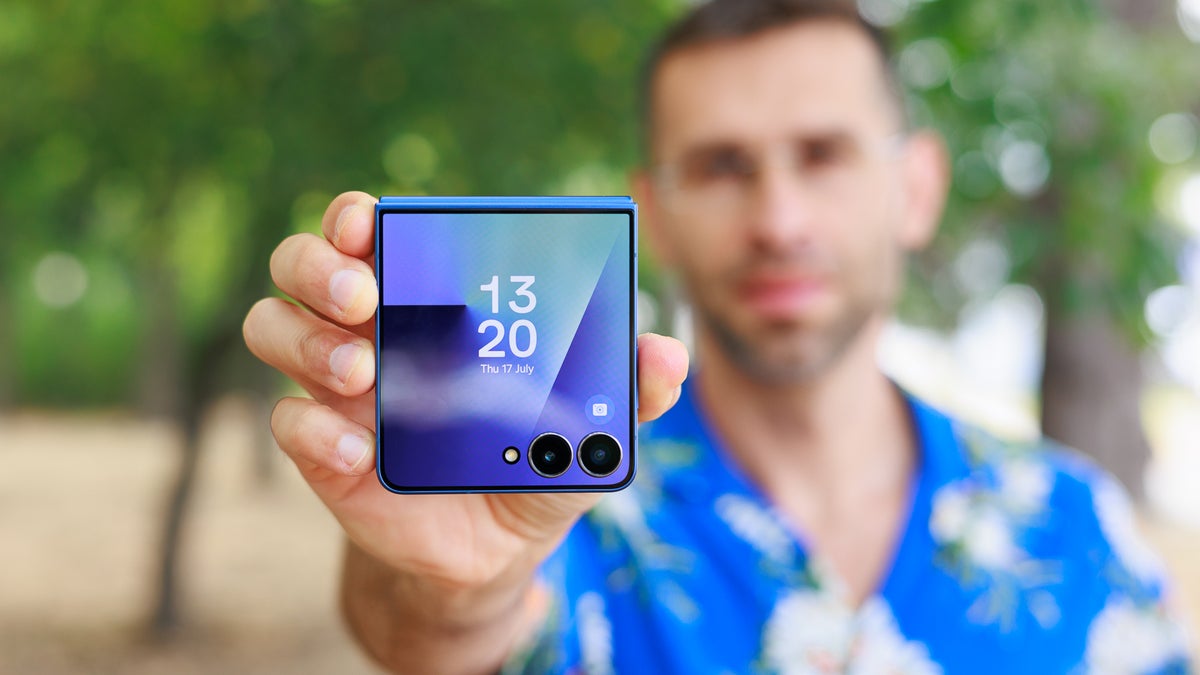
The Samsung Galaxy Z Flip 7 review story is a familiar one for foldables: every year the hardware gets a little thinner, the cover screen gets a little bigger, and the battery gets a little larger. This year, though, Samsung’s changes are more meaningful than usual. The Flip 7 finally ditches the awkward notch-cut cover display for a proper edge-to-edge 4.1-inch FlexWindow, grows the inner panel to 6.9 inches, bumps the battery to 4,300mAh, and slimmed everything down to just 6.5mm unfolded.
The controversy sits under the glass. Samsung dropped Qualcomm for its own Exynos 2500 chip in every region, and the 25W charging speed has barely moved in years. So the big question this Samsung Galaxy Z Flip 7 review has to answer: is this the year the flip phone stops being a novelty and starts being the sensible buy?
Our Verdict
The Galaxy Z Flip 7 is the most complete Samsung clamshell yet — and, on balance, the best flip foldable of its generation. The full-bleed cover screen finally makes the phone genuinely useful while closed, the new slimmer chassis feels like a flagship, and Samsung DeX plus Galaxy AI give it a feature set no rival can match at this price. Seven years of updates seal the long-term deal.
It is not flawless. The cover screen still runs widgets rather than full apps, 25W charging is sluggish for 2026, the Exynos 2500 throttles hard under sustained load, and there is no telephoto camera. But for a flip that folds into your pocket and unfolds into a 6.9-inch flagship, this is the one to beat.
Design and Build Quality
For the first time in three generations, the Flip looks like a new phone. The old folder-shaped cover display with its cut-out around the camera lenses is gone, replaced by a single edge-to-edge 4.1-inch FlexWindow that spans the whole top half of the device. It is a genuinely premium look, and the panel is protected by Gorilla Glass Victus 2 on both front and back.
The push for thinness is real here. The Flip 7 is 6.5mm thick when open and 13.7mm when closed, which makes it 1.2mm slimmer folded than the Flip 6. At 188g it weighs about the same as before, but the body has grown slightly wider and taller, which makes the inner display’s new 21:9 aspect ratio feel more like a conventional flagship phone. The frame is Samsung’s Armor Aluminum, and the updated Armor FlexHinge promises smoother folds and long-term durability. In practice the hinge feels sturdy and can be left parked at a wide range of angles for hands-free photos and video calls.
One trade-off of the slimmer frame: unfolding can be a touch trickier, since there is less to grip between the two halves. And while the IP48 rating means the Flip 7 shrugs off full submersion in 1.5 metres of water for 30 minutes, dust protection is still limited — particles smaller than 1mm can theoretically work their way into the hinge. It is better than most foldables, but it is not dust-proof.
Displays: Cover Screen and Main Display
The cover screen
The 4.1-inch FlexWindow is the headline upgrade, and it is comfortably the biggest change on the outside of the phone. It is a Super AMOLED panel with a 120Hz refresh rate and a peak brightness of 2,600 nits, which makes it sharp and readable even in bright daylight. The thinnest bezels Samsung has ever used on a Galaxy phone let the screen flow edge to edge, and it is marginally larger than the equivalent display on the Motorola Razr 60 Ultra.
Software is where the ceiling appears. The cover screen is still widget-first: weather, calendar, notifications, music controls and Gemini Live are all here, and a handful of apps like Maps, YouTube, Netflix and Messages can run natively. But there is no real task switcher, and switching between cover apps often relaunches them rather than resuming. Rivals — particularly Motorola’s Razr — offer a fuller cover-screen experience, and this remains the Flip 7’s most legitimate weakness.
The main display
Open the phone and you get a 6.9-inch foldable Dynamic LTPO AMOLED 2X panel with a 2520×1080 resolution, adaptive 1–120Hz refresh and HDR10+ support. It peaks at 2,600 nits in marketing figures, and independent lab testing measured around 2,636 cd/m² in peak HDR conditions with very even brightness distribution. Colours are typically Samsung — rich and accurate enough at roughly 99.7% sRGB coverage — and PWM dimming runs at a relatively low 240–480Hz, which sensitive users may notice.
The crease is still there. It has a gentle waviness you can catch in photos or find if you go looking for it with a fingertip, but in normal use it fades from attention. Independent comparisons put it a small step ahead of the Razr on crease visibility, though behind the best of the Chinese competition.
Performance and Thermals
The Exynos 2500 is a 3nm, 10-core chip: one Cortex-X5 prime core at 3.3GHz, seven Cortex-A725 cores split between 2.74GHz and 2.36GHz clusters, and two Cortex-A520 efficiency cores at 1.8GHz, backed by an Xclipse 950 GPU. Every Flip 7 in every region runs this silicon — the first Flip without a Qualcomm option — and it ships with 12GB of LPDDR5x RAM and 256GB or 512GB of UFS 4.0 storage.
In day-to-day use the phone is effortlessly fast. Multitasking with two apps side by side plus a third in a floating window runs without judder, demanding games like Call of Duty: Mobile and Black Desert Mobile hold their frame rates at high settings, and benchmark numbers are respectable: roughly 2,286 single-core and 8,079 multi-core in Geekbench 6, over 1.5 million in AnTuTu 10.
The caveat is thermals. The Exynos 2500 trails the Snapdragon 8 Elite for Galaxy by around 10% in Geekbench, and — more importantly — it throttles heavily under sustained load, with independent testing recording very pronounced performance drops during long sessions. The area behind the cover screen gets noticeably warm during extended gaming, and sustained performance drops off well before a Snapdragon rival’s would. For browsing, social media, photography and AI features it is a non-issue; for long gaming sessions it is worth knowing about.
Cameras
Samsung is alternating camera upgrades between its foldables, and this year the Fold got the new hardware while the Flip keeps last year’s system. The 50MP main sensor (Samsung’s ISOCELL GN3, f/1.8, 23mm, dual-pixel PDAF and OIS) is the same capable unit also used in the Galaxy S25. It is joined by a 12MP ultra-wide (f/2.2, 13mm, 123-degree field of view, fixed focus) and a 10MP front camera inside the main display.
Daylight shots from the main camera are genuinely flagship-grade: sharp, well-exposed, with natural skin tones thanks to the ProVisual Engine. The 50MP sensor allows for high-quality 2x sensor-crop zoom, with up to 10x digital available — but there is no dedicated telephoto lens, and that shows beyond 2x. The ultra-wide is good in daylight with slight softness toward the edges, though the fixed focus is a step behind the Flip’s book-style sibling, which this year gained an autofocus ultra-wide. Low-light performance is solid and has improved over the Flip 6.
Where the Flip 7’s cameras shine is in how the form factor serves them. The cover screen is arguably the best camera implementation on any foldable: it acts as a viewfinder for the rear cameras, so selfies and group shots use the main sensor instead of the weaker front camera, and you can switch modes and zoom levels (including 2x) from the cover screen — something Motorola’s Razr still can’t match. Flex Mode lets the phone stand on its own at any angle for hands-free shooting, waist-level framing or overhead shots. Both rear and front cameras record 4K at 60fps with HDR10+.
Battery Life and Charging
The 4,300mAh battery is a 300mAh step up over the Flip 6 — modest, but meaningful in a chassis this thin. Real-world endurance is decent rather than great: it comfortably lasts a full day of light to moderate use (social media, email, messaging, video), but heavy streaming days, long camera sessions or mobile hotspotting can leave it worrying by dinner. Lab testing paints a brighter picture, with one standardized web-browsing test running nearly 19 hours and an active-use score of 11 hours 52 minutes.
Charging is the sore point. 25W wired charging delivers 50% in about 30 minutes, which is simply slow for a $1,099 flagship in 2026 — rivals like the Razr charge several times faster. There is also 15W wireless charging and 4.5W reverse wireless for topping up earbuds. And note the box contains no charger, just a basic USB-C cable and a SIM tool.
Software, AI Features and Updates
The Flip 7 and its Fold 7 sibling were the first phones to ship with Android 16 and One UI 8 out of the box, and Samsung’s update promise is best-in-class: seven major OS upgrades and seven years of security patches. The interface is the most complete, feature-rich Android implementation around, with an enormous depth of customisation options.
Galaxy AI is the real software story. Multimodal AI via Gemini Live is directly accessible from the cover screen, and the new additions — Now Brief (personalized morning updates on weather, calendar and health), Now Bar (persistent smart notifications), cross-app actions, and Audio Eraser for video — add genuine depth. Cover-screen Gemini works surprisingly well for quick queries without opening the phone. Knox Matrix security, KEEP and post-quantum encryption handle the security story.
One surprise: Samsung DeX is here. The Flip 7 supports the full desktop-experience mode over USB-C, which gives this pocketable phone a credible “computer in your pocket” angle for travel and hot-desking — a genuine differentiator over Motorola’s flip phones. Circle to Search is also on board, and the side-mounted fingerprint sensor is fast and reliable.
Connectivity and Extras
The connectivity sheet reads like a flagship: 5G (sub-6 and mmWave where offered), eSIM plus dual-SIM support, Wi-Fi 7, Bluetooth 5.4 with aptX, LDAC and Samsung’s SSC codec, NFC for payments, and even Ultra Wideband — rare on a flip phone. The USB-C port supports USB 3.2 Gen 1 with wired video output, and a transfer test to an external SSD hit a respectable 325 MB/s. Stereo speakers are loud and clear, with measured output rated good at -26.1 LUFS, and call quality is excellent.
Colours are Blue Shadow, Jet Black, Coral Red and Mint. Storage options are 256GB and 512GB — there is no more 128GB base model, but equally there is no microSD expansion, so choose your capacity carefully.
Price and Availability
The Galaxy Z Flip 7 launched at $1,099 for the 256GB model and $1,219 for 512GB in the US, €1,199 / €1,319 in Europe and around £1,049 / £1,149 in the UK. Samsung held the price flat versus the Flip 6, which helps against the Razr 60 Ultra — itself no longer cheap after Motorola’s price increase.
Street prices have softened considerably since launch, with the 256GB model regularly available online for well under its launch price (as low as around €770 in parts of Europe and roughly $835–$950 in the US depending on retailer). At those prices the value argument gets a lot stronger: you get flagship build, seven years of updates and the best flip software package for upper-midrange money.
How It Compares
The Motorola Razr 60 Ultra (Razr Ultra 2025) is the Flip 7’s defining rival. The Razr gives you a Snapdragon 8 Elite, faster charging, and arguably a better-executed cover screen, with photo quality that is no worse than the Galaxy’s — and it has been cheaper in Europe for much of the year. If raw speed and charging matter most, the Razr is the better buy.
The Xiaomi Mix Flip 2 does several things better too, with superior cover-screen usability and a stronger charging story. If you want to spend less, the Galaxy Z Flip 7 FE is essentially the Flip 6 rebadged with a larger battery — the older Flip 6 at its discounted prices is arguably the smarter value play if the new cover screen doesn’t sway you. And for the same money as a launch-price Flip 7, the book-style Galaxy Z Fold 6 offers a completely different, more productive foldable experience — our round-up of the best foldable phones of 2026 puts all of these head to head.
Against slab flagships, the Flip 7’s cameras and battery can’t match a Galaxy S25 Ultra, but it costs $200 less and gives you the flip form factor, a second screen and DeX in your pocket.
Pros and Cons
Pros
- Premium, slim chassis with IP48 water resistance
- Big, bright edge-to-edge 4.1-inch FlexWindow
- Excellent 6.9-inch 120Hz foldable OLED display
- Seven years of OS and security updates
- Flagship-quality 50MP main camera with OIS
- Samsung DeX, Galaxy AI and Gemini Live on the cover screen
- Fast day-to-day performance with 12GB RAM
Cons
- Cover screen is still widget-based — no true full app support
- Small 4,300mAh battery for the price
- Slow 25W charging
- Crease more visible than on some rivals
- Heavy throttling under sustained load (Exynos 2500)
- No telephoto camera
- No charger in the box
Samsung Galaxy Z Flip 7 Specs
| Specification | Details |
|---|---|
| Main display | 6.9-inch Foldable Dynamic LTPO AMOLED 2X, 2520×1080, 1–120Hz, HDR10+, 2,600 nits peak |
| Cover display | 4.1-inch Super AMOLED, 948×1048, 120Hz, 2,600 nits peak |
| Chipset | Exynos 2500 (3nm), 10-core, Xclipse 950 GPU |
| RAM / Storage | 12GB / 256GB or 512GB (UFS 4.0) |
| Rear cameras | 50MP main (f/1.8, OIS) + 12MP ultra-wide (f/2.2) |
| Front camera | 10MP (f/2.2) |
| Video | 4K@60fps (rear and front), HDR10+ |
| Battery | 4,300mAh, 25W wired, 15W wireless, 4.5W reverse wireless |
| OS | Android 16, One UI 8, 7 years of updates |
| Dimensions | 166.7 x 75.2 x 6.5mm (open), 85.5 x 75.2 x 13.7mm (closed) |
| Weight | 188g |
| Build | Gorilla Glass Victus 2, Armor Aluminum, IP48 |
| Extras | Samsung DeX, side fingerprint sensor, stereo speakers, Wi-Fi 7, UWB, NFC, eSIM |
| Colours | Blue Shadow, Jet Black, Coral Red, Mint |

Frequently Asked Questions (FAQs)
Is the Samsung Galaxy Z Flip 7 worth buying in 2026?
For most flip-phone buyers, yes — especially at street prices well below launch. You get the biggest cover screen Samsung has ever put on a Flip, a flagship-quality main camera, Samsung DeX, the best AI feature set in the foldable category and seven years of updates. The caveats are real but manageable: 25W charging is slow, the Exynos 2500 throttles under sustained gaming, and the cover screen still doesn’t run full apps. If those are dealbreakers, the Motorola Razr 60 Ultra or a discounted Flip 6 deserve a look.
What are the Samsung Galaxy Z Flip 7 specs?
The headline specs: 6.9-inch foldable Dynamic AMOLED 2X main display (120Hz, 2520×1080), 4.1-inch Super AMOLED cover screen (120Hz), Exynos 2500 3nm chip, 12GB RAM, 256GB or 512GB storage, 50MP + 12MP rear cameras, 10MP front camera, 4,300mAh battery with 25W wired and 15W wireless charging, Android 16 with One UI 8, IP48 rating, and a 188g body that is just 6.5mm thin unfolded.
Does the Galaxy Z Flip 7 have a telephoto camera?
No. The Flip 7 has two rear cameras: a 50MP main with OIS and a 12MP ultra-wide. There is no dedicated telephoto lens, so zoom relies on a 2x sensor crop from the main camera (which looks genuinely good) and up to 10x digital zoom (which doesn’t). If long-range zoom matters to you, a slab flagship or the Fold 7 — which got this year’s camera upgrade — are better choices.
How is the battery life on the Galaxy Z Flip 7?
Decent but not class-leading. The 4,300mAh cell gets most people through a full day of light to moderate use, and lab tests recorded up to 11 hours 52 minutes of active use. Heavy days — lots of photography, streaming or hotspotting — can drain it by evening. The bigger disappointment is charging: 25W wired is slow for 2026, taking roughly half an hour for a 50% top-up, and rivals charge far faster.
Is the Galaxy Z Flip 7 waterproof?
It is water-resistant, not fully waterproof. The IP48 rating means it can survive submersion in up to 1.5 metres of fresh water for 30 minutes, so rain and accidental drops in the sink are fine. But the “4” in IP48 only protects against solid objects larger than 1mm — fine dust and sand can still theoretically enter the hinge mechanism, so beach trips deserve caution.
Is the Galaxy Z Flip 7 better than the Motorola Razr 60 Ultra?
It depends on your priorities. The Razr 60 Ultra is faster (Snapdragon 8 Elite), charges much faster and arguably runs a better cover-screen interface. The Flip 7 counters with seven years of updates (versus Motorola’s shorter promise), Samsung DeX, a deeper Galaxy AI toolkit, and in many markets a lower price. Reviewers are split, but the Flip 7 is the better long-term, feature-rich pick; the Razr is the better performer.
Does the Galaxy Z Flip 7 come with a charger?
No. Like recent Samsung flagships, the Flip 7 ships in a slim graphite box with just a USB-C cable and a SIM ejector tool. To get the fastest 25W charging you will need a compatible USB-C PD charger, which most people already own.
How visible is the crease on the Galaxy Z Flip 7?
It is still there but easy to ignore. There is a gentle waviness across the middle of the inner display that shows up in photos and can be felt if you deliberately run a finger across it, but it disappears in normal viewing. Independent comparisons rate it slightly better than the Razr’s crease, though some Chinese foldables hide theirs more effectively.
Does the Galaxy Z Flip 7 support Samsung DeX?
Yes — and this is one of its best hidden features. The Flip 7 supports Samsung DeX, the desktop-experience mode, over a wired USB-C connection. It turns the pocketable flip phone into a credible travel workstation when paired with a monitor, giving it a productivity angle no rival flip phone can match.
What is the Galaxy Z Flip 7 price in 2026?
Launch pricing was $1,099 (256GB) / $1,219 (512GB) in the US, €1,199 / €1,319 in Europe and around £1,049 in the UK. Since launch, street prices have dropped substantially — the 256GB model is regularly found for well under launch price from major online retailers, making it a much stronger value proposition than it was at release.
The Bottom Line
This Samsung Galaxy Z Flip 7 review lands in a clear place: Samsung finally made the Flip feel like the finished product. The edge-to-edge cover screen, the slimmer and more durable chassis, the camera system and the DeX-plus-AI feature set add up to the most complete clamshell foldable of its generation. The compromises — widget-limited cover screen, slow charging, an Exynos chip that throttles hard — are real, but none of them undoes the fundamental proposition.
If you want a phone that folds in half, fits in any pocket and still does nearly everything a flagship slab can, the Galaxy Z Flip 7 is the easiest recommendation in the flip category right now — especially once you shop around for a deal. Check our round-up of the best foldable phones of 2026 to see how it stacks up against the whole field before you buy.
