

The best running watches do more than count miles. They tell you if your pace is drifting, if your recovery is slipping, and if your training is moving in the right direction — and two runners can log the same distance and get very different results. The right watch helps you train with more control, whether you’re building toward a 5K, stacking marathon miles, or just trying to make easy runs stay easy. Drawing on five current expert buying guides, this roundup matches every runner to the right wrist.
The Best Running Watches of 2026 at a Glance
- Garmin Forerunner 970 (~$749) — Best overall — ~26h multi-band GPS — AMOLED — Full-color maps
- Apple Watch Ultra 3 — Best premium / iPhone — ~42h use — Bright always-on — Yes maps
- Apple Watch Series 11 — Best everyday iPhone — ~24h — Always-on — Yes maps
- Garmin Forerunner 265 (~£430) — Best value — ~24h multi-band — AMOLED 1.3″ — No maps
- Garmin Forerunner 165 (~£250) — Best for beginners — ~19h — AMOLED 1.2″ — No maps
- Suunto Race 2 — Best for maps — ~55h dual-band — AMOLED 1.5″ — Full offline maps
- Coros Pace 4 — Best budget — ~41h dual-band — AMOLED 1.22″ — Breadcrumb maps
- Garmin Enduro 3 — Best for ultras — ~120h (320h solar) — MIP — Yes maps
- Polar Pacer Pro (~€250) — Best training metrics value — ~35h — MIP 1.2″ — No maps
Best Overall: Garmin Forerunner 970
This is the do-it-all pick — the kind of depth that can carry you from casual race prep to serious training blocks without feeling like a stopgap purchase. The hardware starts strong: a bright AMOLED display that stays easy to read outside, a titanium case, sapphire glass, and an LED flashlight that sounds small until you use it on early runs or dark winter evenings. Battery runs up to 15 days in smartwatch mode and around 26 hours with GPS on.
Training is where it earns its price: full-color maps, multi-band GPS, race planning, Garmin Coach support, running power, cadence, stride length, and training impact data. It handles triathlon use with automatic switching between swim, bike, and run, and packs ECG, heart rate, HRV, sleep, and training readiness into one place. The catches: it’s premium money, more watch than some runners need, and the Apple-side features are weaker. If running is the main event and you want a watch that grows with your training, this is the easiest recommendation.
Best for iPhone Runners: Apple Watch Ultra 3
If you live in Apple’s world and want the biggest, toughest, longest-lasting option, this is the clear upgrade. The titanium case, sapphire display, and 100-metre water resistance come with a large, bright screen that works well outdoors — and doubles as a flashlight before sunrise or after dark. Battery stretches to 42 hours of normal use and 72 hours in low power mode, far better than the standard Apple Watch line.
For running it covers the important stuff: dual-frequency GPS for route accuracy, heart rate zones, running power, training load, custom workouts, and broad support for cycling, swimming, and other sports. Safety is a real strength — fall detection, crash detection, and satellite emergency texting add peace of mind far from home — while you keep the Apple basics: calls, texts, music, apps, and cellular freedom without your phone. It’s expensive and big on small wrists, and overkill for casual runners, but for iPhone runners who want a full outdoor tool, it’s the pick.
Best Everyday iPhone Pick: Apple Watch Series 11
The Series 11 is the easiest answer if you want a running watch that blends into the rest of your day. It’s thinner and lighter than the Ultra, more comfortable to sleep in, and easier to wear from workouts to work to dinner. The always-on display stays bright and clear, so glancing at stats outside feels easy.
Health tracking is a big strength: heart rate alerts, ECG, blood oxygen readings, sleep apnea tracking, and hypertension notifications, plus a sleep score that makes nightly data quicker to read. For training you get heart rate zones, training load, pacing help, and smart coaching with your iPhone — more than enough if you mainly run, cross-train, and stay inside Apple’s app world. Battery lands at 24 hours, and fast charging gives about 8 hours from 15 minutes. The trade-off is battery that trails Garmin badly and best features that need an iPhone.
Best Value: Garmin Forerunner 265
This is the sweet-spot Garmin for a lot of runners — and the watch most guides would hand a friend who says “tell me one watch and stop talking.” You get an AMOLED display that stays bright outdoors, physical buttons that still matter when your hands are sweaty or the weather gets cold, and battery up to 13 days in smartwatch mode with about 20 hours of GPS.
What makes it easy to recommend is how it guides training: the morning report gives a quick read on sleep, recovery, and readiness; daily suggested workouts shift based on your current condition, not a rigid calendar; and if you’ve got a race ahead, the watch shapes the plan. Add multi-band GPS, more than 30 sport modes, heart rate, HRV, sleep tracking, safety alerts, Garmin Pay, and smart notifications. It skips the 970’s maps and a few luxury extras — which is exactly why the price is easier to justify.
Best for Beginners: Garmin Forerunner 165
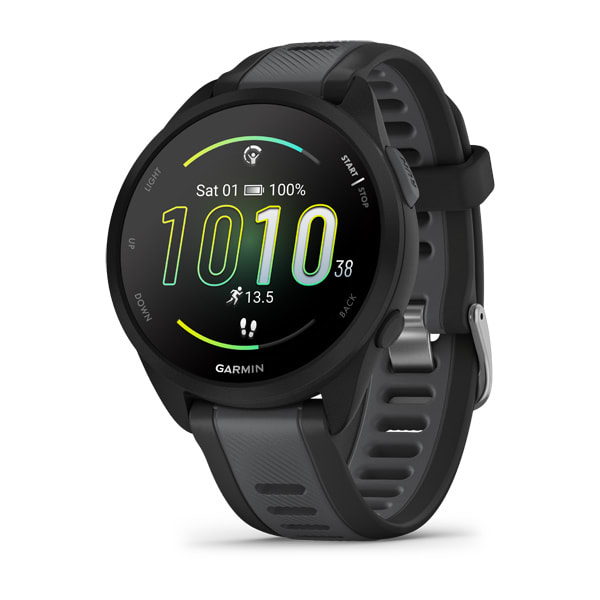
The 165 gets the basics right, which is why it’s the smart beginner pick: simple on the wrist, clear on the screen, helpful in the app, without shoving too much data at you too early. Light and not bulky, with a bright AMOLED screen that makes pace and distance quick to read outdoors. Core tracking covers exactly what new runners need — GPS for pace and distance plus wrist-based heart rate — with battery up to 11 days or around 19 hours of GPS.
The guidance tools set it apart from a plain starter watch: daily suggested workouts adjust based on sleep and recovery, and Garmin Coach can walk you to a 5K step by step. You also get 25+ sports modes, smart notifications, Garmin Pay, and safety alerts. Advanced metrics and premium materials are missing, and the ceiling is lower for serious racers — but for consistency, pace awareness, and simple race guidance, it’s the safe choice.
Best for Maps and Trails: Suunto Race 2
If wrong turns ruin your runs, this watch solves that problem better than most: full offline global maps on your wrist, not basic line guidance, plus 32GB of storage and dual-band GPS for stronger tracking without your phone. The digital crown and touchscreen make zooming and route-checking smoother than on watches that lean too hard on swipe control.
A large 1.5-inch AMOLED display stays bright outdoors, and battery is impressive for a mapping model — 16 days of daily use and around 55 hours of GPS. It supports 115+ sports and tracks heart rate, sleep, recovery, and training load, with climb guidance that reads effort better on hilly routes. Smart features are less polished and the app ecosystem is smaller, but for trails, travel runs, and exploring new routes without a phone, nothing here gives more route confidence.
Best Budget: Coros Pace 4
The low-cost pick that still feels serious. At about 32 grams with the nylon band, it’s light enough to wear all day and sleep in without notice. The 1.22-inch AMOLED display is bright and easy to read outside, and battery runs up to 19 days of daily use with around 41 hours of GPS — strong numbers for the class.
Coros didn’t strip the useful stuff: running, biking, swimming, skiing, and gym workouts, plus heart rate, sleep, recovery, HRV, training load, running power, and stride length. Dual-band GPS helps accuracy, breadcrumb navigation keeps you on course, and the microphone records short voice notes that sync to the app. Navigation is basic and lifestyle features are less polished, but for run data over smartwatch bells and whistles on a budget, this is the buy.
Best for Ultras: Garmin Enduro 3
For runners who measure workouts and races in hours, battery is everything — and the Enduro 3 delivers up to 120 hours of GPS, stretching to 320 with solar. It’s built for long events: rugged endurance design, maps, a flashlight, and a 51mm case that announces its intentions. The trade-off is size and weight: skip it if you want a small, light watch for short city runs. The Forerunner 970 is the alternative if you want premium training in a smaller package.
Best Training Metrics on a Budget: Polar Pacer Pro
Polar has the strongest reputation in heart rate accuracy and training metrics, and the Pacer Pro upholds it at around €250. Thirty-five hours of GPS, only 36 grams, native Running Power, Hill Splitter for climbs, FuelWise in-run nutrition alerts, and the Orthostatic Test for recovery insight. Polar Flow offers some of the most personalized adaptive training plans on the market.
The MIP display is readable in direct sunlight but less visually impressive than AMOLED, there’s no offline music, and it’s a basic smartwatch. But for data-driven runners who want the deepest metrics per dollar, it’s hard to beat.
How to Choose the Best Running Watch for Your Goals
Start with battery, not features. Battery life is the number one thing runners regret on a cheaper watch. Plan for the longest run you might ever do, then double it: 5K–10K runners are fine with 12 hours of GPS; half marathoners should aim for 20+; marathoners want 25–30; ultra runners need 40+. And remember that brand numbers assume the lowest GPS mode with the screen off — in real testing, expect 60–70% of the headline figure, with multi-band GPS using 30–40% more power than standard.
Insist on trustworthy GPS. If your pace jumps around or your distance comes up short, the rest of the watch matters less. Multi-band (dual-frequency) tracking is the standard to look for in 2026 — accurate within a few metres on open ground, and dramatically better than standard GPS near tall buildings, dense trees, or mixed terrain, where standard GPS can drift 10–20 metres. If you mostly run open roads, standard GPS can still be enough.
Buy training tools that help, not distract. This is where Garmin still beats everyone: training load, training readiness, recovery time, race predictor, and the training status system are genuinely useful once you have a few weeks of data. Focus on the tools you’ll use often — daily workout suggestions, heart rate zones, sleep tracking, HRV, recovery guidance, race planning, cadence or power — and skip the metrics that sound useful but won’t change how you train.
Be honest about heart rate. Wrist heart rate is fine for steady running, but no wrist watch matches a chest strap for interval sessions. If you do a lot of intervals, factor a ~£40 chest strap into the budget. The Polar Vantage M3 tested as the most accurate wrist sensor, but for precision work, a strap is still truth.
Match the phone ecosystem. If you own an iPhone and want notifications, replies, Apple Pay, and music that just works, the Apple Watch lineup is hard to beat. If you own an Android phone, Apple Watch is off the table — while Garmin, Coros, and Polar all work with both. If you just want activity tracking without a running focus, our guide to the best fitness tracker options covers the simpler side of the market.
Match the screen and controls to your conditions. A bright AMOLED screen is easier to read at a glance, but buttons matter when your hands are wet, cold, or sweaty — a touchscreen alone gets annoying fast. The best balance for many runners is a watch that gives you both. And comfort counts: a running watch spends hours on your wrist every week, so lighter watches feel better for sleep and long runs; under 50g is ideal, above 60g you’ll notice.
Decide on maps, music, and smartwatch depth. Trail runners should care about offline maps, route guidance, and climb tools; city runners may care more about calls, music, notifications, and payments. If you want to leave your phone behind, make sure the watch actually stores music — the Music-designated Garmins and any Apple Watch do; base Garmins without the Music label don’t. For long runs, noise-cancelling headphones make the miles far more pleasant.

Frequently Asked Questions
What is the best running watch overall?
The Garmin Forerunner 970 is the best overall pick — the strongest mix of battery life, advanced training tools, maps, health tracking, and long-term value. It’s the safest long-term buy if running is the main event.
Is an Apple Watch good enough for serious running?
Yes, especially the Apple Watch Ultra 3. The Series 11 works well for many runners too, but Garmin still gives you deeper training tools and longer battery life. For runs under three hours, Apple Watch GPS is excellent; for marathon-plus distances, Garmin’s battery advantage is decisive.
Do beginners need multi-band GPS?
Not always. If you’re new to running and mostly train in open areas, a watch like the Garmin Forerunner 165 does the job well. Multi-band GPS matters more in cities, wooded routes, and race-focused training.
Which running watch has the best battery life?
Among everyday picks, the Coros Pace 4 and Suunto Race 2 stand out; for ultras, the Garmin Enduro 3 is in another league. For Apple users, the Ultra 3 is the clear battery winner.
Should you choose a running watch or a smartwatch first?
Pick a running watch first if training data and battery life matter most. Pick a smartwatch first if you care more about apps, calling, music, and daily phone features.
Garmin or COROS for running?
Garmin has the most complete ecosystem. COROS delivers better value: more battery, less weight, lower price. For value, the COROS PACE 3 (or Pace 4); for the full package, the Garmin Forerunner 265.
What is the difference between standard GPS and multi-band GPS?
Multi-band GPS (L1+L5) locks onto multiple satellite frequencies simultaneously, reducing positioning error to under 3 metres in cities. Standard GPS can drift 10–20 metres near buildings or under tree cover.
Do runners need maps on a watch?
Maps are valuable for trail running, travel, long routes, and unfamiliar areas. Road runners on familiar routes can often skip premium map watches — it’s the most common way runners overbuy.
Is wrist heart rate accurate enough?
For steady running and trends, yes. It can struggle during intervals, in cold weather, with a loose fit, or heavy wrist movement. A chest strap or arm band is better for precision — factor one in if you train by heart rate seriously.
Should beginners buy an expensive running watch?
Not always. First decide whether you need GPS, workouts, training plans, and recovery metrics, or just basic activity tracking. A well-used budget watch makes you a better runner than a poorly-used flagship.
When is the best time to buy?
Avoid January to March, when new flagships launch and last month’s price drops. April to June brings discounts on last year’s models, Black Friday commonly sees 20–30% off Garmin and Coros watches, and Boxing Day offers smaller discounts with wider selection.
Final Word
The simple takeaway: Garmin still leads for pure training depth, Apple leads for smartwatch polish, Suunto leads for maps, and Coros wins on budget efficiency. The watch you wear matters less than what you do with the data — buy the watch you’ll actually use every time you head out the door.
