

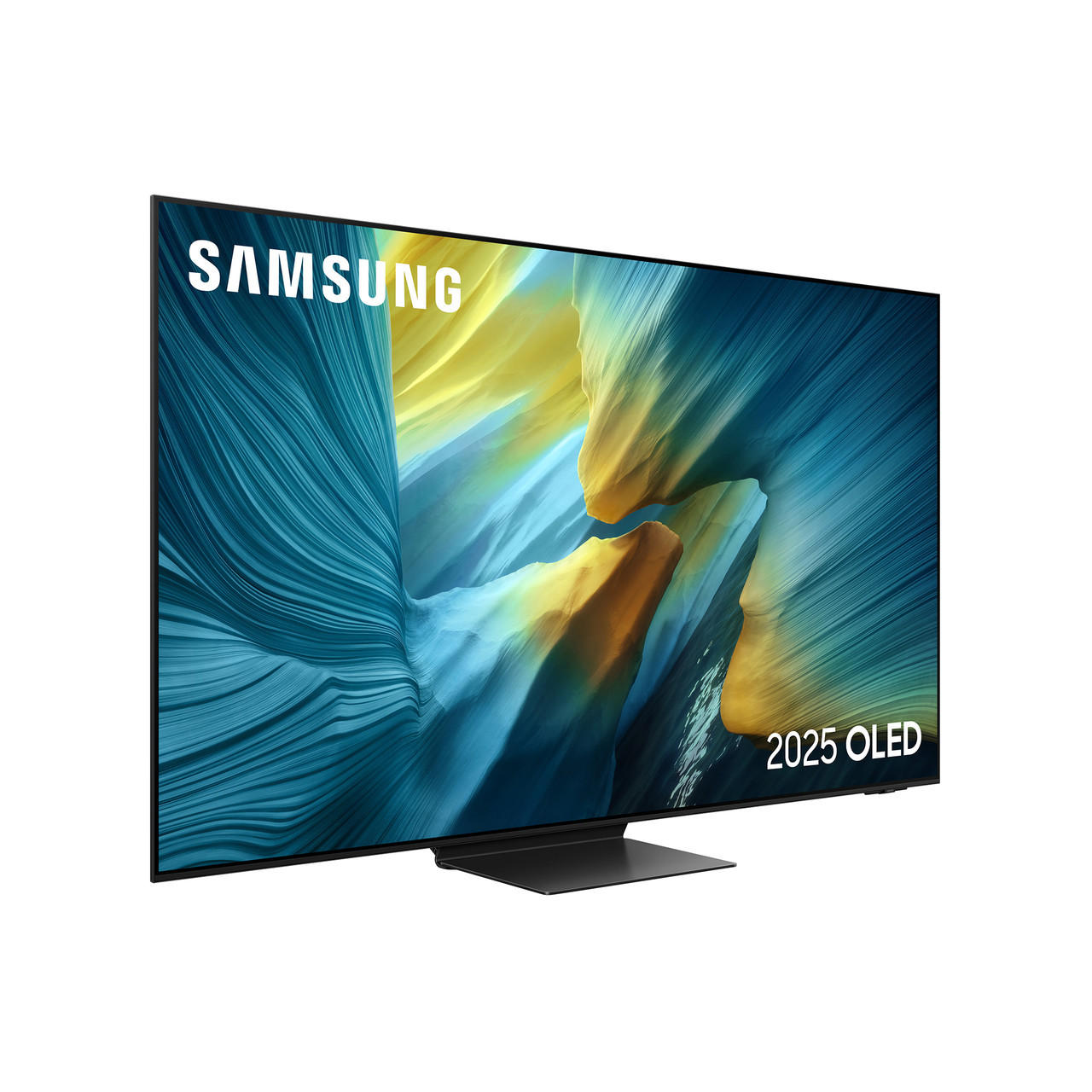
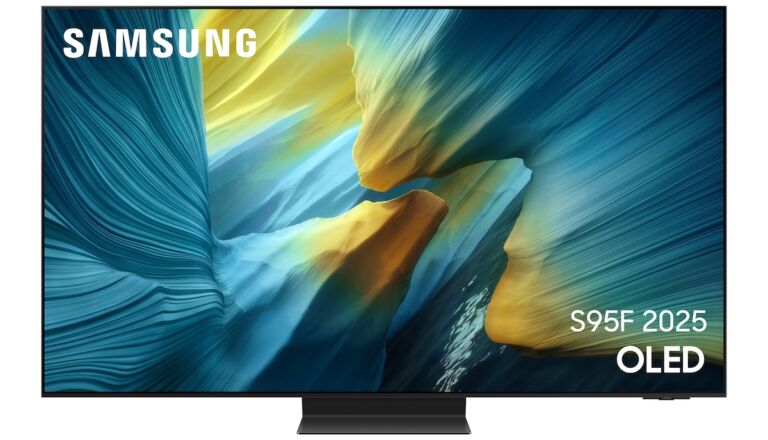
Samsung S95F OLED TV Review: First Impressions
OLED was supposed to have a ceiling. Every year the panels got a little brighter, a little more colourful, and reviewers would nod and say the technology was maturing. Then the Samsung S95F OLED TV arrived and ripped up the rule book — lab tests measured peak brightness past 4,000 nits in Standard mode, numbers that rewrites what anyone thought an OLED panel could do, wrapped in a 11mm-thin chassis with a screen that simply refuses to reflect your living room back at you.
This Samsung S95F OLED TV review pulls together lab-tested measurements and hands-on verdicts from five major review outlets — including a perfect 10/10 and multiple five-star scores — to give you the full picture: the jaw-dropping brightness, the genuinely game-changing anti-glare screen, the gaming credentials, and the handful of caveats you should know before spending flagship money.
Samsung S95F OLED TV Review: Price, Sizes and Availability
What It Costs
Samsung’s S95F is the brand’s flagship 4K OLED for 2025, sitting alone at the very top of the lineup above the mid-range S90F and entry-level S85F. Launch pricing was premium across the board: the 55-inch model at $2,499 / £2,499, the 65-inch at $3,399 / £3,399 / AU$5,299, the 77-inch at $4,499 / £4,299 / AU$7,995, and the 83-inch at $6,499 / £6,799 / AU$9,995. It went on sale from March 2025 in the US and Europe.
That’s flagship money, but it’s priced in the same ballpark as its arch-rival, LG’s G5 OLED — and every outlet agrees the performance backs up the price. Expect the usual TV lifecycle discounts through the year, and note that Samsung’s 2026 range has since brought the S95H as the new flagship, which makes discounted S95F stock worth hunting for.
One Panel Detail That Matters
Three of the four sizes — 55, 65 and 77 inches — use Samsung’s latest-generation QD-OLED panel, where an organically created blue light passes through red and green quantum dot layers to produce pure RGB colour without a white subpixel. The 83-inch model is different: it switches to a new tandem WOLED panel (the same type as the LG G5). Reviewers who tested both back-to-back found no discernible real-world difference, but if you want the QD-OLED panel specifically, stick to 77 inches and below.
Samsung S95F OLED TV Review: Design, One Connect Box and Remote
The S95F is a physically stunning television. The panel is a uniform 11mm deep on the 65-inch model (12.6mm on the 83), with Samsung’s Infinity One design — a near bezel-less screen of around 8mm that looks almost to float in its housing. The reason it can be this thin: every port, tuner and the power supply live in an external One Connect Box, linked to the screen by a single cable that carries picture, sound and power. For wall mounting, it’s a masterstroke — hide the box in a cabinet and only one slim cable runs to the display.
On furniture, a centre pedestal stand replaces the usual pair of feet, so the TV fits on narrower units. It looks premium — weighty, solid, floating — though every reviewer warns that assembly is a two-person job: manoeuvring an 11mm-thin 65-inch panel onto a heavy stand is, in one reviewer’s words, “routinely terrifying.”
The SolarCell remote returns, charging from ambient light (natural and artificial) with a USB-C top-up if needed. It adds a new AI button for the assistant, and swaps the Disney Plus shortcut for YouTube — a change most households will welcome. UK buyers also get a traditional button-heavy second remote in the box, which one reviewer found confusing but harmless.
Picture Quality: Brightness, Colour and Contrast That Rewrite OLED
Brightness Nobody Thought Possible From OLED
This is the headline. Lab measurements across the outlets tell a staggering story: around 2,130–2,220 nits of HDR peak brightness on a 10% window in Filmmaker Mode (up ~30–40% on last year’s S95D), and in the punchier Standard preset, readings of 4,076 nits on a 2% window, 3,449 nits at 5%, and 2,334 nits at 10%. Even full-screen brightness — the torture test for OLED — hit 400–500 nits, outgunning anything previously seen from an OLED panel. A pre-release 83-inch sample measured 2,388 nits in Filmmaker Mode, roughly 10% ahead of the smaller QD-OLED sizes and neck-and-neck with the LG G5.
In practice, specular highlights — stars, glints in actors’ eyes, sunlight on metal — are portrayed with an intensity reviewers describe as “eye-melting” and “unlike anything on a consumer TV.” Yet right beside those highlights, literally a pixel away, sit blacks that are for all intents and purposes perfect. The contrast between the two is what makes HDR on this TV feel so physical.
Colour Accuracy at the Top of the Class
QD-OLED’s pure RGB architecture delivers colour volume no rival OLED technology touches: essentially 100% of the DCI-P3 cinema standard and around 89–90% of the huge BT.2020 spectrum. Colour accuracy is outstanding too — one outlet measured a Delta-E error of just 1.1972, the best result it had ever recorded from any television, with errors under 3 considered imperceptible to the human eye.
Filmmaker and Movie modes track mastering standards with phenomenal accuracy, and the new NQ4 AI Gen3 processing keeps every shade in balance — no tone jumps out and strains the image. Even the punchy Standard preset, historically Samsung’s “too much” mode, is described as a revelation: brighter, sharper and more vibrant without looking unnatural. For film purists the advice stays the same — Filmmaker Mode, possibly with a Smart Calibration pass via the SmartThings app — but note one caveat: a couple of reviewers found Filmmaker a touch too dark with a slightly cool colour tone out of the box.
The Honest Niggles
Nothing is perfect. The matte anti-glare coating is a compromise: shine a very bright light at the screen and blacks can take on a slight greyness — studio-spotlight levels, in reviewers’ words, “which, frankly, you won’t be.” Some minor black crush lingers in the darkest scenes of films like *The Batman* and *Nosferatu*, though it’s hugely improved over the S95D. And while the S95F wins in bright rooms, put it side-by-side with the LG G5 in a dark room and the LG’s marginally inkier blacks are visible. Set Dynamic Tone Mapping to Active in Filmmaker Mode and nudge up Shadow Detail a couple of points, and most of this vanishes.
Glare Free 2.0: The Screen That Kills Reflections
Samsung’s second-generation matte anti-reflection finish is the S95F’s signature feature, and every reviewer agrees it’s the real deal. With room lights on, windows open, even a chandelier hanging above and slightly in front of the screen — not once did anyone report noticeable glare. Mirror-like reflections, which sit on a different focal plane from the image and force your eyes to constantly refocus, are reduced to a faint haze at most.
Crucially, unlike the first-generation coating on the S95D, Glare Free 2.0 doesn’t wreck the picture to achieve it. Black levels and contrast hold to true OLED standard, and the matte finish even helps sell the TV-as-painting illusion in Ambient Mode. The filter also tames the QD-OLED phenomenon where extreme ambient light can turn blacks grey — much reduced versus previous generations. If your living room has big windows and you’ve avoided OLED because of reflections, this is the TV that changes the calculation.
AI Processing and Upscaling: 128 Neural Networks at Work
The NQ4 AI Gen3 processor is the engine room, jumping from 20 neural networks on the S95D to 128. The headline trick is 4K AI Upscaling Pro: it distinguishes genuine picture detail from noise without scrubbing away film grain, and reviewers call the results outstanding — old HD streams like *Fight Club* look genuinely sharper, and even 720p content cleans up well.
The AI suite runs deeper: Real Depth Enhancer Pro gives textures a near-3D quality, Auto HDR Remastering Pro and Color Booster Pro tune colour and tone, AI Motion Enhancer Pro smooths motion, and AI Gamma adjusts the image based on both content and room conditions. An SDR-to-HDR conversion system draws on AI to translate SDR tones into HDR, and reviewers found the results “far more engaging than expected.”
The counterpoint, raised by more than one outlet: AI image tweaking can drift away from the filmmakers’ original vision — it’s easy to make content look spectacular, and equally easy to deviate from the creator’s intent. AI Mode can be heavy-handed with some sources. The fix is simple: Movie or Filmmaker Mode plus Smart Calibration gives you reference accuracy whenever you want it.
Gaming: A 165Hz Powerhouse
The S95F is one of the best gaming TVs money can buy. All four HDMI 2.1 ports — housed in the One Connect Box — support 4K at up to 165Hz, variable refresh rate (HDMI VRR plus AMD FreeSync Premium Pro), Auto Low Latency Mode, and HDR10+ gaming. Input lag measured 9.4–9.5ms in Game Mode, effectively imperceptible, and motion stays crisp with no tearing or stutter.
The Game Bar overlay pops up with a long-press of the remote’s play button, offering frame-rate and VRR readouts plus gaming aids: mini-map zoom, a virtual aim point, dark-area brightening, and motion processing options. AI Auto Game Mode detects your genre and tunes settings automatically. The Game Hub gathers consoles, PCs and cloud gaming apps — Xbox, GeForce Now, Luna — in one place, so you can stream games with no console at all.
One setup tip from the testers: out of the box, Game Mode pushes brightness and dynamic tone mapping too hard, bleaching HDR highlights. Turn off dynamic tone mapping and calibrate with your console’s HGiG tools instead, and you get what one reviewer called “the most vibrant, dynamic and crisp gaming images I’ve ever seen.”
Sound: Slim TV, Surprisingly Big Audio
Thin TVs usually sound thin; the S95F is the exception. A 70W 4.2.2-channel speaker array — including a bank of eight mid-range drivers across the rear panel — delivers punchy, accurate sound with real bass presence, clear dialogue (helped by AI-based Active Voice Amplifier Pro) and a convincing sense of height on Dolby Atmos mixes. Object Tracking Sound+ maps effects to their on-screen position, so screeching tyres and gunfire stay connected to the action.
It’s not flawless: the soundstage can feel narrow, volume needs pushing for the full experience, and extreme bass drops can cause slight distortion at high volumes. Dolby Atmos is supported, but there’s no DTS support. Still, every outlet lands in the same place: good enough that a soundbar becomes a luxury rather than a necessity. If you do add one, Samsung’s Q-Symphony lets the TV speakers work in concert with a compatible Samsung soundbar. For more on audio pairings, see our best noise-cancelling headphones roundup for private listening options.
Smart TV: One UI Tizen 9.0
The S95F runs One UI Tizen 9.0 with a promise of 7 years of over-the-air updates — excellent longevity for a TV. The platform is smooth and stutter-free, with all major streaming apps, AI-tailored content recommendations, far-field voice mics (Bixby built in, Alexa supported, works with Google Assistant), and hubs for Home, Game, Ambient and Daily+. SmartThings integration turns the TV into a smart-home hub, and the expanded Art Store pairs beautifully with the matte screen in Ambient Mode.
The recurring complaint is clutter: the home screen splits into Discover, Live and Apps tabs, recommendation rows stretch endlessly, and settings can be buried. One reviewer called it “one of the most cluttered interfaces on any television.” It’s improved over previous Tizen generations, and a cleaner floating settings menu helps, but if you want a minimalist interface, this isn’t it. UK buyers should also note there’s no Freeview Play or Freely umbrella app — catch-up apps are accessed individually.
Price, Verdict and the Competition
At launch money, the S95F fights the LG G5 OLED, the Sony Bravia 8 II (QD-OLED), and Panasonic’s Z95A. Reviewers are consistent on the trade-offs: the S95F is the brightest and the best in bright rooms, with the most effective anti-glare screen and the strongest gaming feature set; the LG G5 counters with Dolby Vision support and marginally inkier blacks in dark rooms; Sony leans on cinematic processing. TechRadar named the S95F its TV of the Year for 2025 — and its readers voted it best OLED too — while one outlet summed it up as “an untouchable all-rounder.”
If the flagship price stings, last year’s S95D on discount remains a savvy buy with a slightly less effective anti-glare panel. For a mid-range OLED alternative, our LG C5 OLED evo review covers the best-value OLED in Samsung’s rival camp.
Full Specs at a Glance
| Spec | Detail |
|---|---|
| Panel | QD-OLED (55/65/77″); tandem WOLED (83″) |
| Resolution | 4K UHD (3,840 x 2,160) |
| Refresh rate | Up to 165Hz (Motion Xcelerator) |
| HDR | HDR10, HDR10+, HLG (no Dolby Vision) |
| Peak brightness | ~2,200 nits Filmmaker (10%); 4,000+ nits Standard (2%) |
| Colour | ~100% DCI-P3, ~90% BT.2020, Delta-E ~1.2 |
| Processor | NQ4 AI Gen3, 128 neural networks |
| Anti-glare | OLED Glare Free 2.0 matte coating |
| Gaming | 4x HDMI 2.1, VRR, FreeSync Premium Pro, ALLM, HGiG, 9.5ms input lag |
| Audio | 70W 4.2.2, Object Tracking Sound+, Dolby Atmos, Q-Symphony |
| Design | 11mm uniform depth, Infinity One, One Connect Box, centre pedestal |
| Remote | SolarCell (solar + USB-C), AI button |
| Smart | One UI Tizen 9.0, 7 years OTA updates |
| Sizes | 55″, 65″, 77″, 83″ |
| Launch price | $2,499–$6,499 / £2,499–£6,999 |
Pros & Cons
Pros
- Record-breaking OLED brightness: 4,000+ nit peaks, ~2,200 nits in Filmmaker Mode
- Glare Free 2.0 is the best anti-reflection screen on any TV — ideal for bright rooms
- Reference-grade colour: ~100% DCI-P3, best Delta-E accuracy ever measured
- Elite gaming: 4K 165Hz, FreeSync Premium Pro, 9.5ms input lag, Game Bar aids
- Stunning 11mm design with the cable-hiding One Connect Box
- Surprisingly good 70W 4.2.2 audio for a TV this thin
- 7 years of Tizen updates promised
Cons
- No Dolby Vision HDR support — Samsung holds out for HDR10+
- No DTS audio support; no headphone jack (Bluetooth only)
- Minor black crush in very dark scenes; blacks can grey under extreme light
- Filmmaker Mode slightly dark/cool out of the box
- Cluttered Tizen home screen; no Freeview Play/Freely in the UK
- Premium pricing; two-person job to assemble the stand
Should You Buy the Samsung S95F OLED TV?
Yes — if you want the brightest, most reflection-proof OLED you can buy and you’re happy paying flagship money. The S95F delivers a combination no rival matches: 4,000-nit peaks, pure RGB QD-OLED colour, a screen that shrugs off daylight, reference-grade gaming specs, and a design that’s genuinely beautiful from every angle. The perfect scores and TV-of-the-Year awards are earned.
The honest caveats: no Dolby Vision, a busy smart interface, and in a pitch-black cinema room the LG G5 holds blacks a touch inkier. If those matter more to you than daylight performance, look there. But for everyone else — bright living rooms, gamers, and anyone who wants OLED without OLED’s traditional compromises — the Samsung S95F is the TV to beat in 2026.
Frequently Asked Questions
How do QD-OLED screens work?
They pass an organically created blue light through red and green quantum dot colour layers, delivering pure RGB colour and high brightness without needing the dedicated white subpixel that traditional WRGB OLED panels use for brightness.
Which HDR formats does the Samsung S95F support?
HDR10, HLG and HDR10+ (including HDR10+ Adaptive and HDR10+ gaming). Like all Samsung TVs, there is no Dolby Vision support — Dolby Vision sources fall back to their more basic HDR10 layer.
How many HDMI 2.1 ports does the S95F have?
All four HDMI ports are full HDMI 2.1 (one with eARC), supporting 4K at up to 165Hz, VRR, ALLM and HDR10+ gaming. They all live in the external One Connect Box rather than on the TV itself.
Does the 83-inch S95F use the same panel as the smaller sizes?
No. The 55, 65 and 77-inch models use Samsung’s latest QD-OLED panel, while the 83-inch model uses a tandem WOLED panel — the same type as the LG G5. Reviewers found no meaningful real-world difference between them.
What is the input lag on the Samsung S95F?
Around 9.4–9.5ms in Game Mode at 60Hz sources, measured independently by multiple outlets — effectively imperceptible and among the lowest figures on any TV.
How many years of software updates does the S95F get?
Samsung promises 7 years of over-the-air updates for the One UI Tizen 9.0 platform — one of the longest software commitments in the TV market.
Does the S95F suffer from OLED burn-in?
None of the five review outlets reported burn-in during testing (one ran the TV as a daily living-room set for 11 days, another for a full week). As with any OLED, sensible habits — varied content, not leaving static images up for hours — keep the risk minimal.
Is the One Connect Box difficult to set up?
It’s simple in concept: one cable carries power, picture and sound from the box to the screen, and the box itself can sit on the stand’s neck or hidden in a cabinet. Note the included single cable isn’t rated for in-wall installation — surface running only.
Can the S95F’s AI features be turned off?
Yes. AI picture and sound modes are optional — switch to Movie or Filmmaker Mode for a faithful, reference-style image, or run Smart Calibration via the SmartThings app for near-professional accuracy.
Is the Samsung S95F worth the premium over the S95D?
If you can find the S95D heavily discounted, it’s a savvy buy. But the S95F brings roughly 30–40% more brightness, a meaningfully better anti-glare coating, the NQ4 AI Gen3 processor (128 vs 20 neural networks), and 165Hz gaming — the biggest single-generation leap Samsung’s OLED line has made.
